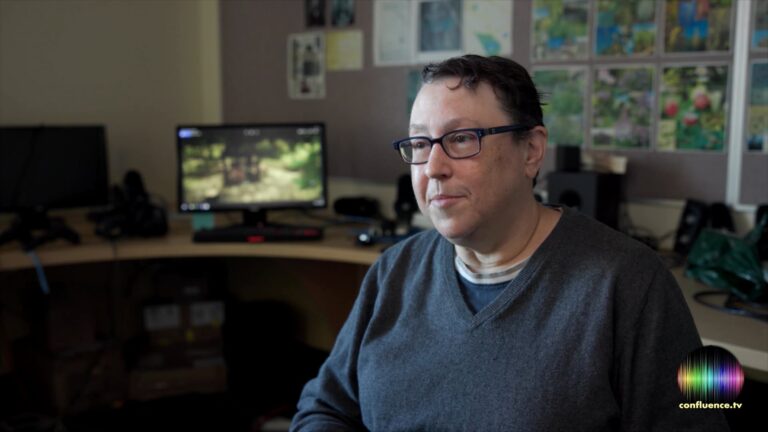
full interview_tracy fullerton_2.mp4

Tracy Fullerton [00:00:00] My name is Tracy Fullerton. I'm a game designer and a professor at USC Games and also the director of the Game Innovation Lab.

Speaker 2 [00:00:09] Perfect, thank you. So games is an enormous subject. We're not going to get to everything in this short bit, so I'm going to try and focus some ideas here. First of all, can you tell me a little bit about what makes a game art? A video game.

Tracy Fullerton [00:00:38] So the relationship between games and art is, I think, too big a subject to really nail down. And honestly, why would we want to nail it down? And isn't that sort of the beauty of some of these ideas? But I would start by thinking about the relationship between art and play. When we are creative, we are often playing. We're playing with ideas. We're playing with sort of. Metaphors and visual concepts and sounds. So as a relationship, art and play are deeply linked. When you think of a game, what you have is a formal construct around play. So I think that there is a connection between art and games that comes to us through that link of play, that primal. Human link of play.

Speaker 2 [00:01:40] And is there something that... Makes it... Can a video game just be play and not art? You know, is there some threshold that it crosses where it makes it something sort of more memorable, so to speak?

Tracy Fullerton [00:01:59] You're just going to dive right into it. We don't have a lot of time. OK. A lot of folks want to define art and put a box around it. And they want to say, oh, this can be art, and that can't be art. This painting is art, and this painting is just a child's painting.

Speaker 2 [00:02:26] So you were about to get into a very deep idea about what makes a game elevate to art. A game can just be play, or is it always art, or is sometimes art?

Tracy Fullerton [00:02:42] The reason I'm hesitating is, what is art? I mean, we can ask ourselves, you know, what is it, can a game be art? But first we have to actually make a definition of art. And to me, that's impossible. To me that is, there are so many economic and political, sort of social. We're in.

Speaker 3 [00:03:08] What's going on? Sorry guys, very sorry about that. Yeah, we have real trouble with that. Okay, I understand the files are going to be too big. This question is cursed. It is cursed, it's a cursed question. Sorry about that, camera speeds. Was that usable? Totally, 100% usable, it was just the files were going to be huge. Gigantic.

Tracy Fullerton [00:03:27] Massive art files.

Speaker 2 [00:03:30] That section's gonna be 12K. Okay. Everything else. What is art? Yeah. It's all just bits and pieces. Well, maybe we could just finish that thought. Okay. Alright, guys. So, let's just, I like the way you started that idea, and I understand your point. How do you even call something art? Maybe, can you just briefly speak to the idea that art video games. A lot of people. They think of an arcade, they think of, you know, something that's just passing the time. Maybe if you just speak to those people, how you perceive video games.

Tracy Fullerton [00:04:13] So a lot of times, you know, people say to me, Why do you make video games about subjects like Walden or the spiritual journey? Because video games are just toys. They're just, they're for kids. So why would you try to take on these serious subjects with a video game, right? And to me, video game is just one other medium of communication and expression. It's my art form. It's the form that I use to express myself. And whether or not it's recognized culturally as an art form, well, that isn't for me to decide. It's difficult to convince anyone who has a stake in what we call art, that video games might be considered an artform. But we could easily say the same thing about video itself. In fact, I've collaborated with a video artist, Bill Viola, and when Bill was starting out, video itself wasn't considered an art form, right? And he joked with me when we were making The Night Journey. He said, yeah, they used to put us in the back of the exhibit, back by the bathrooms, right. But now, of course, we would consider video an art in the same way that film. When it first came on the scene, it was not considered an art form. There's all these questions. There are books written about it. Is film art, right? We're asking these same questions about video games today. But what I think we should really be asking is, can video games communicate ideas? And the answer is resounding yes. Video games communicate idea because they put us into situations where we have to play. We have to play with ideas. We have engage with ideas, we have to question, we have rethink, we are to be critical, we have be challenged. That is art. If we are put in a place where we are challenged, where our preconceptions are challenged I think we are in a a place where we're ready to have an artistic experience.

Speaker 2 [00:06:35] Profoundly good answer. That was really great. I want to talk about game design and being a game designer You know talked about a lot of these things with Richard and I wanted your thoughts on How you approach? Designing a game do you Start with an artistic idea you start with a game mechanic. It's kind of everything at once. How do you get into it?

Tracy Fullerton [00:06:58] So you said you, so I'm going to talk about me. So game designers come in many flavors. There are game designers who start there from a mechanic. So they have an interesting idea for how people might play, and they start with the mechanic. And then there are video game designers who start with a story. They have an interest idea about a narrative that they want players to engage with in an interactive way. I would say that I go back and forth, right? That sometimes I'll start with a mechanic and sometimes I will start with the story. In some of my works, Walden as an example, I started not with a story but with a philosophy. So reading Thoreau's work and thinking about his experiment in playing a type of life. He went out to the woods, he set rules for himself and he wanted to play a type life. A type of subsistence in order to engage with nature at a particular level and see what happened. To me, that was a game he was playing. And I wanted to make a video game that allowed everyone to play the Rose game and make decisions for themselves about what we need to live, what we to thrive, what we needs to be inspired, and hopefully send them out. If not to live in the woods, to engage with nature more in their daily lives.

Speaker 2 [00:08:31] You answered my next question about Walden and how you sort of came to that idea, but is Walden an example of the wide gamut of potential that video games provide that maybe other art forms can't, because maybe Walden as a movie wouldn't be quite the same thing, you know.

Tracy Fullerton [00:08:58] Yeah, so I think that Walden is an example of the maybe bleeding edge of where we might take video games. It plays with the notion of achievement. Most video games set a challenge in front of a player and a promise that if you work hard enough, You're going to achieve, you're going get stuff. You're gonna level up your character, you're gonna get the cloak of XYZ, you're gotta get a better mount, you gonna fly, you gonna do all these things, right? I wanted to play with the ideas of what we need and what motivates us in life. So if we're always motivated by getting things and leveling up, how do we take the time to just... Enjoy and thrive at a spiritual level. How do we just be? So I wanted to make a game where just being was going to help you thrive more than leveling up. I wanted play with these ideas. So a lot of people come to Walden and they say, oh, I've got to get an X. Oh, I got to plant my beans. Oh, got to build my house. And they start. Achieving the way that they usually do, but then they start to realize that they're taking so much time to do that, that their world is getting gray, that it's getting boring in the forest. And all they have to do is set down these tools, go for a walk, engage with the creatures and the plants and the animals and the pond, and their world will start getting colorful again and they'll start to thrive. So I wanted to reward them for doing the opposite. Of what most games reward you for. So what you find is that this is a game where we've taken you to the bleeding edge of what players expect, and we've replaced it with a new philosophy. And I think that that's one way to experiment with what video games can express, the ideas they can express. It's a way that we can start moving out into new territories. Playfulness that we've never explored before with games.

Speaker 2 [00:11:27] When you boil it down, is that agency, that interactivity, what really makes games different than other art forms?

Tracy Fullerton [00:11:37] I think that what makes games different from other art forms is that what we are thinking here, what we're feeling here, has the potential for agency. So a lot of people will say that what make games different is that you actually get to make choices. And I would say yes, but what I think really makes games difference is that are put into situations where you can think and feel. About the choices that you're making. Choices are good, but we see characters in films make them all the time, and characters in literature make them all the times. Thinking a feeling and being responsible for those choices is what makes games different.

Speaker 2 [00:12:25] Well, I'm going to get into how you have that unique challenge of framing the experience for the player. But I want to do that as a function of the game innovation lab here. Because you are the director. So tell us a little bit about where we are. What is the game Innovation Lab at USC? What do you do?

Tracy Fullerton [00:12:42] So the Game Innovation Lab is a place where our mission is to push the boundaries of what video games and play can be, to make games that go out onto that bleeding edge, that ask questions about how can we create new experiences for players, experiences that players never had before. There's a lot of games that have tread familiar paths of motivation and, and allowing people to, you know, tread familiar paths of genre, you sort of genre storytelling and things like that. And we want to explode and go the different direction. We want to say, okay, we've had games where you level up and get a lot of gold and buy a lot stuff. Now what about a game where the objective is to just have just enough and no more than that. We've, you know, we have games where... You know, we want to conquer the world. How about where we want to explore our inner spirituality? How about, you know, instead of games of fast action and Twitch, why don't we go this direction, explore games of Zen and caring and games where we are thinking about our relationship to others, right? So the Game Innovation Lab is a place and it's also a set of people. Whose job it is to go out to those frontiers and take risks. And because of where we are at the university, taking risks are good, we can be early on the curve. We don't have to necessarily deliver by Christmas, which is where the majority of game designers live. We have to deliver by christmas, right? And we have to have this in the hands of players at a certain time to meet our bottom line. That's not our pressure here. Our pressure here is We need to think the big thoughts, we need to push the boundaries. So how do you teach?

Speaker 2 [00:14:43] What we were just talking about before, that unique challenge of crafting something that is your expression, your artistic idea, while also leaving that space for a player to fill that gap with their intention. How do you begin to teach that?

Tracy Fullerton [00:14:59] That's a great question. Here at USC Games, we teach a method of game design called play-centric design. It's a method that I laid out in my book 20 odd years ago. And this method focuses on what we call experience goals, setting experience goals and prototyping, modeling our ideas very early on in the process, and playing with players so that we can see, oh, are we reaching those experience goals? Are players having some kind of experience similar to what we wanted? And if not, how do we start to guide the game closer to the experience that we wanted them to have? It's a secondary problem because it's not, are they pushing the buttons the right way? It's when we talk to them or when we look at their faces, when we hear their exclamations, can we see that they're feeling what we want them to feel about the game? And I think that makes us different than Perhaps a more traditional game design method where the design pillars are often about, you know, how players will engage. Will they go here and pick up this med pack? Will they be able to finish this quest? Fine, we need to do that, but what I want to know is will they feel compassion for the NPC that they are treating with that med pack. I want to know if they are feeling kinship with the player that they are matched up with to go through an adventure with. I want know if there are feeling a sense of introspection about a special moment that they encounter in a forest.

Speaker 2 [00:16:52] And for those that don't know, an NPC is.

Tracy Fullerton [00:16:54] Oh, a non-player character.

Speaker 2 [00:16:56] So can you say an NPC is a non-player character, and maybe just one more thought on having a feeling about something that is not real.

Tracy Fullerton [00:17:06] So what I want is for them to know, what I wanna know is, I want to know if they will experience compassion for a non-player character, a character in the game that they meet, where they use that med pack on them.

Speaker 2 [00:17:23] I know what it means for the record, but not everybody.

Tracy Fullerton [00:17:25] I understand, sorry. Sometimes it just, I try not to do that, but it sometimes just slips.

Speaker 2 [00:17:30] Yeah, yeah. We try to include all. So who are some of the noted alumni who have come through here, if you can mention?

Tracy Fullerton [00:17:41] We've had a lot of fantastic people who have come through the USC Games program and gone on into the industry. There are some names you recognize and then some names maybe that you don't. I think one of the folks that people recognize is Genova Chen. Genova and Kelly Santiago, who also graduated from this program, co-founded that game company. As they came out of school, and they took Genova's thesis project and turned it into a very early game for the PlayStation Network, so that was Flow. And it became very successful as an independent game and they became very successful as independent game developers, and one of the games they're best known for his journey, which came out in 2012. And Journey is a game about the spiritual journey. I feel it's, you know, Genova and I, you know, genova studied with me and I think we have very similar questions about where game design can go. So I was actually already working on the night journey when Genova was here and you know we talked about it and he was already sketching some of these images these of these hooded figures that... Climbing this mountain, actually, and you know, as ideas go, they circle about, and we, in a way, each made our own vision of the spiritual journey. So, Journey is a game where you travel as a pilgrim through a desert land to the top of a mountain peak, and it follows the classic hero's journey, Joseph Campbell's hero's Journey. It follows it actually very closely, but it's a very emotional experience where you are paired up randomly with one other person, and you don't know who that person is, but as you travel, you get to know them through their actions, and it's such a beautiful relationship. When I played Journey the first time, I remember I was with my companion, and we were crossing this bridge of winds. And, you know, we'd already been through a lot. We learned how to use our scarves to fly and to help each other over obstacles. And we were crossing this bridge of winds and a gust came and my companion fell. And I was stunned because I didn't know what to do. So I was running back and forth on the bridge and all you can do is you can sing out one note. Ah ah ah and I'm running back and forth on the bridge ah ah trying to call my companion to see if they're still there and I waited I waited and waited and they never came back and my only choice was to go on and I'll always think about that what happened to them my only choice was finally to turn and and to keep going towards my goal and it was one of the most Powerful moments of sorrow that I've ever felt in a game.

Speaker 2 [00:21:03] I'm so glad you brought this up, because this wasn't even a question I have, but it just touches on something that we talked to Richard about at the end. It's not just a sort of bullet point of gameplay mechanics and there's a beginning, middle, and end to a story, but its those unexpected moments that even the designer can't predict That's right that really makes games special and so can you? Just making a broader point about it, you know, that emotion is real. That's a real memory for you. People don't think about that social aspect, but between people, I know that's very important to Genovez, the social aspect. Talking about games in terms of bringing people together in a way that maybe is unique to that art form as well.

Tracy Fullerton [00:21:56] I think that games can bring people together in so many ways. Of course there are multiplayer games where we are literally playing with people. And sometimes in today's world that can be a positive and sometimes it can be negative, just to be quite frank. But there's a bigger togetherness. So when I've played a game and I tell you about my play of the game and you've played the game and you tell me, it won't be the same. And so unlike a film where we sat next to each other and then we come out and you say, oh, I thought he was gonna do this. And I said, I though he was do it, but he did do something and it was a fact that. In a game, you could have done something entirely different. Oh, I chose to do this. And I say, oh, I choose to do that. And suddenly we have a different color to the experience and there's more for us to talk about. To me, the social aspect of games, it transcends just playing with each other, which of course is important and can be very beautiful. It transcends that immediacy of playing with people. It also is a social conversation that we can have, a meta conversation around games where we each had our own very personal experiences.

Speaker 2 [00:23:28] Getting back to the design and the creativity behind making a game. Are we okay?

Tracy Fullerton [00:23:33] I don't know, there's somebody here.

Speaker 2 [00:23:35] That might be Okay.

Tracy Fullerton [00:23:41] Sorry.

Speaker 2 [00:23:43] No, no, we're okay. So, you know, our show is very much about the intersection of art and science and the many ways in life that those things coalesce and games is obviously in that category. Can you talk about the kind of unique creativity, the mind of a designer that has to balance Artistic with technical issues all at once.

Tracy Fullerton [00:24:18] Game design is a crazy multidisciplinary art form. Amazing to me. I'll go to a dinner party and someone and I'll say oh, what do you do? Oh, I'm a game designer Oh, so you're a coder right now say well I can't go but that's really not my forte, right? Oh, then you must be an artist Well, I can make a little art but that not what I do either right when they're like, what you do then, right I'm like, well, I make the rules. I Construct the experience. I'm the person figuring out what is going to lure you in to this fun house that we're creating, right? It's my job to lay the breadcrumbs that get you into this experience and that constrain you in ways that prompt you to be creative, prompt you be challenged, right, and then by then they're blank. People, they don't know what I'm talking about because I didn't fall into the category of I'm not a computer scientist. I'm a not a visual artist. I'm something they don't really know. But I think that the closest thing that I could map to say what is a game designer, I think they're really a social engineer. I think at the root of game design, there's a kind of psychological play where you're setting up constraints that are just enough for people to kind of move within, but not so much that they're completely rigidly constrained. They have to perform within the rules, but there has to be enough leeway for them to be creative and express themselves and come up with different solutions and sort of weave their way through your rules in a way that is satisfying, right? So the game designer in some ways is a social engineer. Right, I think it's an art form. Prompting people, motivating people, finding things that will draw them through an experience and. Make them come out the other end feeling energized and and accomplished and um you know as if they have uh sometimes gone through a catharsis of kinds i mean at the end of a really well played game isn't there this sense of like Tharsis right and whether that's a sad game a happy game or exhilarating game It still has that sense of I've come through it. I've done it

Speaker 2 [00:27:05] think about that dinner party what what do you think about culturally this need to silo art and science endeavors uh... Especially as an educator where you're very much teaching all of it at once

Tracy Fullerton [00:27:18] There is definitely a divide between the way that people think about art and the way they think about science. You know, in the cultural vocabulary we call left brain, right brain. We think people have one or the other. Guess what? We have both. And we can fully engage both, right? And game design fully engages everything, not just our brain, but our. You know, our hearts and our bodies, right? So, you know it is not a left brain or right brain endeavor, right. In our culture we like to put things into boxes. We very much like to say, this is art and this is science. And never the twain shall meet, right, but this is not really the truth. If we actually look at the history of science, we see many scientists who were artists and musicians and you know. Had a love of nature and expression, right? And simultaneously we see artists, you know, who have to create new types of paint or new types light or new type of technology in order to extend their art, right. So we see that these things are not separate. It's just that for whatever reason, when we, you now, on the surface level, when we discuss it in culture, we like to think of them as separate. But of course, in a fully realized artist or scientist, there is both the ability to engage technology and science and the ability to engage creativity and wonder and awe.

Speaker 2 [00:29:05] What do you think are some of those most formative technological advancements that have helped designers make their games?

Tracy Fullerton [00:29:13] Well, obviously, video games are part of a technological revolution around the computer, around digital technology. The interesting thing is that games themselves, as a larger form, also are beholden to other technological advances, like advances in printing gave rise to the board game and puzzle industry, right? So. You know, we think, oh, board games, they've been around forever. Well, that's true, but industrial board games only come about when we have cheap and reliable ways of printing boards and making those pieces, right? And that's part of the industrial revolution, right. So video games come out of this, you know, world of, fortunately or unfortunately, come out this world of the sort of military, you know. Industrial complex where you know we poured a lot of money into computing and testing computers and one way you can test a computer is to build games right was one of the first things that we did was build games and I think then you have people who are building these games and they think oh wait a minute I could take this out to market you have the pioneers who think of this as more than just a technology and we take it out to market. And the beginnings of the game industry very much come out of people spinning out of DARPA projects, ideas for games. People have access to computers and start making games. But I think once technology takes off and you have access by artists, and I would mark, say for example, there's a moment I think it was 1983 or 1984 when Doom comes out and Myst comes out. They come out in the same year and what you have are brilliant, you know, game designers, computer scientists making this, you now, fast-paced, realistic 3D shooter, which also is configurable, right? So a lot of people get their start by modding, making wads, right. And then you have, on the other hand, you have this slow-paced, pre-rendered 3D world made by artists, Myst, where sound design, environment design, character design, story are all beautifully rendered in this early example, right? But you couldn't think of two more different games, but they're all both wildly popular in the same year. Now, Doom, and it's sort of... Follow-ons take over the game industry, right? But we never forget Myst. And as the technology gets faster and it gets in, you know, we start having game engines that are available for the masses really, for everybody to download and use. What comes back around is the beauty and the storytelling and the sense of character and the sense of environment and sense of how do we make something that is an emotional experience? And I think these two have come back together. In more recent years, as we get this new generation of game designers, they have the sensibilities of all of this technology and all of this emotional, expressive energy, and you see it coming together in today's games.

Speaker 2 [00:32:53] I was a Myst guy, by the way. I just have one more question, and then I'll see if these guys have anything to add.

Speaker 4 [00:32:59] Trey Andrea is here.

Speaker 2 [00:33:00] Oh, thank you. We're wrapping up here. I'm just curious if you've ever heard of a company called Akili, or a project called Endeavor RX. We're talking to this team that it's the first FDA approved video game.

Tracy Fullerton [00:33:15] Oh, I've heard that this has happened, but I'm not.

Speaker 2 [00:33:17] But I'm not familiar with their product. Okay, that's why I won't ask you to talk about the product itself.

Tracy Fullerton [00:33:22] But I did see that that happened.

Speaker 2 [00:33:23] I'm just curious your thought, especially where Walden the game is concerned and everything that you wanted to do with that, what you think about video games as a healing tool.

Tracy Fullerton [00:33:36] So I think that media has the opportunity to... To allow us to experience emotions that we perhaps need to experience, to heal, to learn, to grow. I played a game recently called Lost Words, which is the story of a young girl's first experience with grief. I cried. I don't want to spoil it, but at a certain point she loses someone. And the words she uses were so close to the words that I used when I lost my father that I just began to cry when I was playing it. And, you know, that was a healing moment for me because I actually felt seen. And media can do that for us. It doesn't matter what If it's a book that helps us heal or a poem or a movie. Or a song. Many people turn to music. Video games can have this healing potential for us. Not every game, and not every game will touch us when we need to be touched. The potential is most certainly there. You know, when we made Walden, one of the reasons that I wanted to make that is because I felt that my life was just cycling out of control, that technology had quickened the pace of my life and the pace, I'm an introvert, and it had quicken the pace with which people could contact me and expect things from me. And I wanted to make. Of sort of place of solace. I had the privilege of spending time at Walden and I also have the privilege of being able to go out into nature fairly regularly here in Southern California. But you know, not everybody has that privilege and not everybody that practice as something they know to do. So I thought, what if I made a game that was a place of sort of rejuvenation and solace that allowed us to take that journey with Thoreau. Learn about what it means to practice that kind of solitude and to practice that kind healing because it is actually a game about healing if you play it all the way through he had tragic losses in his own life that drove him to do this experiment and As you play it, you realize that he is going through a process of healing. So I wanted to make this game where people could experience that.

Speaker 5 [00:36:26] Wonderful. I think we're pretty good. We have a quick follow-up on something. You talked about the role of choice, and the role choice, which is true in cinema. It's true in all those things. However, you made a distinction between video games with choice having to having to do with taking responsibility for your choice. Could you elaborate a little bit more on that?

Tracy Fullerton [00:36:48] Sure. You know, a lot of people say it's kind of common wisdom that the thing that makes games different from other media is that. Players make choices in the game. And I think that's true, I think players make choices in games, absolutely, 100%. But you know, characters in films make choices and we are empathizing along with them as they make those, oh, don't do it, don't do it. Or, do it! Do it! So you're wishing and hoping and fearing about those choices. In a video game, what's going on? Is you're considering those choices and then you're living with the repercussions of those choices as you go through the game. So rather than just hoping and fearing, we're taking responsibility for those choices and we are in a way rehearsing the kinds of choices we might make in our life. I think that video games allow us to rehearse very important choices. We might go through in our lives. Will we betray this character? Will we stand by them even though it's a lost cause? You know, will we be frugal? Will we, you know, strive for more? All of these things that we can watch people do in other media, and we can hope and fear along with them, in video games. We live with those choices. We have to sit with them. And later on, maybe we regret them. Or maybe we get a sense of exhilaration. Maybe we are empowered by the choices that we make, and we take that empowerment with us back into our own lives to practice standing up for what we believe in or doing things in a way that we always wished we could have.

Speaker 4 [00:38:53] Is that one question, and then we're going to let Terry end it here for a moment.

Tracy Fullerton [00:38:58] Hi, Trey.

Speaker 4 [00:38:59] No rush, I'm enjoying this. Okay. We asked this of all the artists that we've interviewed, how they feel, and you're gonna answer to Chris, how they've feel when they've finished creating a work of art. How do you feel when you finish the game? Finish as a creator, not as a player. Not as a play? So called finish.

Tracy Fullerton [00:39:21] No, I'm dead. Yeah, you know. You know. You know. Making a video game is hard. It's, some people compare it to like a war, right? You're in the trenches for a very long time. Sometimes, regretfully, there's a grind that happens and you just drag yourself in and you're like, okay, I'm just gonna get through this level today. Get through it, right. Sometimes there's the grind. And sometimes there's brilliant moment where you solve something and the whole team will run in and we're like we did it, we did and there's this exhilaration of having solved the problem that we absolutely needed to solve. So making a game as an artist is just this up and down experience. It's both beautiful and it's grueling and it something that you have to be up for. Emotionally and physically. When you finish a game, you put it in the hands of players. And it's like you're putting your baby, it's you had your baby and immediately someone said, can I hold the? Yeah? And you put it in the hands of players and they play with it and sometimes they roughhouse with it and they're like, oh, look at what it can do, you know? And they're jumping up on top on it, right? And then they send you, some of them send you this, great, great, but can it do this too? When's the next version coming out? You know, and you're just dying, right. But every once in a while, you'll get a letter that... Just fills your heart and you'll get a letter from a player like for example I got letters from people who'd never played a game since Myst. Grandmothers at this point who said I never thought any game looked interesting to me. I loved Myst but there weren't any games for me. I saw Walden and I thought this is fantastic and I downloaded it and I played it And now I play it every day. I go and I garden in my bean field and I chase the rabbits and I watch the sunset. And I wanna thank you for making a game that I can enjoy. And when you get that letter from that player, it's amazing, right? When you get a letter from someone who appreciated what you did, who has... Twisted and turned, but rather has played it deeply, has played deliberately as we ask them to play. It's worth everything, it's worth all of that grind. And that's what it's like to finish a game.