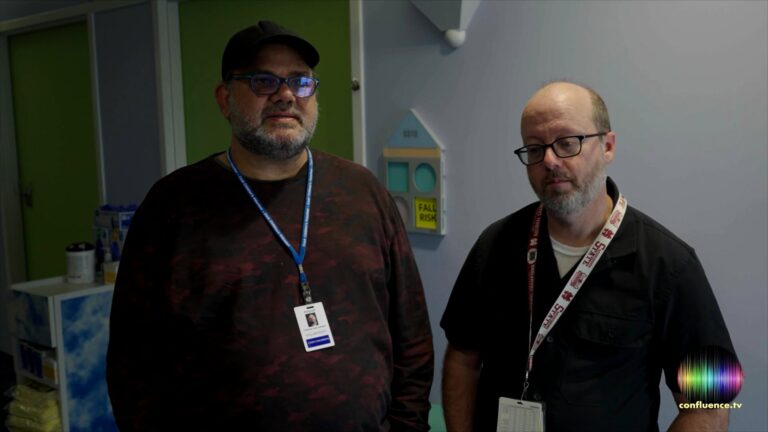
full interview_pindar van arman_scott perry_2.mp4

Pindar van Arman [00:00:01] I didn't know Scott, but I guess we met because you're buying some art, right? Some jazz art. Jelly Roll Morton. An old painting of mine. A large one. Probably one of the largest paintings I've ever made. And one of weird coincidences of, well we met and one of this weird coincidence of this world is he had the art and he had this idea and he's like, you know, what If we did this for November, was it Epilepsy Awareness Month? And he mentioned that we could probably do it at the hospital. At the very same time, I was working on another project to make an art creation factory here in the Fort Worth area. And I was like, wow, that's two projects popping up at the same time in the same part of the country. I was, like, maybe we should move. And so Bonnie and I decided to move there. And I let Bonnie pick the place we're gonna live. And in a strange coincidence, I think Dr. Perry here is like 10 houses down that way. And every time I drive to work or the hospital, I look into his foyer and see my beautiful artwork. Right there.

Scott Perry [00:01:02] Right there in the front window.

Pindar van Arman [00:01:05] So that's how we met in a bunch of coincidences and brought this together.

Scott Perry [00:01:10] I was saying before, you know, what had happened is I bought that art originally and then you and I did not communicate, you now, I bought the art, it's up in my house and that was really it. And then I was thinking about this thing to do at the hospital and for whatever reason you had sent out a mass mailing from your cloud painter and I happened to on your mailing list. Or maybe it was crowd painter, but you were doing the crowd-sourced art, and I saw that and I was like, well, wait a minute, this would work in the hospital, this is exactly what I'm talking about, if people could log in and the kids could log-in and work together. And then I looked you up on, it linked to your Twitter, so I found you on Twitter and sent you an instant message and you were like, yeah, let's talk.

Pindar van Arman [00:01:59] Yeah, I actually, yeah.

Scott Perry [00:02:00] And then it went from Twitter IM to phone call to you moved down the street from me.

Pindar van Arman [00:02:13] I just wanted to talk about a robot, that's all I wanted to talk about. All right, so I'm a little creepy like that. So yeah, I actually remember all that and I remember it was the first mailing I'd done and you were one of the first responses so that was really cool. That's wild. And here we are. And then just a lot of the ideas are coming from our therapy department, Scott here. I think it's turning out to be this really big collaborative effort. Which is seeing how we can make this work for all the kids at the hospital.

Speaker 3 [00:02:51] So how is it gonna work? How is this guy gonna work here? You can just talk to him.

Pindar van Arman [00:02:56] Oh, OK. Well, there's going to be a bunch of touchscreen tablets. And children are going to take control of the robot and even soon paint along with the robot. So the robot will be this augmented creativity or augmented created assistant.

Scott Perry [00:03:17] I think those are like the, I don't know if I call it the basement level, but the foundation level of the things we think it could do. We talked about its potential for, I'm a neurologist, right, so I deal with children who have all kinds of different cognitive developmental motor capabilities and to be able to imagine a kid could ask for a certain amount of assistance from the robot to maybe help finish a painting or to contribute to a painting. And some may want no help at all, they want to just do it all themselves and some they want. They may want to help them more or, you know, in our rehabilitation unit, for example, we have kids with spinal cord injuries or kids with neuromuscular diseases that are, you know, very, can be very creative but simply don't have the strength to paint. Is there a way we could use the robot? Verbal command or something like that to help with painting. I mean, I think there's all kinds of possibilities like the the painting this what we're talking about like coloring book or painting with a robot that's like the ground level. There's so many things I think we can do with time.

Speaker 3 [00:04:38] Um, just tell me, just introduce yourself and tell me who you are. Hi. Uh... Go ahead and just speak to me, don't worry about the camera.

Pindar van Arman [00:04:46] Oh, Pinder van Armen, AI artist, crypto artist, work with painting robots.

Scott Perry [00:04:53] Scott Perry, neurologist, epileptologist.

Speaker 3 [00:05:00] And so when you get together here, you're living a few houses away. What do you come over and talk about?

Scott Perry [00:05:08] Uh, well, I guess primarily about the robot. That's generally at least how the conversation starts is what we're doing at the hospital.

Speaker 3 [00:05:17] And if you could start, if you can just say we talk about it just so we know what you're talking about.

Scott Perry [00:05:20] Yeah, yeah. So we generally talk about what's going on with the robot at the hospital. So, you know, that thing's installed. We're doing projects throughout the week. I'm the one that's usually, obviously, at the hospital. Pindar comes up there, but I'm there all the time. So I kind of try to come let him know what went right, what went wrong, maybe what improvements I think we could make, things that seem to work for me, and then he tells me why they can or can't work or oftentimes there's a better way to do it. That just makes sense with the the code that he's written since he knows it so well yeah we just you know create that list of items to check off

Speaker 3 [00:06:01] Go ahead, please.

Pindar van Arman [00:06:02] Yeah, one of the things we've talked about is we set up the priorities of what's worked in the last couple of weeks with all the improvements, because it works as is now, but it's never worked in a hospital environment, and I'm learning about all these special needs, like for example, like these patients which are being put on these strict regimens and have to do stuff constantly for the doctors, they have no choice. I've learned through my experience here that choice is really important for them, because when they're doing art therapy, that's the only time they have choice. And so that totally changes the way I have to make this robot. I can no longer say, this is how you have to use it. I have worry about what are the choices I have to give these kids.

Scott Perry [00:06:40] Kids when they use it. Yeah. The conversation we had early on was about the colors, right, because, I mean, a lot of what's behind us is very colorful, but some of the portraits he was working on at the time are, you know, just kind of a shade of the same kind of color, you know, and we're like, we want the rainbow for the kids, and he was like, yeah, the rainbow's kind of hard to work with, like, you know, that color doesn't really go well with that color, and I remember I said, the Pindar. Well, some kids put peaches in ranch dressing, like I don't care if they go together, that's just what they want to do. That's exactly what you said. That's what we're going to do, we've got to figure out how to get the colors because they're going use them.

Pindar van Arman [00:07:17] So there's some challenging things like that that we're getting into.

Speaker 3 [00:07:21] How did Dr. Perry convince you to do this?

Pindar van Arman [00:07:24] It was just such a good idea. And then lots of lies about that. No, I was going to say, hold up. I don't think that's actually how it worked. I want to cut that. Let me start that over, because I don't want that joke in there. He just got in touch, and it was such a good idea, I said, oh my goodness, I have to do this. And I just want a contest. And I was like, this is where the money from that contest is going. And then he's put a lot of his own money in. He's going to be shy about that, but his personal involvement is really pushing this through.

Scott Perry [00:07:53] That's what I was gonna say, like how it went down, like I was not, all I was expecting when I messaged him was that he might let us use his crowd source painting application to do a painting during the month of November, during Epilepsy Awareness Month. That's all I checking out to see if that was even possible. And in that first 30 minute conversation we had, he was like. Oh, that's a great idea. Why don't I just give you a robot, basically? And I was like, well, okay. Sure, sounds great. I was, like, I'll be back in touch.

Pindar van Arman [00:08:34] And everyone we tell about this has to get involved, like the manufacturer of the robot. This is their favorite project. They pushed us right to the front and got us normally. There's a month-long, month-in-month-long wait, and they just sent it. They just sent the robot, always asking how it's going. So, let's sort of...

Scott Perry [00:08:50] And then the ball started rolling. And so then I had to like back up what I said we were gonna do. So then I have to go to the administration of the hospital and have the conversation of, hey, so I've got this idea. We're gonna put a robot in the hallway that paints. You can imagine the conversation.

Pindar van Arman [00:09:13] And the hurdles that we had to go through, I don't even know, but I imagine if you're impressed with the AI behind this robot, I think even more impressive is just like everything we've gone through to get the robot in that hallway, to convince everyone that this is not gonna be a problem. So it's almost like one of my favorite artists is Christo and he used to drape things with cloth. And he would always talk about, the biggest part of the process was getting a... A city to say, okay, you can wrap a cloth around this island. The whole administrative and bureaucratic process. And Scott here has mastered that. It's just really got everyone on board.

Scott Perry [00:09:49] Well, I think it's, I always say the hospital I work at is very forward-thinking, you know, and I think this is one of those examples, right? I mean, I didn't give them much more detail other than, we've got this robot, it's going to paint, kids can work with it, I mean it can really build out over time and be pretty awesome, and they went with that, and I mean you saw today when you were there, I meant they put that thing on what we call our main street. That is the main hallway of the hospital that everybody's gonna walk by because they wanted it to be a place where, you know, everybody could could see it and see what it does. So, um, yeah, they've they've invested their time. They come along, uh, gingerly, uh you know sometimes, but they're there. They're in it. I think it's gonna be great. Yeah. Yeah, I mean, we've got I don't know how long ago, like I don't know what the end point is, like when have you used up all the possibilities of what it can do. I think that, as I said, the first things are going to be just simple things to show it works. We've got the camera in now, we've got tablets connected to it so kids can paint on the tablet and the robot can do that, that's great. After that, then we bring in the AI technology hopefully to help the robot really collaborate with the kid. And to... To add to what they're doing, you know, participate. And then do we take it to the next level and maybe not just participate, but help to a degree, however much degree they want it to help them paint. I just think there's, and we'll do those and we will come up with like the next thing you could do. I just feel like we'll see kids working with it and figure out something else we can do to make it even better.

Pindar van Arman [00:11:44] Yeah, I'm looking forward to what we don't know like for a kid to like start doing something like I didn't even think of doing that And that could be a you know become a program in and of itself, so I'm look forward to what we learned from this like Just this is this audience and that's gonna be really fun. We were talking

Scott Perry [00:12:03] yesterday about taking, you know, I'll use my resources in the biomedical half to take a kid who's in the hospital getting an EEG all week as part of their epilepsy workup and then transforming that EEG into something that's then translated to the robot painting. Like here's what your EEG over the week looks like. Take that home with you. I mean, they're sure.

Speaker 3 [00:12:32] You may have just answered my next question a little bit, but I just want to play the part of the skeptic and ask, kids in art, I totally get it. Why not just give a kid a crayon or a paintbrush? Why go through everything that you're working on?

Pindar van Arman [00:12:48] There's a lot of answers that, I don't know all the answers, but I know some, one thing we're talking about, we're, I dunno if I can mention that Amazon's interested, but we're talkin' about some voice-activated robotic uses for the children that can't use a crayon or a pencil. And, you know, every time I mention, I talk to them, they're like, when can we do it? And they just wanna, they wanna hook, I'll say this, they want to hook Alexa up to this robot to have this robot painting for children that want it. So that'll put them on the spot to actually do it now that I've said it. And it's going to be in this, so.

Scott Perry [00:13:20] Well, and there's, you know, other reasons to do it is because there's ways to make our current process better, right? We've got a couple art therapists. We have 454 beds in the hospital, so they can't be working with every single kid. And the robot will not either, but it's yet one more set of hands that could work with the kids. You know, kids might start painting and then they have to go off to a test or do whatever else, right? For that art therapist to circle back and come back and get restarted with them later on, it doesn't work real well, right. So, hey, just pick up where you left off with the robot when you come back, you know. So I think it has some advantages to kind of improve the current process. And, you know, it's... I mean, medicine's all about technology and finding better ways to do things. We're using robots all the time in the operating room. Why not use them somewhere else? Why not using them in heart therapy? Like, the first thing I think about is, again, the kid. You know, if we get to a point that it can augment or really assist someone who has the cognitive abilities but not the physical abilities, I think that that is, that's probably like the biggest. Step I can see it doing for a kid because it's really, I mean just like in rehab we use robotic exoskeletons to help them say walk again, right? You're doing the same concept here, it's their creativity, you're giving them a way to let that creativity out by using the robot. So I think that's probably the biggest one I can think of.

Speaker 4 [00:15:09] Pindar, as you travel this road with Scott six, eight, ten, twelve months from now, how many iterations, where do you see Spicalangelo able to do what more?

Pindar van Arman [00:15:22] I think I think an iteration every three months and then in culmination of November is when we really get serious because of Epilepsy Awareness Month. So I think we have something pretty fleshed out AI wise for next year. And then beyond that I mean we're just like take cues from where it goes in the here to come.

Speaker 4 [00:15:44] So what do you know between now and next November?

Pindar van Arman [00:15:49] Well between now and next November to start making a lot of art with the kids and seeing what works and what doesn't work And then follow the lead of what works. What's the most fun? For the different population of kids too, you know from age groups Or I guess the age was very from everything from like toddlers to teenagers Yeah, so maybe we find that teenagers like using it in one particular way to make Expressionistic portraits and then toddlers just want a free form They like taking the brush and scribbling colors all over the page, or the canvas. I don't know yet. I imagine it will be interesting to find out.

Scott Perry [00:16:24] I think we'll see what direction that goes when we start taking it to the kids. The first two months has been me using it, trying to figure out, you know, how does it work? Because I wanted to understand every step that takes place before I hand it off to a volunteer or the art therapist. You know, I don't want to be the guy that says, you figure it out, it's easy. I would do it myself, so I know exactly how it's done. And try to work those kinks out, and I think we have. And so now, the next part is to take it to the kids and work the kinks our there and hear them say, eh, I didn't like doing this, that was boring, or, oh, I really like that piece, and so then we can capitalize on the stuff that really works well and simplify or get rid of the stuff that doesn't work well. Make it better. Kids are pretty young for giving. Nah, it's fine. They're fine. They are unforgiving, right? So I tell you the story. I saw this kid the other day who came to see me from Tennessee. Her dad, believe it or not, found me on Twitter, follows me on Twitter and came to me for an epilepsy evaluation, right. So I go in to see her because she's in the hospital getting her work up and I walk in and she said, first thing she says to me is, you're not as tall as I thought you'd be. As a kid? Yeah. No guile. Well, thanks. I'm not really sure what to say and I can't do anything to fix that, so thanks for coming. That's my daughter as well. Whenever, yeah. Very straightforward. They will tell us the truth, so that's fine. That's good quality for them. Yeah, it's fine, yeah, she also told me that she thought I would have white hair and I said, well, I thought I'd have hair. It is what it is.
full interview_pindar van arman_scott perry_4.mp4

Speaker 1 [00:00:00] All right, so obviously it was really heartwarming to see what happened here today and yesterday. The whole process is great. Beyond that, what does this mean sort of medically and therapeutically?

Scott Perry [00:00:16] I think we saw with Oscar, right? He does therapy every single day, and this was a real break from his usual therapy to do something else. I think he clearly had fun. I think is like super interested in what it's doing. I think when we went down there, I think, he's told me he's gonna be an artist, a builder, and a scientist, all from. You know, maybe he had those dreams beforehand, but my goodness, he kept coming up with more things he was going to do after working with that robot, so that was pretty cool. You know for me just in these couple cases, right, I mean I've been very involved with them, right. So that is, as a doctor, is fun because I get to, I guess, experience what the art therapists experience all the time when they go in and work with the kids. So I mean, that was fun, but I think, yeah, it's just a good experience to see. Oscar and Juan get to do something that's a little different than what they do every day and how interested they were in it and how excited they were and how proud they are of their final products when they see what they were able to do with the robot.

Speaker 1 [00:01:22] And why is that important medically?

Scott Perry [00:01:25] Well, I think it shows them, you know, for Oscar, again, you know, I it shows him, he probably already knew, frankly, but all the things that he could do. I mean, he just, he felt like he was accomplishing something. I think Juan, obviously, was really impressed with what he was able to do, you now, and so after all these days, you know in the hospital, having to be treated and things you couldn't do because of, you know, whatever you're here for, to be able to. Do those things, see a finished product accomplish things, I think that's really cool for them.

Pindar van Arman [00:01:59] I'm not an art therapist, but I've learned from the art therapists here, it's like one of the things you're trying to do is get them, one of them is as simple as moving their muscles and you know just like doing actions and I think we saw that today where you know there was a touching moment where Oscar was tired but he's like, I'm going to keep on painting and he just kept on painting, kept on moving and that's a, I think that's a good session but I, yeah, it just looked right. Yeah, I agree. Thank you very much.

Speaker 4 [00:02:25] I'm good, how are you?

Speaker 1 [00:02:33] So, you know, you deal as a medical innovator, you're dealing with all sorts of new products, but this robot was not designed to help you as a doctor, you know, but you're using it. It tells what is it about that sort of, is it because any tool will work, you'll take anything?

Scott Perry [00:02:53] I don't know if I'll take anything, but you're always looking for ways to... Help the kids, to interact with the kids. I mean, I don't really care necessarily if it improves, you know, reaches one of our therapeutic goals. If it gives them something that's fun to do and makes them, you think about something other than being in the hospital, then it's worth it, it's fun. Yeah, it is fun for me too. I mean I'm in the hospitals all day long, I like to do something different every now and then too, right?

Speaker 1 [00:03:29] And what about the fact that it's a robot? You worked with robots. And before you started working together, the robot had a particular artistic purpose for you. And now it's sort of doing something else.

Pindar van Arman [00:03:41] Yeah, I guess that's interesting. I always built my robots to be my assistants in my studio. And this is the case where it's actually the assistant of these children that are using it. So that's interested, seeing how people use it that's not me or that are not me, and I'm learning a lot from that. We're making a lot of changes. Almost every patients, we tweak it a little. Every single time we see it used, we change it just a touch. And that's been fun doing and learning from the children using it

Speaker 1 [00:04:09] So this is out of left field, this is my last question. One of our other stories is about, it's a product called Endeavor RX, and it is the first FDA approved video game to treat ADHD and like preteens, and it's just been approved for adults, okay? It's a video game. Nobody ever thought that video games were gonna be somehow therapeutic, you know, for medical purposes. What do you, I assume you don't know about, you've probably not heard about that product, but what, does medicine kind of need all the different inputs that are out there? I mean, that's kind of what we're trying to get at.

Scott Perry [00:04:48] Yeah, for sure. For sure. And I mean, there are other examples similar to that, that we use in neurorehab, like virtual reality kind of rehab, because I mean how long can you sit and walk on a treadmill? I mean it's boring, right? Kids need something to do. Kids can recover very well a lot of times. They are eager to get up and go do things, so giving them lots of modes and ways to do that. And especially ways that don't even feel like it's really therapy. It's just like doing what I enjoy doing super beneficial and very useful

Speaker 5 [00:05:28] Scott I have a question. Interacting with like somebody like Scott or both of these boys on an emotional level how does this make you a better doctor when that you kind of pierce that intimacy zone? Yeah. You're on one hand you're a father, a man, and also a medical doctor. How improve your, your profession.

Speaker 1 [00:05:56] Respond to me.

Scott Perry [00:05:57] Well, I think that's important with every patient I see outside of just doing the stuff with the robots, you know, and to be able to connect with the kids, to let them know that, yeah, I'm a doctor, but I'm your friend, I am here to help you, I help make you better. Not always here to come make you do tests that you don't want to do, or take things that you do not want to take, like I'm on your team, you now, and I think both of these kids we worked with, I mean, I day. They identified with that, right? And it makes me, obviously it makes me happy to know that they did. And it fills me up, right, to keep doing what I do.

Speaker 4 [00:06:41] Do you see a big future in this kind of thing? And this sort of, this kind of interaction with technology.

Scott Perry [00:06:48] I do, I don't see how we can't interact with technology, it's in everything we do every single day. You either embrace it and learn to work with it, or I suppose it will leave us behind.

Pindar van Arman [00:07:03] Yeah, I agree with that. I think more and more, like right now especially, we're just gonna start learning to collaborate with technology and specifically artificial intelligence and it's gonna make us all better at everything we do already. As you can see, we have children painting portraits with likeness, we're gonna just see that in every aspect of our lives coming soon.
full interview_scott perry_2.mp4

Scott Perry [00:00:00] What would I commission from Pindar? I guess, you know, I had to stick on the brain thing, but that's what we've been talking about the most. Like I talked to him about, I wanted to do a piece, but you know if you ever looked at a MRI or you've seen a, back in the day when we had films and you put it up on the light box, right, it was individual slices all the way across. And I'd like to take an MRI and take all those slices and each one be its own, you now, painting. Let the robot kind of envision its own kind color scheme across for the hole. See the whole brain from slice to one side to the other slice.

Speaker 2 [00:00:46] 22,000-Something slices.

Scott Perry [00:00:48] It depends on how you do it, it's a very thin slice, probably 150 images, depending on what direction you go. We would bring it down a tad. We don't need 150 paintings, but I think that would be cool. I wouldn't have to commission him, though. I'd just come down to his garage and say, Fendar, hook me up.

Speaker 2 [00:01:15] Why did you guys first get in touch with each other? How did that work?

Scott Perry [00:01:20] Uh... So first first for real got in touch with each other met via met via an ebay purchase i purchased his art on ebay and then Communicated with him by email only because it was a slightly flawed painting and that was like the only communication He was very kind got it all fixed up for me we went living happily ever after and then randomly, I don't even remember how long later five seven years later got a Email from his mailing list which was just at the right time that I needed an email from his mailing list because I was Looking for a way to do art with lots of people being able to collaborate on something together lots of kids in particular that might not be able to all gather in one room. We used to, I would have artists come to the hospital. And paint with the kids. And the problem we had, it was great for the kids that could leave the room and come, but for the kid who weren't able to leave the room because of whatever testing they were having or however they were being monitored, didn't get to participate. And the artist couldn't go to each individual room in the amount of time they were at the hospital, so I was trying to figure out a way how can an artist work with lots of kids at one time and they don't all have to be in one place. And that's where the idea of the robot and the cloud painter came from. And like I said, that's like the email came like that day when I was talking about trying to figure out how could we do this. And you see this mailing list email from Pindar about how he's doing crowdsourced art. So looked him up on Twitter, he replied. The rest is history. There's a lot more history to that.

Speaker 2 [00:03:03] Can I ask how you would describe your relationship, the way you collaborate together?

Scott Perry [00:03:10] The way we collaborate together, the way we collaborate is he is a creative genius and I am a checkbox list maker who says focus on this please and let's get it complete. He's got he's got a thousand ideas all of them very good. My job is to wrangle them into a pathway I hope to get things done and then you know, as we've talked about, then to kind of help him understand how what he does can be translated to something that kids can participate in and enjoy as much as we think they should be able to. But you have to adapt the way. He's been doing it his way for a long, long time, and it works, but it's not going to work for a five-year-old. So we've got to figure out, how do we make it work for five-years-old?

Speaker 2 [00:04:06] When you're working together where where do you think the creativity lies it kind of it's both of you being oh?

Scott Perry [00:04:11] Oh, oh, for sure. For sure. Yeah. I mean, he he knows. I go with the idea that nothing is impossible. And if I just tell him what the idea is, he'll figure out some way to code it. The way I look at it. But, yeah, I, I come up with the things I think will work in a hospital setting or with kids. That's that's my piece. And then he has the, he has the other half.
full interview_scott perry_3.mp4

Speaker 1 [00:00:00] Just tell us how Speckle Engine is working.

Scott Perry [00:00:02] How's it working out? It's hitting its stride, it's hitting it's stride. It took us a little while in the beginning to try to figure out what we thought it could do well and what kids might enjoy. I think we found something right now that kids enjoy. The parents really enjoy it. And I say it keeps getting better every week because kids are brutally honest so they'll give you some opinions of how you can make it better. And each week we come back with something new. So, yeah.

Speaker 1 [00:00:31] So we were here like a year and a half ago. Right. What's changed?

Scott Perry [00:00:34] Well, a year and a half ago, we were really just kind of getting the interface together and trying to figure out what we would do with it. And if you remember, we had like a blank page basically, and then we had a couple like coloring book pages. And the problem with that is that a lot of the kids, the blank page, they would paint something, but then what was the robot supposed to help them with, right? Because the robot didn't know where they were going. And then when we did the the coloring pages. If we didn't have a coloring page they were interested in, we only had nine choices, you know, then it wasn't like, I don't want to do this, right? So that's why we settled on the portraits because we could talk to them about it ahead of time. And it was something, again, they enjoy it. I think they enjoy because I think their parents enjoy it, that's one of the main reasons. But yeah, it's improved. Like we took it the first time, right? The first time we took, it was a picture. It's a kid's picture. And the kid liked it, but they were like, you know, it was a color picture. So every time they made a stroke, first of all, they couldn't see the stroke because it was the same color. And they were, like, I don't really know what I'm doing. And so they're like, why don't you make it gray or something like that. And then the next person was like, well, why won't you color by number? Because that will help me know where to go. And then they, occupational therapist, because we were doing it a lot on the rehab, the occupational therapist were like that would be great because it helps like match up the numbers, plus it helps with their fine motor to get into these areas, right? And then the next kid was like, well, why don't you make the brush strokes different? We only have one brush stroke, I want a bigger brush stroke. So then we added the brush stroke and the next kids, multiple kids have said, why won't you make a zoom feature? We're not doing that one yet. We're working on that one, that one's a little harder. And then, the erase feature. Of course, we tell them the erase doesn't matter. Like if you're unhappy with it, just paint over it. That's no big deal. So.

Speaker 1 [00:02:27] Um... Have you were, I think, last time, somewhat frustrated with the slow motion? Do you feel it's kind of bounded?

Scott Perry [00:02:45] It's in its second stage of finding its niche. So it works really well right now with me and Pindar. We got a schedule. I identify patients that want to participate. Child Life may give me some people that want to participate, I go talk to them, tell them about it, get them set up. Pindarr and I, every Wednesday, are painting. We paint on Wednesday. Thursday I take the painting and give it to the kids. Some weeks we've done a couple. So that part has worked. Now, I have another job. So as much as I enjoy this, I have some other stuff to do. So getting it more operationalized where the Child Life and the Art Therapy Program are involved with it, that's kind of the next step. And then that way, hopefully we can get more kids involved with it cuz right now we're pretty much restricted to the day that Pindar and I can do something.

Speaker 1 [00:03:37] And I think also regularizing Hindar's appearance here, right, that was part of the deal.

Scott Perry [00:03:43] Yeah, so that was, excuse me, so that was getting in a Pendarol all set up. First of all, I was a volunteer in the hospital. So he could come, he could go to the floors. Poor guy had to do all the training that's necessary to interact with patients and go on floors and deal with all our restrictions, right? So we got that set up so that he can come and go as he pleases to work with us. So that's been great. I think, you know, you can ask him, but I think good for him to interact with the kids and get their immediate feedback what they think.

Speaker 1 [00:04:17] Yeah, that was interesting because from last time that was sort of the high point of y'all's conversation was that he had his thoughts as an artist on how things were supposed to go with art and wasn't necessarily shared by the patients.

Scott Perry [00:04:33] Yeah, and we had our thoughts, too, as in, you know, people that work with kids all the time, right? And we think about art, like one of the, in the beginning, the art therapists were pretty adamant about we need the whole rainbow, right, because kids want the whole rainbow. And we're like, well, you can't have the whole rainbow, because if you do, it turns into mush, right. And honestly, that's not been something that the kids have complained about. Usually, we ask them with a portrait, we're, like, what's your favorite color? And we try to get them something in that color scheme. But they haven't been really that upset that they don't have all the colors. I think they're more interested in the novelty of selecting it and painting the different colors.

Speaker 1 [00:05:11] And so, do you personally go to every patient that's using this on a Wednesday and you present it?

Scott Perry [00:05:17] Right now, I do, yeah. Right now I go usually the week prior, you know, Thursday or Friday, to meet them, talk to them, again, get the consent signed and that kind of stuff that we have to do. And then get their picture.

Speaker 1 [00:05:32] Can you say, I go to meet the patient, or I meet the kid? Use that word. Sure.

Scott Perry [00:05:35] Sure sure yeah, so I go I go generally to the room the week prior into the week prior meet the child and their parent talk to them about the project explain to them how it works sounds like something they want to do then we we get the consents done and I get their photo send the photo to Pendar usually try to send the put a send it to Pinar on Friday so he can work on the weekend and then we're ready to go on Wednesday It paints throughout the day on Wednesday and then Thursday. I take the painting back to the kid. So that's the usual route. Most of the children who have painted thus far have been kids that are in our neuro rehab unit. The reason I selected the neuro rehab unit is because, number one, it's my unit. So I know the people up there and it makes it really easy to work with them. It's also because those kids are going to be here for several weeks. So it's very predictable that if I see them the week before, I know they're going to be here the next Wednesday. You know, we've really become a little more efficient so we can speed that process up so every candidate, you know, every kid that's going to paint doesn't have to be here for weeks. Um, but that's why we started there because that was very predictable and we could work with it.

Speaker 1 [00:06:51] The other thing which I think we should restate, the thing we talked about last time, is there's a reason why that unit is important for them to participate here, why you came up with it in the first place. Because they can't go, they can move around to other parts of the hospital.

Scott Perry [00:07:09] Well, yeah, well it originally started in the Epilepsy Monitoring Unit, right, because the Epilexy Monitoring unit, the kids are hooked up to EEG, and the original concept for this came because we did an art project every Epileptic Awareness Month where all the kids could participate. Well, the problem was all the kid couldn't leave their room to go down to the playroom or wherever we were doing the project. And so I was trying to find a way that we could get multiple people involved without having to leave their rooms. And so that's kind of how this was born. As I said, the rehab unit comes in because number one, it's predictable for the most part. It's predictable. And two, we thought that there was a real opportunity to use the art as part of the rehab. Like a lot of the children we see up there, you know, they've had strokes or they've some kind of brain or spinal cord injury. And I mean, their therapy, I mean the reason they're in the rehab units do occupational, physical, speech therapy and work on those things. And this is really a good form of occupational therapy and again that's another place where we got good input from the occupational therapist. Like this is how you can improve it so that it achieves some of the goals I'm trying to achieve for the kids and I think for the kid it's fun you know I mean you can only do so much regular occupational therapy before it gets kind of boring so like what else can we do to make it interesting for them.