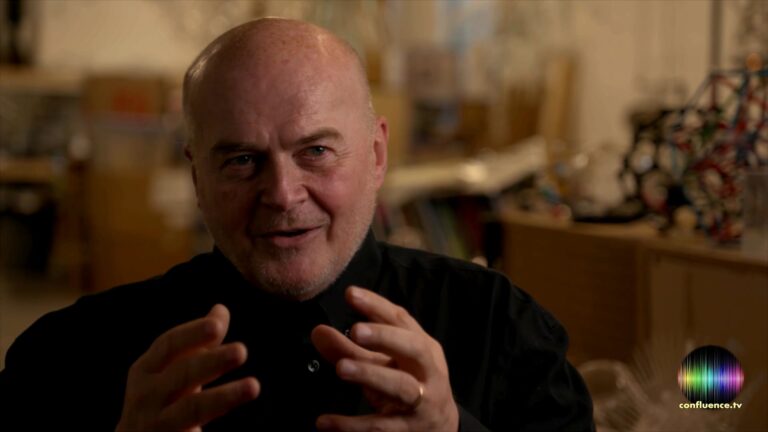
full interview_philip beesley_2.mp4

Philip Beesley[00:00:01] I'm Philip Beasley, and I have a studio here in Toronto where I work with many artists and scientists and engineers, including my beloved friend, Iris Van Herpen. And I. I can be rather strong in saying that we're really a very hopeful group in trying to shape the built environment and perhaps even the future.

Speaker 2 [00:00:35] So what is the work of the day here? What are you doing?

Philip Beesley[00:00:41] We're developing a number of small, rather intimate shaped materials which are compounded quite energetically into large arrays ranging from fabrics that wrap around our bodies to furniture scale things that make environments to canopies and shells and column arrays that make architecture. That scale of things is sometimes divided into separate phases, like, okay, here's clothing, here's a building, but in this practice, it's seen as somehow a continuum that really is offering a quality of sensitivity that's open, that can really foster a sense of almost empathy and sharing in the built environment.

Speaker 2 [00:01:39] We've walked around and seen a lot of people working on a lot of different things at once. Sort of broadly speaking, what are we seeing around here? Now.

Philip Beesley[00:01:51] So when I walk around my studio each day, I'm handling and thinking and fostering the possibility of objects, rather special objects, things that can twist and move and shake and that have intelligence built into them and that act in quite interesting ways, ways that have sensitivity, that even have empathy, that even care about you. And at the same time as making those things, we're also trying to make ways of doing things so that others can share this, so that perhaps new generations of people could work and design and share as well. That's a rather ambitious vision, but increasingly it seems rather important to do that for the world. The world's rather strained. I think it needs ways. Finding and knowing things that can really be a contribution, a contribution to a viable future.

Speaker 2 [00:02:57] So tell me, what is living architecture? Define that.

Philip Beesley[00:03:03] I've been using the word living quite a lot in recent years, and it's become a rather bold thing to say. When I say living, perhaps living architecture, that might just be an analogy for lively or perhaps something that's holistic or sustainable or sensitive, but increasingly we're using in a more deliberate way to say buildings and things and dresses too. In the past have been inert, have been things that we make. I mean, of course they're not alive. They are precisely not alive, they are things that shape, that we cut, that we manufacture, that dispose of. They're tools all around us, which is utterly different in an ordinary sense than. The precious quality of what's living and sentient. And yet, that kind of polarized picture in which what we make and who we are and what life is are somehow separate and inbounded categories, I think produces something very dangerous in the world. The sense that I am different than you. The sense I can walk on an inert surface of the earth. The sense there are walls between things. If we start to use the idea that what we make literally can come alive, and I think that's increasingly true today. I think with computational design, with artificial intelligence, with synthetic biology, and with the general language of complex systems, where we really are starting to understand how things can loop and complement and work in continually refreshing ways, then It seems that the kind of paradigms of life... Words like homeostasis or dynamic equilibrium or self-generation or care, that whole cluster of words could really be very useful for use in design. I'm a designer, I'm, I am a maker, and yet I, I think that some new paradigms could be used for using and fostering a new kind of sensitive work.

Speaker 2 [00:05:22] So we saw meander this morning. Can you tell us a little bit about what's going on under the hood? You had talked about algorithms and the way different sensors are sort of communicating different data to each other. Tell us briefly, without getting into the weeds, what's happening in that piece. And can you use that as a way to talk about how your work is generally, if that's an example?

Philip Beesley[00:05:53] I've just been talking about living architecture, and let me give you an example. The environment meander. This is an environment that we've recently constructed in a historic warehouse, big framed textile mill from 200 years ago, quite muscular, really embodying the ages of believing in using matter as thoroughly as you can and converting it into work and being as industrious as possible. What we've constructed in Meander is instead a very unapologetically fragile, gentle series of hovering shells and spheres and constructed river-like systems and canopies that start from a center and then reach out in quite large gestures through a hall with a very organization to it. On one hand it's made of sensitive scaffolds that can shiver and shake and vibrate, things that are made with a minimum of material. They're also shot through with microprocessors and little clusters of intelligence. And so that scaffold is actually riddled with many, many centers that can speak to each other and shift and offer continually evolving behaviors. And so those two things between themselves, that is to say. The scaffold, and the intelligence make for a very interesting kind of continually shifting sensitive system.

Speaker 2 [00:07:38] Does seem to be alive in a way, the way it shivers and quivers that way.

Philip Beesley[00:07:45] Meander takes some of the principles of being alive, that is, not absolutely being at equilibrium, but being an open system. Perhaps oscillating, quivering, resonating, and passing its signals from part to part to part to party, much like our own neural system has many many individual cells and chain reactions are not simply one great unified thing. But rather, there are many individual things, each with their own kind of agency. That is to say, even a cell somehow negotiates with its neighboring cell. Those many different components and assemblies make something that is rather more like a shambling kind of awkward hybrid network of things rather than a pure kind of assembly. That produces quite an interesting conversation with us as we walk through it because we negotiate and we gesture and it responds back. That's a kind of a communication, and it also has its own agenda. There's some sharp things in it, there's some things that are awkward and that are obstinate and that remain inert, and other things that become quite intense, even storm-like and overwhelmingly large. And so there's a fairly large spectrum of involvement within which we can explore and work and live.

Speaker 2 [00:09:22] You know, one of the things I find so fascinating about your work is, you seem to celebrate not just the esthetic and the artistry of what you're trying to portray, but the engineering and the literal nuts and bolts that were used to build the thing. You can see that in some of the work. Where are your, where's your creative drive coming from? Are you starting from a place of, I have a piece of material, I had an engineering idea. And I need to find a use for it, or are you thinking of something more esthetic and then you have to solve it from an engineering standpoint?

Philip Beesley[00:10:02] The question of whether unapologetic esthetics, just the most delicate kind of poetic language, or whether the kind of sharpest possible precision in which something is quantified and rigorously analyzed and proven somehow. Is a rather vexed one for me. Somehow I don't know how to tell the difference between those things, not when I really work at it. Because the precision of, say... Flickering light that I see from the corner of my eye and it makes me feel happy in communion with the rippling water that shines, for example, when I look at a pond or a lake, and the sense that okay there's a prime number and it repeats and then it repeats again and it repeats but because it's a primate it drifts a little bit each time and now we have this efflorescent series that's somehow oscillating as well in its resonance. Those things, I think, have extraordinary common ground, and each one has an exquisite kind of precision. One is conditioned by my own feelings, perhaps, you know, my impressions. The other is conditioned perhaps by all kinds of value systems which say, is it important? How can I use it? What could I use to imply? Is it real? Seems to me that these things come together in the sense of caring deeply about what reality can be. And that's a little bit different than standing back and only commenting or only analyzing or only painting. It's an activist kind of environment of wanting to make proposals for change and wanting things to work on a very, very practical level so that then they can wrap around my body and I can move comfortably, I can flow, or I can shape an environment, or somebody else could use that as a template and reproduce it. So the kind of sense of reliability of science and the possibility crafting of art, it seems to me are deeply complimentary in any kind of activist practice.

Speaker 2 [00:12:36] When we witnessed you yesterday looking at a piece of material are you a designer in that moment? Are you, you know, thinking of the function of how you're going to stitch this on? Can you, and it's a hard, it's a hard question really, but, but are you artist or engineer in that, in that?

Philip Beesley[00:13:07] When I think about the question about who I am, I rather quickly also think about who we are, and perhaps about who are as friends and collaborators. I'd like to describe just a sense in which Iris and I work together sometimes. We might take, say, an array of a textile. Wrap it around a shoulder or wrist and maybe it's a bare shoulder so that it feels something intense or perhaps it's just clumped over our clothing. Inevitably one of us will turn it inside out and make the other person chuckle or in this kind of like annoying, lovely dance in which we say, well, yes, but did you really mean that? And what about the underside? The sense of who we are in those kinds of moments, are we a designer or artist? Maker It's very tempting to say that we are certainly, at least both of those things, that is to say engineering rather precisely and also rather hopefully creating a possibility of vision which is precarious enough to be called art, changing consciousness. But I think underlying those kind of disciplines is something that's rather more involved. And the involvement comes from, I'll just speak personally. Looking at the thing and being as amazed as an infant. Somehow in a happy disposition, being somehow uncertain at what I'm looking at and finding it and discovering it again, and even being a little bit terrified at it quivering or shaking or oscillating or offering something back to me. When I speak about infancy, I don't necessarily mean something particularly happy. It's much more of a state of being, somehow. Having what a being who has agency already and and and moving into something and and moving my bodies and and my and my senses and and somehow being already in placed I I am cared for I can work and yet at the same time the slightly lurking terror perhaps engulfing me or perhaps turning out to be something that's radically larger than me is always there at the horizon, I think, when we were very little, before I think we've forgotten the sense that these things lurk and have nightmarished dimensions as well as being very, very kind. I'm talking about the kind of the world before it's settled into into certainty. I think if I were to answer that question honestly of whether I'm an artist or science, I think I'd have to say I'm a baby. Play is a rather curious word, and we can talk about some really interesting thinkers about that. I really love the words of Ioannis Vizinga, homo ludens, this beautiful mid-century text which says that it's not so much homo sapiens, the person who thinks. That's not really what defines our species, that's the name for our species. And it certainly isn't animal labyrinth, the laboring animal, and it might be a homophobe, or the person who makes it, the sense that underlying our consciousness is this rather restless manipulation of things in which we turn things inside out and repeat and repeat, and repeat and discover something along the way in a dialog. And that suggests that the word play is almost a wolf in sheep's clothing to me. Because it might sound benign, but it really means deadly business at the same time, about the consequence. And perhaps that's a hint, I guess, about how pregnant the term is in human history, where play is also something eternal, and where cities can be framed around a sense of cosmic games as well. A war game or a political game or an athletic game is very serious business indeed. It's an immensely productive term because it means that it's possible to invent and to fundamentally use curiosity to develop new materials.

Speaker 3 [00:18:47] When you use the term baby, you're not an artist, you are not a scientist, you are a baby. What does that mean?

Philip Beesley[00:19:05] When I've just spoken about this, I've used the term baby. Inevitably, that's a rather loaded term. I've said it rather emotionally. I'm trying to be rather honest when I use that term. I can cool it and say infant, you know. But what I mean by that is something rather deliberate, which is... The state. When I am not yet fundamentally separate from my mother's body. The body of another is still part of my identity, literally, somehow. Whether or not the separation has occurred, there still is some sense in which boundaries have overlapped between me and another. And the state of being in love is perhaps that as well. There's an extraordinary sense in which somehow you find yourself riddled with another. To me, that's a terrifying quality. And yet it's fundamentally a kind of a delicious one as well. And I wonder whether there's a kind of a truth in that slightly oscillating state, the kind of undulating, curious threshold state as being something that's not simply something to grow out of, as I've been taught to grow out of any of us have. I don't be a baby. But rather that it's really a very precise state of understanding and wisdom, which actually somehow resolves and motivates. I mean, when I think about that, I think of, okay, well, is that somehow similar to the place that I look for when I walk along a beach? I mean... What do we do when we walk along a beach? We walk along the wet, hardened sand, precisely at the edge of where waves move in and out, constantly as somehow an amphibian between two realms, as being a delicious state of oscillation, of somehow wanting to experience that edge. Slightly chaotic, definitely coherent, it's far, far, from just tumbling. And yet somehow with a boundary always opening. That's the kind of quality I think is embodied in the state of being an infant. And I wonder whether that could be a rather motivating state rather than a disabling thing. I'll have to think about this some more. I'm not sure whether that's a promising term, but I do think that that might be a useful one to use. For all kinds of reasons.

Speaker 2 [00:22:14] I agree, I love that you said it, and Marion did too. I just have a couple more ideas, and then Marion might have some thoughts here. Just wanted to put a finer point on the idea of collaboration. Sure, of course. You are a polymath. Why the need or want to collaborate with anyone, and maybe you can kind of talk about your experience with Iris as a second thought to that.

Philip Beesley[00:22:44] I had a rather happy childhood and one of the lovely things that my parents gave me was encouraging me to look at many different things. Even though it was at a rather stressed time after the Second World War and amidst all kinds of extraordinary political pressures and rather solemn senses of what the world could be, nuclear war, terrible suffering, anxiety about what is happening on the planet. At the same time, the sense that it's possible to look at one thing and then see another thing happen and another thing relating to each other that that rather lovely sense that things do relate and they do cohere and we can understand and we can understand difference and that that is incredibly motivating thing. The kind of harmony and resonance between realms is something that I think I've been very very blessed with learning and practicing and that's made me very hungry for learning from others. The sense that when we learn something it just opens a door and then you discover just how blithely ignorance and what universes and realms and dark oceans lie before you is something that's almost inevitable in anyone who's curious. I've been really very drawn to the sense that intelligences can be combined, and that we can find work in a kind of an oscillation and an exchange. The intelligence and curiosity and insight and creativity of another is a kind of dance. My friendship with Iris is one that I deeply treasure, as of that kind, we come from utterly different worlds. Iris comes from dance, from the world of a runway, which is utterly public. She might be a shy person, but certainly that world is one of social exchange. I'm a rather shy person myself. I might sit in an overstuffed armchair and read a book late at night with a solitary candle or maybe I might be attracted to being a monk as I was for a while in the woods and practicing a sense of being rather far away from people. Those worlds, the worlds of looking at nature. Of looking at people is a kind of an intersection in the collaboration that we've found. Both of us are rather curious, and so it would be absolutely distorting to say that Iris is the social one and I am the private one. That would be quite inaccurate. Each of us has very personal worlds. What I do think is bringing us together is somehow two worlds of practice and of quite deep experience, both of which are quite deeply embodied as through play, through dance, through activity. The world in which what we make is like a possibility shell for our bodies here, just wrapping around our intimate selves and clothing us and brought to life by walking and behaving with each other. That's one kind of possibility crafting that Iris practices. And a world of framing a space or a stage for action, a floor, an array of columns, a piece of a city is another kind of frame in which we can work very freely. Those two worlds of the rather intimate scale of dresses and the rather public scale of buildings are ones that I love bringing together. And I would have to say I'm rather uncertain whether I could draw a certain boundary where one begins and the other stops. It would be very, very tempting to say that in fact our project is one.

Speaker 2 [00:27:36] Lastly, can I ask you as a professor... Do you think you can teach creativity?

Philip Beesley[00:27:47] The question of teaching creativity is a very sensitive one. I'd like to think you can. I'd like to think that creation is an activity, and a practice, and an insight, and intelligence. It's not quite the same as innovation, that is, we haven't done this before, this is new. It's is not quite same as ethics, that this is important, and we need to do this in order to care, and because this is a value that we practice. It certainly isn't the same as politics when this is what we share and here's how we could govern together or share those symbols together. And yet somehow it needs somehow the practice of a dress or an industrial design or a piece of architecture or a pencil that makes a very particular drawing in order for it to be effective. I don't think that... Creativity on its own means anything. In its nature, it is something which is about the possibility of reality, the possibility of growth, of living. Maybe the term is almost identical with what life embodies, in fact, the sense of realizing and nourishing and playing and opening and regenerating. But can that be taught? I think it can be fostered. In a myriad of ways. The crafts of invention and the examples of innovation and rigorous analysis and the activism of projecting the work out into the world are all dimensions that can foster creativity. Perhaps it comes down to something that is just the most minute sense of instability in a disposition. Instead of something being closed, there is the infinitely tiny disposition of something quivering open and bifurcating or folding or transforming. And perhaps it is that infinitely small, cliving, somehow quivering, almost unspeakably tiny bit. Of a glint of hope and surge that actually is the key to creativity. Can that be taught? I do think it can be shared. And I think that in the same way that mysteriously things are entangled and can be coterminous, I think it is a spark of life that each one of us fundamentally knows. And in the same way that when I stand here and then I just turn my shoulder or my eye glints or my mouth slightly purses and how my friend immediately somehow is coupled to that, the sense of hair triggers in our minds and dispositions that we are so very primed. I think that that sense of when something... Wakes in creativity is one of the most finely tuned human faculties of all.

Speaker 2 [00:31:48] I loved that. That was really wonderful. I could go on, but I know you were short. So, Mary, do you have anything to add? Mary, do you have anything to add?

Speaker 3 [00:31:54] I have a couple of questions that are sort of practical and specific to our series, which is about, as you know, the confluence of art and science. So one of the things we've been looking at is the fact that throughout history, technology in many ways has led art. The invention of oil paints and the change in painting. Putting that oil paint in tubes so that the impressionists could go outside and paint in plein air. Is that true of your practice as an architect and as a designer and as maker? Does technology lead you or do ideas lead you to technology?

Philip Beesley[00:32:46] There's some very old questions that constantly recur in my studio, and perhaps they recur in my conversations with Iris, my friend, as well in our collaboration. Do we start with ideas? Do we with action? Do we play, or do we start with implication? This sense that those are different, that you should look before you leap, for example, is an old, old kind of watchword that seems like it's a very important thing. We shouldn't just leap with unbridled passion. We need to be careful. We have the capacity to harm the world. I would be very foolish if I were to sweep aside ideas and planning. And in some way, my own practice actually is riddled with planning. As a designer, I very carefully model, I theorize, I set up paradigms, I look, I visualize, I work with implications. I test. It's responsibility to shape the world, and that responsibility is really taken very seriously as a professional. And yet, at the same time... This sense. If I were speaking to an indigenous elder, I would be speaking to someone who is experienced, that has been there, that has seen. That kind of sensibility is quite different than the idea that I've theorized it, and I have a hypothesis, and so it should happen. Likewise, my body touches and drinks in information and probes and manipulates and exchanges. And that kind of quality is surely information that forms me, just riddled in the meaning of the word, in formation, it informs me, which suggests to me that the split between a mind and a body, or technology.

Speaker 2 [00:35:08] If you strip it, I'm going to split behind.

Philip Beesley[00:35:12] The idea that there is a split between the mind and a body or between technology and art, when I look very carefully at what that practice is, turns into a kind of absurdity for me. Yes, I am very driven by technology. I'm very, very interested in how computational design and the practice of algorithmic multiplication and of simulation spaces and possibility spaces can produce a kind of a pluripotency. That's a term from stem cells, in which we say that here's a plastic bit, which can be specialize and move and change into a myriad of forms. I think that that word might be very useful for thinking about how architecture and design could be practiced today. That's possibility space. Now that's a possibility space which depends on certain practices, so technology is extraordinarily important. Somehow the sense of a disposition of play, of an intensely emotional quality, seems to be so critical to work with a tool that in the end the sense manipulating something with a sensitive touch while at the same time gaging and being rather wily and looking at the manipulation. Those things seem to, again, be riddled together. So I really would be very, very confused if I were asked to draw a boundary between technology and art. I don't think I know what the difference is.

Speaker 3 [00:37:04] I have one last question, has to do with real time in the future. Based on where you are right now, working with materials, seeing things connected with 3D printer, what are you anticipating come January in Paris?

Philip Beesley[00:37:29] Iris and I are working quite hard, quite intensely right now, on a new body of fabrics that have some rather special qualities. They're based on small cellular units, and each one of those cells is quite thin and very sensitive in the way it can vibrate and quiver and shiver, and they're fused together in rather special ways, through some new... Kinds of fasteners and some fusing and interweaving in order to make some arrayed fabrics. Rim full of shimmering, oscillating qualities, and they have some new qualities. They are gentle and compliant. They speak of a kind of vulnerability and exposure. So the inner body is very significant, and a kind an intimacy comes by this clothing being partial. There are also several different kinds of boundaries that are being worked on, almost as if there are multiple auras that reach out. And those are being played with very, very gentle gestures that gather light and that puncture and that shiver. And the kind of oscillating play that make that kind of experience, those multiple boundaries, somehow an act of consciousness as well, the uncertainty of, am I seeing it? Is it a kind of an illusion or is it there is something that really is perhaps at the heart of what we're trying to do right now. This is just emerging. It's just glimmering as possible worlds and possible bodies.

Speaker 3 [00:39:38] And how will those be revealed in your imagining when they're put on an actual body? If you close your eyes. And you transport yourself to January in Paris, what will you see?

Philip Beesley[00:39:57] So if I close my eyes and transport myself to a runway in which a series of people are entering and moving clothed in this new work, then I imagine a series of vibrating fields of very, very lightweight material, shimmering around those people, gathering light in a series aura like clouds. Tiny little lenses as if they are dupe-decked. Sometimes gathering into many, many skeins and tendrils with many, very filamentary networks all wrapping around, turbulently gathering into tight, tight bodices and very, very robust constructions that expand that body as well, and then blossoming out into veils, the trail far behind them and in sometimes. Some cases, precede them as well, occupying a kind of a material possibility space. I've just been describing veils, but I think I could also say that they are rather careful constructions of multiple cellular units that could be almost like cities in the way the individual elements are all overlapping and working together in a kind of a chorusing hole.

Speaker 3 [00:41:41] And one small request, otherwise my editor won't let us into the editing room. Can you simply self-identify again, I'm Philip Beasley, I'm a designer, I am an architect, I am a teacher, however, in whatever

Philip Beesley[00:41:56] Of course, yeah, because I went on a little bit more. I'm Philip Beasley. I'm Philip Beasley. I'm an artist and a sculptor. And I work rather scientifically as well, engineering new materials, shaping them, working with images, working with quite a lot of words and analysis, creating new generations of fabrics that become dresses, that become rooms, that become buildings, and that can be shared.