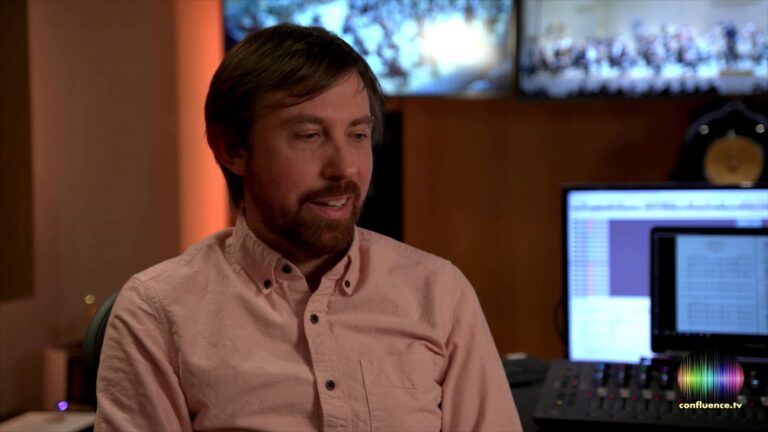
full interview_nick squire_6.mp4

Speaker 1 [00:00:00] So Nick, you've heard this music live in the great symphony hall. You hear it in this amazing sound studio. And then you have to reproduce it so that it sounds live. Tell us about the differences in those experiences.

Nick Squire [00:00:16] Yeah, well I think, you know, as one sits in Symphony Hall and partaking in like a live concert experience, you're, it's, I mean it's awesome. You're surrounded by hopefully your friends, maybe your family that you went with and you're excited and you are in this beautiful space and you look around and all the architectural details and you know just the volume of space is just fun to be in. Then you have live musicians on stage. That are some of the best in the world playing for you. And as they play, you hear that sound directly. You also hear the sound interacting with the space and it comes back and it bounces off the wall and comes back behind you. And you're completely enveloped in this beautiful sound. And I think that's what's so special about, you know, seeing a concert live is both experiencing the music but experiencing the experience of just being there end. Listening to music with other people and you know as you can kind of hear as people start breathing together or holding their breath because there's this climatic moment and then kind of all breathing together at the end of it, I think makes like the live music experience so interesting and so exciting. So on the flip side, my job as a recording engineer is to capture that energy and somehow be able to... Take that experience package it up but then deliver it so that people at home in their living room or in their cars driving or maybe you're chopping onions to make dinner and you're listening you know to a recording at home take that same energy and so what I try and do is capture certainly what the musicians are doing and capture what the space is giving but because you're not physically there, and you're not sitting next to your friends and family. And you're not seeing the space and sort of basking in the glorious details of the space, what I try and do is bring out as much excitement as I can in the recording and bring out all these elements that maybe if they're live, you see the harpist move his or her arms and you see that and so you hear it differently, you feel it, you experience it differently. But if you're at home, you're seeing that. And so sometimes, I try and bring in these little details so that you're sort of recreating that experience at home for a listener. So it's a challenge, but it's lot of fun and we try and recreate what's happening but make it even better, even more exciting and have people at home experience what the live concert's like.

Speaker 1 [00:03:03] When you talk about the sound alone, rather than the whole physical experience of being in a hall, when you talk the sound about alone, do you think technology will ever make it greater than sitting in the hall itself?

Nick Squire [00:03:22] Great question. Yeah, I don't know if technology will ever get to that point. I think, you know, the magic of being there and being in the same space as musicians. I don t know. I mean, maybe someday it will. That would be fun to experience. I t think we're trying new technologies to do that. You know, for instance, this room is set up for Adobe Atmos, which adds speakers above and behind. And so you can get a more sort of enveloping and more more interesting experience My, you know, my hesitation right now is most people don't have, you know, eight, 10, 12, 15 speakers in their house. And so they're not, you know, hearing it, um, in the same way. Most people like to just put on, on their stereo in their car, like I said, in a kitchen while you're cooking and just experience music. And, uh, that's a different experience. I, and it's, um not to say. Not to say it's not as good as a live experience, but we'll see if we ever get there. I don't know.

Speaker 1 [00:04:34] Would you say that again briefly using the word technology? I don't know how close technology will become, however you want to say it.

Nick Squire [00:04:43] Sure. I don't know how close technology will ever come to recreating the live experience. I think we're getting closer. I think that we're trying new technologies to get there. But we do our best to recreate it and present it in the best way possible. But I don't t know if it will ever be the exact same experience as seeing an orchestra or any musicians live. Well, this... This particular space, like many studios, is designed to be sort of acoustically transparent. What that means is that the sound that we're hearing out of the speakers, when it arrives to us, isn't really being colored. And what that allows us to do as engineers is to, when we make decisions about balance or timbre, you know, reverb sort of space panning. It allows us to sort of make the best decisions we can so it translates to as many systems of a home consumer as possible. So whether they're listening to car, on headphones, at home, all of those systems sound very different. And so by having a space like this, that's neutral, controlled, we can best make those decisions to translate to somebody listening at home.

Speaker 1 [00:06:12] Have you ever had to work in a really crummy studio?

Nick Squire [00:06:16] Definitely, I think every engineer ever has always worked in not so great environments. But that's okay, you do what you can and you make the most of it. And hopefully you get an opportunity after the fact to listen on a space you know or headphones you know, speakers you know before it needs to go out. But yeah, certainly we all work in bad spaces from time to time.

Speaker 1 [00:06:42] You can go back to just just a really

Speaker 3 [00:06:44] Just a really quick question. Oh, yes, please. I've heard that the, it used to be the big Neve board with all the pots and the sliders and all this stuff. Yeah. And this looks like, I don't know, a video toaster. Sure. Do you miss the kind of muscle boards of past? Or is it?

Nick Squire [00:07:07] Yeah, technology has changed drastically and we don't have a huge audio console that takes up the whole room. We sort of are able to work with newer technology where I can control 60, 70, 80 microphones in this small format and I can switch between different layers and sort of group things so I'm controlling multiple mics with a single fader. And that personally allows... I prefer it. It allows me to work very efficiently. And I can always be what they call the sweet spot, which is sort of in the center of the room in between the speakers. If you're working on a huge console that takes up the whole room, you're sort of sliding from left to right to work over here and work over there. And you're never really just focused in the sweet spots. So this sort of has a lot of advantages. I'm controlling computers, which mixing the sound versus working on an old. Analog console.

Speaker 4 [00:08:10] Which is an improvement from what you had previously. This, what's here now.

Nick Squire [00:08:13] I think so. Yeah. I think.

Speaker 1 [00:08:16] I think artificial intelligence will ever be able to replace what you do.

Nick Squire [00:08:20] Hmm. I think AI is certainly will get close in a lot of fields, including mine. I think there's already some programs out there that try to anticipate what a human might do. I think at the end of the day, a lot of what I do and a lot of what my colleagues do is is so embedded in the art itself. There is no right or wrong answer. It's sort of how do you feel in the moment and what are you trying to create? And so I don't know if we'll ever get, AI will get to that point. I think AI can say that it can make it sound like this or make it sounds like that, but someone needs to decide what is it supposed to sound like in the first place. And so, I think we'll get close. I don't know if it'll ever fully replace it in that regard.

Speaker 1 [00:09:09] So nothing will replace the human ear.

Nick Squire [00:09:12] I think so, yeah, and the human touch and...

Speaker 1 [00:09:16] The ability.

Nick Squire [00:09:19] Nothing will replace the human touch or the ability that we have to really fully experience it in the moment and react to things, emotional things that are happening in the music and sort of enhance that. It's really great to listen and music in here, you know, in Dolby Atmos and I wish everybody could experience it because you're listening to music and it's coming from all around you. But the reality is is that at home, nobody has the same setup with thousand-dollar speakers surrounding you, and so I don't know how I feel about it. I love it and I wish everybody could listen that way, but like myself, I listen in this great studio, but I go home and I cook dinner and I listen to music out of a cheapo hundred-dollar speaker that's just sitting on the counter, and I don't care. It's music. It's great music, and I enjoy it. And... And I don't know, it's nice. That's what I love about music is it can be listened anywhere by anyone on any device and you don't need to have the best speakers or the best environment. Be listening and you share it with people. And it's something that two people can enjoy together wherever they are or whatever they're doing. And I think that's really magical about music.

Speaker 1 [00:10:43] Do you have musical moments that just shatter you, make you weak, make you stuck in your tracks?

Nick Squire [00:10:50] Yeah, I certainly do. There's moments that you experience and it's almost hard to explain because you try and explain it to somebody else, but unless they were there, they can only guess at what it made you feel. But I think what's great about music is it makes you think about or the music. You're all of life's experiences. It pulls that out of you. And somehow, when you hear a moment in music, it makes you think about some moment in time that was beautiful or sad or exciting or maybe you think of a loved one or something. And it's hard to, you can't share those feelings. Feelings are so hard to explain to somebody else because they're so personal. But also at the same time, universal. So I think everybody can enjoy it and everybody can feel something. But there are magical moments where you think about it and you just smile and you remember how good it made you feel.

Speaker 1 [00:11:57] You were going to ask some things to me. I think you picked it up. Oh. It's, you know, we've been talking to people a lot about whether there's some identifiable neurological explanation for why, as John Stork said, when he hears the end of Madame Butterfly, no matter what happens, he just has the same emotional reaction. And even as an acoustician, he has no idea why. Yeah. Just happens.

Nick Squire [00:12:35] Yeah, yeah, I don't know. I think music, while universal, is, you know, everybody prefers their own genres or prefers their own pieces, and yeah, and I'm trying to think if there are any specific pieces that I react to. I can't think of any off the top of my head, but there's moments... Well, for me, actually, as an engineer... I work in music all the time, so I often, it's not that I don't enjoy the music, but it becomes something that I'm working on. And so I hate saying this because it seems so cliche, but my favorite piece is what I'm currently working on, and so like this week, for example, I'm gonna hear the same pieces multiple times. And it's really, for me, it's so enjoyable to experience it. Again and again and hear more details that I didn't before or understand things in a different way because I'm hearing it multiple times. And I think that's really special and something that I'm lucky to be able to do. I kind of, yeah it's funny, I fell into this in not the traditional way I guess. My, my family didn't. Wasn't necessarily musical. I mean they like music of course, they listen to music, but no sort of musicians necessarily. I just have always enjoyed music and I started playing piano as a kid and I hated it like many people. I had to go to piano lessons but then I thought I'm going to play something louder so I started to playing drums and my parents somehow bought me a drum kit and I played drums in a rock band. And so I was always interested in music. And, but at the same time, I remember I had a little cassette deck, dual karaoke machine, and I had two record heads, and I have two microphones. And I remember as a, you know, teenager, playing in a rock band, I'd set these microphones up around the room and I'd record my drums with the mic here and then I'd move it and then record them again and see what the difference was. And so I was always kind of interested in both the music side and the tech side. And I think that's where I ended up in a really good place now, because I'm equally interested in both, and I get to do both. And I thin that's really magical. But I always thought I was going to be a professional musician, and I realized very quickly that I'm better off kind of down here in the basement, helping them sound better than up on stage.

Speaker 1 [00:15:15] Yeah

Nick Squire [00:15:24] And now, you know, everything is computer-based, that these days I feel like I'm as much of an IT person as a musician or recording engineer. It's sort of like, you now, 50% IT, 50%, music, and 50% psychology sometimes too. We're dealing with musicians and their insecurities. And they're just human beings, and we need to be careful with what we say and how we act around them to make everybody feel comfortable.