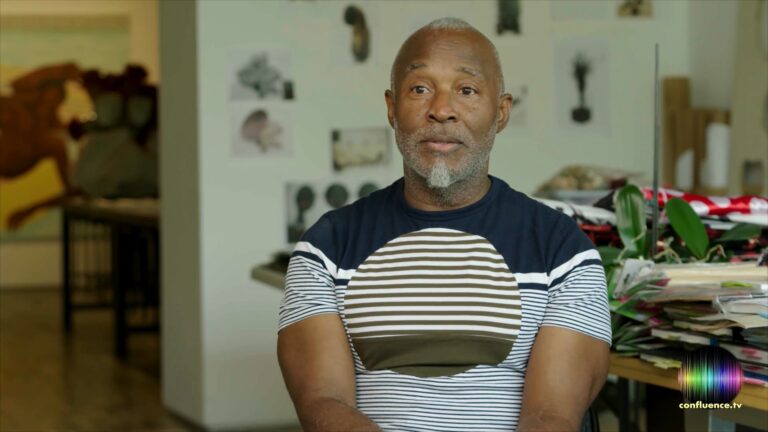
full interview_nick cave_1_1.mp4

Nick Cave [00:00:00] My name is Nick Cave, visual performance artist, activist.

Speaker 2 [00:00:11] So, walking around with you, I was taking away that there's a lot of trial and error in your practice. Can you talk about that?

Nick Cave [00:00:22] Yeah, there is a lot of trail and error in my practice. I think, you know, for me it's, you know, I don't really, it's not that often where I sketch. Because I think the way in which I'm working is. Well it's sort of trial and error and sort of being sort of open to the process and sometimes in that sort of development, you know, as you're sort of creating, there may be an perfection, and that's okay. I mean, that's sort of like this sort of thing that is sort of important to me that the imperfection is the sort of truth. It's the sort, it's the, sort of, core. It's the character that becomes part of the work. And so, you know, I've always been sort of... A gambler, you know, I'm willing to sort of try things to see in order to learn, in order to find the sort of best solutions. And so, you now, that is also sort of important. It's also important to understand that I have a studio practice with, you know, 10 full-time assistants and everyone's sensibility is not exactly the same. And so how do I sort of allow? That sort of visual language to also come into play, but yet still where there is consistency with again these sort of characteristics that sort of reveal themselves.

Speaker 2 [00:02:32] I feel like you seem to try a lot of different things. You're kind of very open, and that's my perception of just spending time with you. And you just go, and maybe you go pretty far along and go, well, that didn't work.

Nick Cave [00:02:49] Oh, yeah, there's Sherellan-Era 24-7 in the studio. That's, again, for me, it's finding the sort of material language that really supports the idea. And not everything may work in clay. Not everything may worked successfully as a painting. And so I'm sort of just sort of in search of seeking out, Again, what's going to? Be of the essence that's going to allow the work to stand. In place to be everything that it can be. And so, you know, it's a little scary, but it's also... Probably one of the most important factors in the development. So, you know, I have to. Really ask myself, what is the message that I'm trying to deliver and what is the best sort of solution at arriving there? And so that then comes with a lot of testing and sort of questioning and meaning and definition, so.

Speaker 2 [00:04:21] You're dealing with all these different materials. So one of our episodes is with this woman who's talking about the glass symbol, Zoe Laughlin. She's an engineer, a material scientist, and an artist as well. And she talks about stuff. Stuff has a life. And stuff is doing stuff all the time. This table is holding things up. And you can do things to that. But what's your relationship with materials? Do you have favorites? Do you listen to them? Just tell me about it.

Nick Cave [00:04:50] Well, you know, I've always said that, you know, my sort of what I need in terms of supply and surplus is outside of my studio. So I am in the world looking for resources, primarily at flea markets, antique malls, you know. You know, I'll jump on a plane and fly to Washington State, one-way ticket, rent Cargo van and flea market and antique my way back to Chicago. And, you know, there are things that I need in terms of material and surplus. And granted, you now, what I need is an abundance of stuff. It's not just one thing. It may, I may need 300 of one thing, and so that's how I sort of source. And so, on one hand, moments where it's like, could he be hoardering in the studio? But it takes so much access to make a And so, you know, that's where I sort of resourced. But then at the same time, I'm wide open to something that may trigger a new way of thinking. And so I'm, what I'm finding that's amazing right now is that I am making work in the moment, on the spot. Like I'll find And I remember finding this, my partner Bob was like, Nick, you've got to come. And there is this dog that you have to see. And I'm thinking, dog, like, I'm not even interested in dogs? Like, why? But he's like, no. This particular dog is so amazing that I think you will sort of be interested in it. So I went over and looked at the dog. A sort of hand-painted, sort of large ceramic sort of Doberman that was reclining on the floor. And it was really quite amazing, it had this sort of Americana sort of vibe to it and I was sort of like. Interested and I sort of looked at it and sort of went on my way, but then I sort of came back to it and I said to him, you know, I need to find a Go Satie for him to recline on. And he's like, well, where are you gonna find that? Like, and two Morris stops, guess what we find? Is this go city? So I had bought the doll. And so we're like in this antique mall, and I'm like, we've got to bring the dog into the store. And so the salesperson's sort of with us, and we're, like, can we bring our dog into this store? And they're, what are these two, what are they doing? And so Bob goes out and gets him, and puts him on the gulp of tea, and it was like. So perfect. And so that was sort of that moment where I realized that, wow, I am literally making the composition as we speak in the moment. And so again, allowing that, being aware that that is part of making work. But it's always that one object that I find that sets it all, that triggers everything. It's the catalyst for the idea. And so I'm always so, and it's really sort of, this sort of emotional sort of trigger that I have with an object. And I may not know why, or what it. Or how I may use it, but I tend to always buy it. I mean, I've had things where I've had them for two years before I have used them, but it's just something about the object that it's like everything that I can imagine it being is all sort of contained within this. And so that is sort of an amazing sort of gift, maybe, to sort of be connected to an object in such a profound way.

Speaker 2 [00:09:57] The material, do you have favorite materials that you'd like to work with, or do you push them beyond what they seem to be intended for?

Nick Cave [00:10:07] You know, my favorite material, I would say, I think the found object is probably my favorite material. Because I'm always, it never is. Purchase with the intent that it will be used as we know it. It's always sort of me sort of reclaiming it and sort of turning it on its head. But it's always this sort of provocative sort of element. Because I like what it stands for. But I'm more interested in what it becomes. So it's really sort of about the past and sort of fast forwarding us into the future. And so I'm interested in living in these two sort of worlds.

Speaker 2 [00:11:15] We talked about this before, but tell us again about the importance of handwork in your practice in relationship to higher technology or whatever you want to call it.

Nick Cave [00:11:26] You know, I think hand work is important in my sort of practice. Is because of my sort of upbringing. You know, I come from. Family of makers from painters to woodworkers to seamstresses to quiltmakers to bakers. I mean I have always been surrounded by makers, musicians within the family and so I've always sort of being sort of surrounded by that being sort of part of my sort of presence. But it was when, you know, it was me, you know, for example, if I met my, when as a kid I was at my grandmother's house and, you know, let's say we're there for Sunday dinner. After dinner she pulls out her quilt and starts quilting. I found that that moment I was so calm, and it just relaxed me as she was quilting and sort of telling stories. I was just completely sort of saddled in my body. And I think that that has been profoundly sort of the same sort of structure that happens in my studio here. Is that we're working in very labor-intensive ways. But there's a moment in the studio where everyone just settles and gets into this zone. And it has always been very therapeutic for me. It has also allowed me to sort of work through a lot. It's just, you know, this repetitive sort of motion that settles my body and then allows me to sort of put things in order. So it's really part of just a condition, a practice that is very zen-like. And has always been in my practice for decades.

Speaker 2 [00:14:06] I'm going to shift here because this puts us in mind of another artist that we're talking to, Bisa Butler. Okay. Did you ever hear? Yeah. Can you, anything you want to say about your sharing of quilts?

Nick Cave [00:14:17] I mean amazing, the quilts are like extraordinary, the color, the pattern is so phenomenal. And so I think again that labor of love, you know, in order to do that work you have to be in a certain sort of mindset. You have to be settled within your body because of the detail. And just the sort of building and the making is so... Intricate and so beautiful in itself. I mean, it's a work of art in itself, not the finished work, just the process of building. But I love the work.

Speaker 2 [00:15:12] But I was just going to, I'm just curious your thoughts. Iris Van Herpen.

Nick Cave [00:15:16] Love her designer. Again, just someone that is sort of thinking outside of the...

Speaker 2 [00:15:22] Can you just say Irish?

Nick Cave [00:15:24] Iris, you know, is someone that is sort of thinking outside of the box, you know. Again, I think about, like, performance. I think about sort of dressing the body, dressing on the body and dressing away from the body. So again, just how, you know, the body for me has always been the carrier. And so to be able to be adorned by her sort of garments and to watch them move as you as they're sort of depending on motion and air to help sort of agitate and Bring them to life. This is extraordinary and I like her way of building Again, you know, it's multiples And again just the execution I'm aligned with her as well. And so again, I understand these sort of mechanics. I understand the sort of technical aspect of that work as well

Speaker 2 [00:16:37] Let me just get you to say because I was talking over you, it's my fault. Something to the equivalent of Irish Van Herpern is amazing. I just need you to see that.

Nick Cave [00:16:44] You know, Iris Van Herpen is amazing. I love how she. Has sort of brought this sort of, these sort of work of arts. You know, it's fashion, but it's kinetic sculpture at the same time. So I love the fact that she has herself planted in these two worlds. And I think that's also a place that I sort of find myself that, you know, we could talk about sculpture, but we could talk about performance. We could talk about paintings. So, you know, these artists that are sort of skirting the fence where we sort of work in this sort of transformation, this metamorphosis kind of space where defined by one medium or being sort of recognized as this particular type of artist, but we are sort of creators that are just making amazing things, I guess, I hope.

Speaker 2 [00:18:08] She also has a lot of sort of scientific, if she looks at, she loves like sort of 19th century guys who did this amazing glassware of scientific phenomena, sea creatures and stuff like that. Do you, is there any kind of like a, do you have any science stuff floating around in your brain sometimes or is that really not your thing?

Nick Cave [00:18:31] Well, I think it definitely is floating around in my brain. I think this sort of working in this sort of how do you build something from nothing? And what does that sort of mean in terms of where is the mind in that sort space of? Of openness and yet forgiveness at the same time, so this sort of expansion and this sort of contraction, like, you know, the idea may start out here, but then how do we sort of get it to sort of become aligned with a particular way of thinking and operating? And so that's all through this sort of, sort of. Spiritual, psychological sort of dance. It's, you know, it's and sort of allowing that sort of vibration to sort of be the sort of guiding force. It's you know as again I don't sketch but I know when the work takes its first breath. And so I know it's done. And so that sort just being sort of you know, open to that sort of moment of improv and sort of having this sort of amazing dance. I think that's all, you know based in some sort of psychological sort of ethereal kind of way of existing.

Speaker 2 [00:20:21] What does it feel like when a piece is done?

Nick Cave [00:20:25] Oh, it feels incredible.

Speaker 2 [00:20:28] That's one of the pieces there.

Nick Cave [00:20:29] You know, when a piece is done, you know, for me, it's this moment where it does this. It goes, and I know that it has arrived. And so, not that I know anything about it, and so that's the other sort of amazing thing on the other side, is that, you now, the moment that it introduces itself to you. And so. In some cases I don't really, you know, we're in such sort of production that do I really know what the work is about? Probably not. Because it's production, photographed, and then it's out of the studio and I never see it again. Isn't that wild? To think that I never seen it again, unless it's in an exhibition of sorts. But, you know, again, sort of... Creating that space of letting go and, but it's never been for me, so.

Speaker 2 [00:21:37] You're one of the other many hats you wear is you're an educator, and I know you do not only teach professionally, people are going to be professionals, but you're committed to community work and working with young people. The whole question of can creativity be taught? Is there a way to do it? Is it harder to teach somebody who's already grown and adults or kids are naturally creative? Do you have any thoughts on that?

Nick Cave [00:22:05] You know, collaborating and teaching, you know, I work a lot with sort of public and sort of having this sort of, public sort of outreach and thinking about community and particularly under-served communities. You know, creativity. I don't, can you teach creativity? Sure, you can, you know, it's all sort of, I think it's just giving permission to be expressive wherever you see fit. And that's what I try to do in these sort of collaborations and in these outreach moments. You know, I bring a project to a city and then I hire the city to build the project. I never bring dancers, musicians, vocalists, none of it. I will bring the idea and then I will. Feet on the ground and I will start to navigate it because I'm interested in who lives here, what am I here for and how do I introduce myself to the community. So there's many times I'm working with social services, underserved communities and just sort of building this sort of network of creators. And then we go into a, it could be three to six week residency collectively. I talk about the grand idea, but I don't talk about the process because that's where we learn and start to build the work. I have no idea what that's going to be. But let me tell you, that is probably the most life-changing part of the work. The conclusion, I know that we have to get there, but the process in between is life-changing. And then to conclude with the testimonies that follow that is everything. So for me, I'm interested in creating. Space of possibility, you know, for individuals that may not have the audience that they inspire to sort of be a part of and to deliver work to, and to create that kind of space for them to say, you now, maybe they've only had 300 people at a performance or... An engagement to say it's going to be 8 to 10,000 people here. And for them to see how we're building the set. The process of like, whoa, this is how it's done, this how Nick does it, is everything. Because it's... You never... In that sort of moment you come out and you never will be the same, you never will be who you once was. And so for me that's probably the most important sort of part of my work, not the exhibitions, not museum shows, it's really how do I allow the work to serve. And pretty much with the majority of my large installation, there's always an invitation. That's a part of it. And that's me inviting you to come in and use the space however you see fit, which then allows me to step back and to see what that means. How does this work open itself? Up for performance. And so, you know, I'm interested in that, you know, that I'm always learning about the work in terms of how it's used, how it serves, how it makes one feel, because it's always been for others.

Speaker 2 [00:27:06] I have one more question. It's a little bit out of left field. It relates to another one of our stories. We filmed at Google as a company that is building robots for everyday use. The whole point is they could work in old age homes, giving people medicine. They can clean tables, things like that. Well, the idea was that there aren't going to be people with labor shortages to do this kind of stuff. And so then the robot's like learning how to open doors because it's not every door knob is different. Humans don't have that problem. So they brought in a choreographer who was also a computer scientist, very smart woman. And Katie Kwan her name is. And she's teaching the robots how to move so that they don't freak people out because they're gonna be zipping around. And she doing that and of course it's like teaching toddlers because the robots go off and don't pay attention and things like that. But you obviously have your own dance history personally, but movement and people wearing the sound suits, for example, is an important part of your life. But it seems like the people are the part of it. And the question is, could you imagine some day having a robot in there doing that, if you were allowed to control, if you are allowed to tell it what to do?

Nick Cave [00:28:26] Totally. Again, I think technology is... Again, how do we, to me, I look at it as another medium. How do we sort of fold it into the mix? So I'm completely 100% all in. Because again, I think it's about relationships. I mean, you know, I'd think about like, but then even some of my sort of kinetic work. Where you know I think about like what I did at the Park Armory there was you know this 40 foot tall by 200 foot mylar curtain that was moving throughout that entire space and then there was then choreographers that were invited to then to integrate and to respond to this object moving in space. So. I think it's just, again, part of projecting the future and how does that all align with our needs and, and, um... You know, the shift in sort of moving ourselves forward.

Speaker 2 [00:29:55] I'll just get you to say, if you're comfortable, I'm all in with technology. We didn't have my words in it. People want to get on with the subject. Thank you.

Nick Cave [00:30:03] Yeah, I am all in with technology and just again finding ways in which it fits within in the core sort of practice. I think everything has a place and I think it's really sort of understanding, you know, its role within the making, within the development of the work.

Speaker 3 [00:30:30] I've got one, I'm just going to, well I can't quite think of it. Yeah, I'll look, yeah. So you know the drill. So your sound suits, your sculptures are full of so many parts, objects, ideas. When do you know it's finished? When do know a piece is finished?

Nick Cave [00:30:54] Well, you know, with my work, in terms of, you know, sound suits, sort of any of the work, painting, sculpture, bronze, you know, I know when a work is finished, when, you know, as I said, it takes its first sort of breath. And so, I know, it just sort of like, and then I know but when it does not. It may not ever be finished. And I have no problem pushing that to the side, and maybe I'll hold onto it for a little bit and see if something sort of gets resolved, but there's moments and times that it doesn't, so. Yeah, so I'm at a bonfire and I'm just throwing hundred dollar bills in it because I'm just like, ideas are just falling apart. But that's part of the learning curve and I have to have that allowance there to do That's all for now.

Speaker 2 [00:32:12] It's interesting, we asked Iris the same question, we'd asked everybody that. And she said, well, I don't know if I should say this, but I'm always very depressed when I finish work. And I said, because Amy and I work together, that's the way we feel. When we finish a film, it's very depressing.

Nick Cave [00:32:30] When I finish a body work, it used to be depressing, but not anymore. I've sort of, you know, I've worked through that and I mean, I used to go, like it used to get really dark after a show opened. Because you know what are we doing? We're thinking about like what's next, like well stop thinking about what's and be in the moment and... Realize what you just did. And so I think that that has really saved me. Quite often where I just am sort of like, you know, in the moment, because coming down off the high is very abrupt. You know, because we've spent months, years in the development and then the high is one. One three hour evening and then it is over. And so for me, I just sort of, sort of embrace, you know, the sort of the impact of that and sort of give myself time to sort of reflect and step out of everything, like everything and refuel. Recondition, rebuild. And then I, you know, come back into something else. Well, you know, there's, within my sort of studio practice, you know when I make a shift in my work, I always keep one piece. So I, you and I have this sort of survey of the practice, which I think is very important, because then it, you now, I sort of know how, and when I've arrived to a different sort of direction, point of view. But there's a sculptural piece that I have here that's out on view. And I found this object, which. It was a baptismal font. But when I read the label, it said a planter. But I knew that it was a baptismal font, and so I bought it. And so then I sort of talked with the fabricator that sort of forged this sort of copper bowl that fits down in the center. Then I took the font and handed it to a fabricator that works in metal. And so it built this sort apparatus up around it. And then that was brought back to the studio for me to then embellish and sort of adorn it with floral and birds and sort of beadwork really creating this sort of migration hub of sorts. And so it really is a piece that sort of speaks a lot about, you know, my upbringing and the role of religion within my sort of upbringing. Sort of celebrating that and really sort of also thinking about the sort of tree of life and the family tree and the history that aligns that within a religious sort of core.