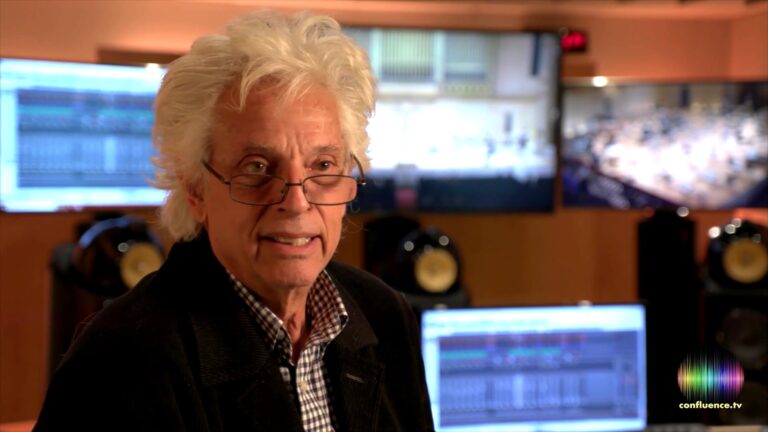
full interview_john storyk_2.mp3

John Storyk [00:00:00] I'm John Storyk, I'm an architect, I am an acoustician, a technologist, an engineer, and a music lover.

Speaker 2 [00:00:08] So what do you actually do?

John Storyk [00:00:13] Okay, saved the hardest question for first. Well, I'm going to ask a question back at you. Do you want, do you mean, what do I do for a living?

Speaker 2 [00:00:24] No, I mean, you are an architect and an acoustician. You're working in a very specific field. What is that field? Because it's not something that normal people may not be aware of.

John Storyk [00:00:36] Well, I think most people know what architects do. I think a lot of people might not know what acoustic engineers or acousticians do. In general, it's a technology craft to try and optimize the performance of any space where critical listening takes place. And that could be from a stadium, outdoors or indoors, to a concert hall. To a recording studio. Recording studios are where I have spent the most amount of time. I've been involved in the design of something in the order of 3,000 studios over 52 years. And that probably puts me in a relatively small group, if not very small group. It's a perfect medium for me because it's a perfectly nexus of architecture, music and technology. All three of those disciplines take place in these rooms. They're small rooms. They often get built relatively quickly, as opposed to, for instance, halls and stadiums, which could take years. So there's a kind of a gratification that works for me. It's kind of worked as a business, although I'm not a businessman by training, I'm a manager by training. I actually really don't enjoy. Those tasks, although I am entrepreneurial and I've never really worked for anyone else after my first job of three or four months. Um, so it's kind of worked out nicely. Um, but that's my passion. Along with a few others, um, but, uh, combining architecture, engineering and acoustics, um. Gives me a lot of pleasure.

Speaker 2 [00:02:30] So, you know, our series is about art and science. We have science, technology, engineering, all part of that. It seems to be that.

John Storyk [00:02:37] This is a good break for us because I'm in the right place at the right time. Good break. It's a perfect intersection of both of those. There are moments when I feel very scientific and very technical. We're using a formula, or we're dealing with mathematical issues, or were dealing with a lot of data points, and we're processing them. I often joke and say we're acting a little bit more like a plumber. We're trying to solve a problem in a very empirical fashion. Empirical and in a very systematic, orderly fashion. A follows, B follows A, C follows B, D follows C, et cetera, et cetera. And those are exciting moments, and they can be difficult and tricky and challenging. Most of my work is in the client universe. By that I mean people hire us to do things, so that brings a whole nother level of expectation. You're kind of expected to be a little bit of a genius in those fields. Let's just assume that you're gonna do that correctly. I always found that very interesting. And I will use a baseball metaphor. In baseball, if you get a hit one out of three times, not only are you in the Hall of Fame, you're in the elite part of the Hall Of Fame. Mickey Mantle didn't do that, Babe Ruth didn't that, and I can go on and on and one. On the other hand, if I'm asked to design a recording control room, which we are sitting in now, I'm not sure what the camera is seeing, but we're in. The only control room for Boston Symphony in the Boston Symphony Hall that is used every day to record accurately what the Boston symphony orchestra and other artists perform upstairs in the hall. There might've been a thousand decisions in this design, that kind of number. If I got 990 of them right, I'm gonna get yelled at. If I've got 995 of them, right, I might get a thank you. Not exactly the case with BSO, BSO was an amazing client and their dear friends. Okay, but if I got one out of three right, I'm in a lawsuit. Okay, so it's a very interesting business to be in. But it's the business that we chose, it's profession that I chose and I love it. Then there are times when what I'm working on is anything but empirical. I will substitute now the word artistic. So now B absolutely doesn't necessarily follow A. As a matter of fact, sometimes you're required to put down A and jump to F. Why? Because it's just interesting and then F is what came into your mind. And then we got to go back and deal with B. Then maybe we can go to D. We got to fill in C. And by the way, when we finally fill in the C, it affects A. It's anything but linear. It's not empirical. It's architectural, it's vibe, it is artistic. And now comes the fun, both of these disciplines, both of these activities, both of these actions, both converting these activities to something that maybe pays the bills and hires staff and makes a living for about 60 people, which is the size of my company that I founded with my wife that then was built on my career of 25 years. They both have to live more or less at the same time in the same universe. And that's actually not so easy and can become stressful.

Speaker 2 [00:06:41] That's the art and the science.

John Storyk [00:06:42] Art and science, okay?

Speaker 2 [00:06:43] The art and science have to live together.

John Storyk [00:06:45] The art and science have to live together, they want to live together. It's fun, it's challenging. For me, I find it very beautiful. But at times it's very difficult. But it's the life I chose, and I'm 76 years old in a month. I have no interest in retiring. I've changed my schedule a little bit. God has been very, I've been very blessed. He's given me some pretty good health. Great family and finally allowed me to find a great partner in life and in business. That's Beth. And so although I've transferred a lot of the management and business over to other people, so I don't have to kind of deal with that because I never really liked it, I'm still in love with those moments. I couldn't, it's, I mean there are a lot of places that I could be talking to you about this in. Spaces that I had to do with and even spaces that I didn't have anything to do with maybe we'll get an opportunity to do that someday. But I'm particularly proud of this one that we're in. It was a crappy room to begin with in the basement of Symphony Hall, which is nothing to shout home about. It's just awful. The ceilings are too low too many pipes and this was the only room that we could get by the way, it was being used as a kind of an ad hoc studio for years, but not particularly successfully. And we got the opportunity to convert it and make it. I don't want to say perfect because I don't want to be, uh, I just don't want to use that word. Nothing's really perfect, but very proud that this has become a very accurate listening and producing a music producing machine, um, that not only can Nick who's, who's who's with me today, Nick Squire, their, their, their full-time engineer can, can work in, but, uh. From the symphony can come down and listen and trust the room, okay? In addition to feeling comfortable in the room. Okay? They feel comfortable. They're happy with the colors. There's not too many colors, but there are some. We didn't have an opportunity for windows because we're in the basement. Okay? But most importantly, when they listen to a piece that they just played minutes ago on stage in one of the great halls in the world. They trust what they're hearing and then they can learn from it and they can because they're trying to take their craft to a level That's unimaginable That's my job. That's our job. And that's that's our Oscar. We don't get an Oscar. We barely get applause. We sometimes get thank yous. We did it in the case of working for for the BSL but the real the real The real bow is that moment and I've been actually lucky to watch it a few times. I Thanks for watching, I'm Andres. Their conductors sit here. Sean Murphy, the famous classical music producer of Star Wars, in addition to his credits, work here in this room. And it's when that happens and they trust the room and they believe in the room and their comfortable in the room, and all the work that we did, Nick, myself, my team, to make it so that they're happy staying here a few extra minutes to make a decision. That's it, that's the payoff. Art and science, art and science. Art and Science.

Speaker 3 [00:10:27] Can you turn your phone off? Come again? Can you just turn your phone off. Thank you very much.

Speaker 2 [00:10:30] It was vibrating.

John Storyk [00:10:31] It was vibrating.

Speaker 2 [00:10:34] Or we can hold it for you if you want it.

John Storyk [00:10:36] The lesson there, hey Carlos, do me a favor. Call, call PK back, go outside, hit PK and find out what he wants, maybe he's trying to get in for all I know, I don't know, just figure it out. And then stay out, just turn the phone off or just put it in your pocket so they don't hear it. That's the very beginning. But see, it's a real interview and it had a real phone. Because I'm still working. Let the camera, okay, still, still working

Speaker 4 [00:11:05] At the very beginning of this interview with a real phone, you said a very simple sentence, which I would love for you to re-say as a sentence. And that was, acoustics is the perfect intersection of art and science.

John Storyk [00:11:21] Actually, what I really said was my work is the perfect intersection of acoustics, architecture, and science. OK, it's.

Speaker 4 [00:11:28] Because we would love to have a cool...

John Storyk [00:11:32] Um, what we do, what I do, or what I spend a lot of time on, um, particularly in small room design control rooms, studios, which is where we are is, uh, the perfect nexus of architecture, technology, and acoustics in this room is architecture vibe, feeling, emotion, acoustics, accuracy. Okay. And technology all around you. You see a lot of technology and some of it's pretty complicated and it all has to kind of work together in what appears to be this very simple, seamless moment. I've also been happy when I walk in here and people will say, Oh, this doesn't look that complicated. Looks pretty simple. What, what'd you do? That's, that's a great moment. That's an Oscar moment. I'm sure Nick has. Smell. Yeah, yeah, this is simple. You just put this together in a week. No big deal. I can't even tell you how painful this was to get this done. This is hard, okay? It's hard to do something that looks simple.

Speaker 2 [00:12:40] So what do you need to know to be an acoustical, to be acoustician? You need to have materials you need know about.

John Storyk [00:12:46] Well, that's a really interesting question. And you can come at that a few different ways. And people have come at it a few ways. I'm gonna go back to my same position. I don't, particularly for recording studios, I don't see how you can design recording studios and not be a musician. There are people that do it, that have come up, there are people who have come up and said, in that world through technology. They basically were engineers. I don't mean mixing engineers, I mean installation engineers. So they installed a number of studios and then they were kind of hanging around studios and they kind of sort of picked up a little bit of this and a little of that. And the next thing you know, they're studio designers. Then there are people who have become studio designers because they were carpenters that actually built the rooms. So there is a universe of studio builders. By the way, this studio was not built by a studio builder. What is a studio building? A studio builder, his first studio, he was not a studio builder. He built one, he built two, he build four, and now he's a studio builder. And yes, there are people that are better at it. They know they're more comfortable with the materials. They're more uncomfortable with the assemblies. They know where to get the products, which is actually part of the battle, particularly now in the world that we're in. In this case, we did not have that. We had to use builders that came with the hall, who did a good job, by the way.

Speaker 5 [00:14:18] And then there are Okay, and I got a ticket for him.

Speaker 2 [00:14:36] So let's, let's if you don't mind, I want to make this a little more generic about your field rather than about this particular room. Okay. We've got plenty of stuff on this.

John Storyk [00:14:45] No, no, we're trying.

Speaker 2 [00:14:47] So, for example, when I talk about what you need to know to be an acoustician, you need to know about materials, you know about sound, I mean, whatever.

John Storyk [00:14:57] He's rolling, he's good. Um, well, to be an, to be an acoustician, that's different than a studio designer. So let's, let's talk about being an acquisition first. Um, that essentially a science. Okay. Um, you have to have a reasonable command of math because the language, the, the language of acoustics is physics, the language of physics is math. That's, that, so you kind of can't really avoid it. Um, on the other hand, part of the language of being a successful acoustic engineer or acoustic designer, um, involves interpretation. So now there's art. So, but you need to, you need, you need to know some math. Can't imagine being an acoustician and not having some feel for architecture. You certainly can be an architect and not have feel for acoustics. As a matter of fact, there's an entire universe of architects that don't know anything about acoustics, they're actually some of our clients as a matter fact, but I don't see how you can be a student and a practitioner of acoustics without having a passion for architecture and a love for architecture, particularly if the acoustics you're involved with is is interior spaces. There are acoustics in exterior spaces, but my world is small interior spaces up to and including halls. I think you have to have a love for music. At some level because it's rare, it's a rare day that we're exploring at an acoustic level of space where we're not having to have some kind of conversation about what's going to happen in the space. So not to dwell on any specific space, but we are at Austin Symphony Hall where that control room had a very specific requirement, as opposed to Electric Lady Studios or Ocean Way Studios or any one of hundreds and hundreds of recording studios or other kinds of halls or, you know, BB King venues or Live Nation venues. These are all spaces that have very specific acoustic requirements. Some of them niche, some of them quite broadband, which are actually difficult. They have to be a lot of things for a lot people, but you have to You have to understand them. You have to know. What's going on. So if we're being asked to do a room that's dedicated to film mixing, that's very, very different than a rock and roll tracking studio, for instance, where you might expect John Mayer to record in, or Jack Antonoff's private recording studio. That's being designed specifically for him in a way that specifically mirrors how he wants to work. He and he alone, because it's his. So you got to understand architecture. You have to understand some science. A little psychology now and then wouldn't be bad, okay? Should have read more Shakespeare in college. It would have been. My work, because it's the nature of the work, is client driven. Studios are complicated, it's not like I wake up one day and say, I'm just going to start designing a studio. No, we're asked to do it. We're asked do it, we are the plumbers, we hired people, so we have a responsibility. So we have to learn about that. And with that comes rejection. Rejection is tough, I've been rejected many, many times, I have been fired, I have been re-hired, I haven't been paid, I mean all the stuff that you read about. It's going to happen to you. And you don't really learn that in an economics class or management class. It's you think you do, but you really don't. So you'd be, you'd, you would be better to read Shakespeare or Robert Frost. Okay. So you need a little bit of that too. Again, I find all this very exciting and I have no. People are asking me, when are you going to retire? When are you gonna retire? Cause I have made some structural changes in our business, which are just that. Some younger people are now partners and I keep looking at people saying, where, where did you get this idea from this retirement idea? Where'd this come from? I said, I have, no interest in retiring. Well, what about if you slow down? Well, okay. If I slow down, I'll just do less. But right now. I'm lucky, God has given me physical ability to keep going, so.

Speaker 2 [00:20:00] There seems to be something emotional going on here.

John Storyk [00:20:03] I'm happy doing the work. I like doing the work.

Speaker 2 [00:20:07] But there's also the emotional about whoever the client is, whoever they are. I mean, it doesn't matter if they have different demands, client A from client B, they are getting something. If you design a room properly, they are hearing something that works for them.

John Storyk [00:20:21] Yeah, it's exciting. It's exciting when that happens. And it's also exciting unpacking their needs because more often than not, not the case at BSL by the way, but more often than not clients are not a hundred percent sure what they want. They think they are, but they're actually not. Okay. Um, they think they have a budget, but they really don't. Or they think they know how long something should take, but they really don't understand that information. Or yeah, I want to have a room that's big enough for 50 people, but when you start working with them and really drilling down and sort of kind of unpacking some of the details, turns out they never record 50 people once every three years. And what they really do all the time is five people. OK, and you have to kind of, and by the way, these are sophisticated people. These are not kids. Nothing against kids, and I'm saying these are people that have been in and around studios. So that's kind of fun to do that, that's the psychology part. The architecture part is a lot looser. Some clients have really passionate visions about what things should look like. Other clients have no idea what things should look and you kind of have to shepherd them through. Again, I've been very blessed. We have enough projects where we're really driving everything and then we have projects where we are really more of the bus driver kind of helping and we're okay with that, whatever is required. I'm

Speaker 3 [00:21:58] Can I just ask something real quick actually? You talked about the science, you talked about architecture, and you started to talk about art, the art as kind of the interpretation of what's going on. Could you talk a little bit more about that?

John Storyk [00:22:20] The interpretation.

Speaker 2 [00:22:21] What is the art? I mean, you explained about the song. Well...

John Storyk [00:22:24] Well, OK, I think what you're driving at is the interpretive part of science. Interpreting a client's needs, the English says it all. That's called programming. By the way, that's an art. And some of that involves science. Budgets involve science. Timelines involve science, and sometimes they're complicated. Sometimes they're extremely complicated. But the one that I think is the most interesting is the artistic interpretation of science. So what does that mean? So tomorrow, for instance, I'm going to be in a studio. And I'm going to be acquiring scientific data about a room. Why am I interested in that? Well, in this case, I'm interested in it because I'm going to be teaching some people about the room. But even if I wasn't teaching, why is that interesting? Why is it even interesting to know that? Because if we can codify or turn what we hear, at the end of the day, let's get this straight. In fact, this is the lead. At the end the day the only thing that matters is what you hear. Everything else is our humble, feeble attempt, OK? To put down what we hear into another language. Words, numbers, pieces of paper. Why? Why is that even interesting? So that we can share it with somebody else. If we didn't have a need to compare it to somebody else or to share it someone else or to get an award or to have a standard, we wouldn't need it. It would be the same, for instance, the Mayan language. I happen to know a little bit about it because I live in Mexico in the winter. Was never a written language. There was no need for them to write it didn't mean it didn't exist now It's written. They've kind of figured out how to write in some other kind of an English English lettering style But in its day, it was not written As opposed to Latin, which I think was written and now it's written, but it's not spoken. Okay. So at the end of the day, that's all that matters. So why am I interested in this data? And we're going to get the data. The data is unrefutable. It's undeniable. I mean, you can make the test incorrectly. Okay. So there is a little bit of fuzziness there. Thank you, Mr. Heisenberg. Okay. So you can annotate that out if you want. So that's a scientific principle. Nevertheless, let's just assume for the moment that the data we get is the data. And it'll give us all kinds of interesting numbers. But we're not done yet. So now what do we do? So is this room good? Let's just go ask a really stupid third grade question. Very low level question. Well, the data, it's 1.8 seconds at 1 kilohertz is the reverb time. Well, the first question that someone's going to ask is, well, is that good? Is that good enough? What does that really mean? And now comes the art. Because the answer to that question, you've got 20 acquisitions in a room, you're going to get 21 answers.

Speaker 3 [00:25:55] I don't know.

John Storyk [00:25:55] I mean, I have an answer, I've an opinion, okay? I may answer that question with a question. You know, I can't answer that questions until you get the reverb time for the next octave up or the next octaved down, because actually what's more important is how does that compare to the next Octave? Okay, so now all of a sudden we got one of those A doesn't go to B, I need C to fill in B, et cetera, et cetera. This is what I think is fun. And I believe that this takes place in lots of science universes. I mean, this just happens to be a universe that I know a little bit more than most people about, but I, I'm kind of an Einstein fan. I mean I've read the sort of, uh, lay biographies of Einstein. I went to Princeton. So if you're at Princeton in the sixties, you're in his shadow. Uh, my girlfriend sat on his lap. I always thought that was my connection to Einstein because her mom was a babysitter for him because he lived not far down the street there. And, you know, at the end of his career, all the great physicists in the 20th century said, I give up. And these are guys that came as close as possible to understanding. And, they all became extremely religious, OK, but they didn't start out particularly religious. They started out quite empirical. Okay, I don't think I've gotten anywhere near that moment. But the aha moment comes when you can take the data points, somewhat irrefutable, and convert them into meaningful information, stuff that actually means something. So for instance, recently, I had the pleasure of being on the stage at the Symphony Hall and speaking to. The assistant concertmaster who was playing a piece, and we were in a very interesting conversation with her. Noted correctly that there was a small time delay between what she was hearing, what the conductor was indicating, which is going at the speed of light, very fast, and maybe what a triangle player or a timpanist, 40 feet away, back, upstage, backstage, upstage was playing. Well, 40 feet is about 40 milliseconds. 40 milliseconds is something you can hear. Quite reverb, but it is something you can hear. And I found it fascinating to hear this violinist talking about it, who I think under her own admission would tell us that she's not a scientist. She's an artist and you couldn't get much more artistic than this person. Okay, yet she was aware of this. And in some strange way, she was aware that they had to deal with it. And then came the fuzziest explanation I've heard about. Well, how do you deal with it? And then she couldn't quite answer the question, at least not in a scientific. She couldn't answer the questions empirically. She couldn't give me data points. I don't, she couldn't given me anything that I could, that was, that was scientific enough that I can share it at a, from a data point of view, from a science point of you, but her explanation was perfect. It was, it was as valid, if not more valid. We're one organism on the stage and somehow we figure out how to play together and I don't know, maybe they delay theirs a little bit automatically or I intuitively delay my stroke a little bit and somehow, we play as one family. And I'm like listening to this explanation. It's like, are you serious? Yeah, she was serious. She was dead serious. This is one of the best violin players in the world and she knew exactly what was going on, but she couldn't scientifically. Which one's right? Let you figure it out in your, that's your job. You're the publisher, you're the writer, you're in the interviewee. They're both right. I'm more comfortable in the first, I'm comfortable with the numbers and the science, but we still have to interpret it. And she had no interest in the numbers or the science. At least I don't think she did. But her feeling about it was just as valid and got to exactly the same point. I find that fascinating. I find kind of cool.

Speaker 2 [00:30:30] It's very cool. And so are you saying that there's it's not just about the numbers. It's not

John Storyk [00:30:36] It's absolutely not just about the numbers. Anybody can get the numbers, I'm saying that with one of my acoustical engineers here who tomorrow is gonna go get the number and Carlos, I don't mean to say that, as a matter of fact, not anybody can go get numbers because I don't even know how to get them anymore, okay? But I know how they're gotten, okay, and I could learn if I wanted to, I just, it's just not what I do anymore. But I do know how to interpret them, at least I know how I want to interpret them, and I also know people who will interpret them differently. And I'm not afraid to get into a conversation about interpreting them.

Speaker 2 [00:31:16] And that's where the creativity comes.

John Storyk [00:31:17] That's exactly where the creativity comes in. And let's take another standard. Because basically, these numbers then go get standards. The standards are used so people can design things or rooms, and we move on. So let's a standard that you would think would be rock solid at this point. Stereo. Been around for as long as you're alive. Well, you probably remember mono, and then you remember stereo. Okay. And the albums came out and they even showed you where to put the speakers. And this is 50, 60 years ago. It's, I mean, now we have 5.1, we have immersive sound. We have lots of, lots of other standards, Dolby, et cetera, et cetera, but let's just take good old fashioned stereo, stereo. So you would think at this moment in time that there would be a drop dead. Everybody agrees to standard as to the angle that those two stereo speakers should be in a recording studio, of which we have 10,000 of them in the United States. Absolutely not. There are definitely standards, at least a dozen of them, you know, ASTM, ISO, this, that, people's opinions. Okay. But there's no one agreed to standard on what I would think is the most fundamental, one of the most fundamental configuration standards that you would go to. So you tell me, how about speed limits on highways? I don't know, 65? 60, what's wrong with 60, what about 63? How'd we get to 65? And I could go on and on and one, okay? So it is interesting. Okay, but at the end of the day, the correct speed limit is the one that optimizes economy and optimizes accidents. Well, that's a really big sign. You can't put that up. Please drive at the speed that you think is appropriate to optimize your fuel level and not kill anybody. So in Germany on some roads, they don't have any speed limits. Because they basically say, you know, do whatever you think is safe, as you know. We could go on and on. I love these kinds of examples. I mean, I do. I find that I find this stuff really interesting and really fascinating. I don't think about it a lot, but you're giving me an opportunity to talk about it. So if you're ready to listen, I'm ready to talk.

Speaker 4 [00:33:34] More questions. So I have two very different questions. How, you've been at this for a long time. Very serious, you're very serious. You've been asked this for long time, John. How has technology changed the listening experience? You can look at me.

John Storyk [00:33:52] Yeah, so technology changing the listening experience. That's a good question. It's a question that's been asked quite often. And different people will give you a different answer. The moment. The aha moment for our generation took place in a small lab in Germany for a Hafer Institute when somebody realized that they could take sound and digitize it. If you were there at that moment, you would have then realized that everything was going to change. I was about maybe one year behind that. I have been to that institute, by the way, because I have a good friend that lives not that far from there. So, when that happened, for me, I think two things happened. I think a certain way of listening, and I don't want to say quality, but a certain... A certain manner of listening, and we'll just call that analog for the moment, because that's how we were listening in analog reproductive systems, the bell rang for its demise. It's essentially over. Okay? And a whole new way of listening took place. Now, for the longest time, those two listening experiences were not the same. And for the longest time analog, I mean, CDs did not sound better than albums, not even close. What CDs did sound better was, was scratched, scratchy albums, and they were convenient. Et cetera, et cetera, etc. But now we're in a moment now where digital reproduction and digital recording, you can't hear the difference. I can't hit a difference. I haven't been able to hear the difference for a while. And I'm with serious engineers, Eddie Kramer's, Jack Antonoff's, Ronson's, guys that have extraordinary ears, even Bruce Wadine when he was alive, and they can't hear the difference anymore. And we have a sampling rate, et cetera, et cetera, that allows all that. So that disappeared. So we have the same quality now. But what happened was the art of recording changed. And I'm not sure if it changed for the better. That I don't know. My official position to that question is that I don't care whether it changed for the better. That may not be the answer. That may be what you're looking for. My job and my responsibility is to understand how it happens. Because that then allows me to make rooms, tools, machines, to accommodate how work takes place. Now comes the even stranger sentence. I'm not sure if you're going to want to put this in. I actually don't really like the recording process that much. Uh, kind of a strange thing for someone who has designed 3000 recording studios and has essentially supported 150 kids in college and, and whatever. I particularly the repetitive overdub-ness of it. I kind of really love live recording better. I think what happened when the digital age entered and all the tools followed was some gains and some losses. So we have extraordinary tools that allow people to do amazing things. That's the good news. We have extraordinary things that allow us to do things that's the bad news. People have just taken these tools and abused them, okay? Um, I don't want to be cute with my answer, but, but that's, they've, they've just done too much. Okay.

Speaker 2 [00:38:14] Isn't that the nature of artists though? They see a technology and they go, I can do something with that.

John Storyk [00:38:21] And then some artists are more extraordinary than others. My start was with Jimi Hendrix. I mean, it's known. How lucky was I? You know, he hired me to do a club. I did the design. It got scrapped. It became a studio and I walked out really upset at 22 that I lost my first commission and they said, you could do the studio even after reminding them that I'd never been in a studio. So off to the races. I went to try to do the best I could with another 26 year old kid named Eddie Kramer, and we got a little lucky, little bit of science, little bit of luck, a lot of hard work, self, uh, Developed internship etc etc and we can fill you in on that story. It's not that unknown The real, the real aha moment was that I didn't bring anything to the table other than just raw emotion and vibe and a little bit of science, not even in that thing. The only science I brought was structural engineering. I kind of had minded in structural engineering, so I was not afraid of science and I wasn't afraid to read about another science. I was, not uncomfortable with the math. It was pretty easy. I was, I was working around a true genius. I mean, someone who just heard stuff, Hendrix, he, I don't know how he had no idea, but that was the first guy I got to work with. I mean I could have been working with. Other artists who were not geniuses, okay? And he dies, and no sooner did he die than the next person who moves into Electric Lady is Stevie Wonder. There's another guy who just heard stuff and he couldn't even see, okay. And, you know, these guys are on another wavelength. They're on another wave length. I don't know how it got there. It's like Mozart. I don't know. And I've kind of given up caring. I don't know why Buddy Holly can sing the way he can sing. Or why Puccini can write chords that just the chord will make me cry. Forget about the passage. Just the chord, just the cord, just the last chord on the first act of La Boheme and I'm in tears. I've seen that opera 40 times. I've sat in the audience with a score. They gave me a baton. My kids gave me full score on a batone. I walked into the Met with it. The person thought I was crazy. I was following it note by note. And I don't know how they can do it. They just do. So how cool is it to be, you know, if you get to be around those people. Okay. And you get too, to, to help them. I don't know anything about, I don't know about Puccini and technology, cause I'm not, but I do know a little bit about Hendrix and technology and Stevie and technology. These guys loved technology. Stevie, those four great albums were all based on a synthesizer that I helped design actually. I designed the cases for it for his producers. And Jimmy would have loved technology. Stevie recorded and mixed everything in quad. I know that because I designed a studio for him in Los Angeles in quad, but there was no quad. There was no Quad being released. And years later, I asked his engineer producer, lifetime friend Bob, I said, why? He says, well, that's just how he heard it. But he knew it wasn't going to be released in quad He said, that doesn't matter. We're working. We're recording. Work. And then they had to down mix it to stereo because it had to be released in stereo. So he was way ahead of his time. He loved technology. And I think Jimmy would have, would have loved the technology today. They just recently remixed Electric Ladyland 50th anniversary in Surround. Eddie Kramer did it from the original stems. Eddie is my daughter's godfather, lifetime friend. And I, and I was at Capitol. I was in LA and I went in, just sat there for a few minutes and listened to one of the songs. I said, isn't this, this is a pretty amazing responsibility. You have the responsibility of trying to figure out where Jimmy would have put these sounds. He said, I said is who's checking you? He says, nobody's checking me. I, I got it. Estate is letting me do it but I kind of think I know how Jimmy would have done it because he worked with him. This is really the intersection of technology and art and music and it's... Its truest form.

Speaker 2 [00:42:59] And you're collaborating with these guys, you're collaborating with Stevie Wonder, even if you don't actually physically share the space.

John Storyk [00:43:05] Well, I'm collaborating with Stevie Wonder because we did a studio for him. So yeah, I mean, the projects that, we have a lot of projects in our business. Not all of them are interesting to me. I mean we have other kinds of isolation projects and whatnot, but when we're doing a studio for an artist in particular, one that I really enjoy, I'm on it personally. I enjoy the conversation. I enjoy The Challenge. You know, we're doing a private studio for a very well-known talk host. Why does he need a studio? He's got a voiceover project. He's also kind of a musician dabbler. Probably can take a guess. There's only a few, but he has a voice over project. I'm trying to pull out from him what he wants in this studio. Now, this is a person that does not know the cubic volume of the studio. He barely knows whether we need an ISO booth or not. Doesn't know anything about this stuff other than he's been in a lot of rooms with this stuff and it should work. Quietness readings, not gonna get it. These are all things I need to get to, but I'm not gonna to get any of them by talking to him. But he's very specific about wanting a burnt orange couch in the back of the room. I got it in a text message. I could pull it out right now and show you, and it came on a random day, no less. Okay, you know my reply back was got no problem with the burnt orange couch So on one hand you could okay burnt orange couches But what is he telling me? So he's telling me that he's gonna sit in the couch a lot So now I now know something else about how he thinks the room should look Okay, so that is gonna change. Maybe how I orient the room Maybe I'm gonna want to make the room work a little better for the couch So I'm gonna make, this room is longer than it's deeper. Okay, we're in a specific room that maybe you can see, but it didn't have to be this way. As a matter of fact, for years, it wasn't this way, it was wider than it was deeper, which by the way, I think has some acoustic benefits, but this room has to be an office and also has to have a producer's desk. That information was not scientific, that information was architectural. You see where I'm going with this? So sometimes an architectural piece of information gets me into an acoustic solution, but it's driven by technology, okay? We had a project once where the owner, who a rock star, kind of his own producer, always stood. And lean against the column that was in the middle of the room. Seriously? He says, yeah, I just like to listen standing next to the column. We offset, we designed the monitor system to sound good in that spot. That's a little bit of a fluke. Okay. But these kinds of moments are, they're breathtaking. My favorite one in history is the Wright brothers. So I'm a kind of a Wright. More than a Wright Brothers fan. I've read a lot about the Wright Brothers. And I'm a pilot, so I naturally, I fly planes. So, first guys to fly planes, this is not why they're famous. Yeah, they were the first ones. December 19th, I got a boom, they went up. Lots of people were flying planes. They were crashing. They were flying, they just weren't, they weren't controlling. And if he didn't do it, someone else was soon gonna do it. The aha moment came a year earlier. When, when two things happened, one, they figured out how to control, how to turn. No, nobody was turning. They were, as they were turning, they were crashing. You, it's like, I believe it's no good to just get to the top of Mount Everest. You have to actually get down. You getting to the topic, not getting down doesn't count. You got to get down, okay. Who knows how many people got up there before what's his name in 1953. That was the aha moment when they figured it out how the turn. Came from their bicycle experience.

Speaker 3 [00:47:20] Nothing to do with it.

John Storyk [00:47:21] Science. They were in and around and breathed bicycles which are fundamentally unstable items that become stable. It's an unstable item. It is naturally unstable. It wants to fall. Yet everybody in this room, everybody in your world, from kids, everybody knows how to ride a bicycle. And then the other moment was the science moment when for two years they used somebody else's out of points. I forget his name right now, I'm going a little blank, because I'm too old, it was the airfoil tables, and they finally came to the conclusion that they were wrong, and they just threw, they said, no, this is not working. These airfoils are not giving us the lift that we should get, okay? And they threw them out, made their own wind tunnel, and came up with their own airfoile designs. And those were the two moments, these two bicycle guys with no money, no government money, no nothing, okay. This is why they are who they are. The fact that they got the plane up finally was, they knew this was academic. Yeah. Okay. We got it. You know, and it never flew again, that plane.

Speaker 2 [00:48:31] Yeah, just gonna do a quick battery tune.

John Storyk [00:48:34] Got a little off course there but you know it's my dime as much as yours what's the name of the plane yeah the right the right flyer

Speaker 2 [00:48:42] Is that what it's called? Well.

John Storyk [00:48:42] Well, the right flyer, yeah.

Speaker 2 [00:48:43] Yeah, something Jenny wasn't I don't know that's different. I'm really forgetting. Yeah, so

John Storyk [00:48:49] So that plane flew once, actually flew four times that day. The longest flight was about the wingspan of a 747. It never flew again.

Speaker 6 [00:49:00] Ready for it.

John Storyk [00:49:02] It flew, is the first one, and it sat, as you know, the older right died very soon after, and Wilbur, and Orveral lived, or was Wilbur? I forget which one died, and was a very cantankerous guy, and always arguing with the government over patents and whatnot, and sent it to England, and only almost in the 40s it just came back to this country.

Speaker 4 [00:49:27] Do you want another clutch, please? Do you need another clutch? Is Joe going? Yeah, I'm still going. Do you have anything?

Speaker 3 [00:49:35] Very good question.

Speaker 4 [00:49:37] So what is it about sounds that's so interesting?

Speaker 3 [00:49:43] Is anybody else hearing that? Yeah, we're all hearing it. I've got a piece of foam in the lid of the television case.

Speaker 2 [00:49:51] Low grass, they're sort of like a mechanical area over there.

John Storyk [00:49:55] Hey, we're in a real room.

Speaker 2 [00:49:57] I just wanted to make sure I wasn't the only one. It's like the water buffaloes have gathered. We're all here. It's fine.

John Storyk [00:50:07] What is it about sound? I like, I like... Ooh, what is that? No, it just is what it is, yeah.

Speaker 3 [00:50:19] Peter in the wall.

John Storyk [00:50:21] You know, I like the music. I like to music. It's not for me. I don't go around listening to arbitrary sounds, although I often, you know, every iPhone now, every cell phone can be a sound level meter. So I got to sound every. So, I don't know, sometimes I'll just see how loud something is or sometimes I will be somewhere and I'll turn it on and I will look at Octavan noises because I'm mainly just to collect some data points for my work. But I'm not a person that just randomly goes around listening to sound. I like the music. It's about the music, I'm a musician. I've been playing piano since I was six. I was piece and clarinet player, sax player, multiple bands. When I graduated from college, I thought I was going to be a musician, I got a day job cause I needed to pay the bills with the new wife living in Greenwich village, 1968 time of my life. But my real, if you asked me in July, of 1968, where do you think your life is going? I would have said, I'm in a 12-piece blues band and we're playing clubs. And that was what I thought was gonna happen in an era where you didn't have to think very much. It's much harder now, now, much harder, now. You could, at least in the summer of 68 in Grinch Village, not think that much about where you were going. Money seemed to be easy. It was. It was just the nature of the time, much harder right now. But if I was forced to think about it, that's where I thought it was going. And then this serendipitous set of events just completely changed the course of my life within a matter of months. And life changed very quickly. And, but I still was a musician, but now I'm designing this recording studio and I fell in love with that. But it was always about the music. It was really not really about sound.

Speaker 4 [00:52:24] And on the subject of music, what is it about those seconds of pooching that make you cry?

John Storyk [00:52:33] I have no idea. It's a fantastic question, but I, but I can tell you that it happens. You, you could play the first, well, I mean, because I've

Speaker 2 [00:52:44] And look at the

John Storyk [00:52:47] because you can you can the opening four bars of la boheme or the ending chord of the third act the the park act the act where they're just or the first act when they finally go off stage, okay, which is extraordinary, both theatrically and musically. They, I'm welling up a little bit talking about it, and I cannot give you an explanation for it. And I actually like that I can't give you any explanation for it, I don't want to give you explanation for. I'm not even in search of an explanation for want to know when I can go to the med again, and see it again and wear a tuxedo, which I actually own and I will wear it because it's fun. It just is fun. And it makes me cry and it makes me laugh at the same time. I don't have an explanation. I don't want an explanation, I don´t want to answer that question. The answer to that question is that I don't like that question, that's my answer, that´s my official. Now that I'm thinking about it, I'm getting angry even thinking about the question, I´m not angry at you. That´s the whole point, is that you´re not supposed to know why. You´re NOT supposed to why you feel that way. And I'm definitely not supposed to know why he was able to do that. I don't care. And there are other moments in music when that happens. But that is my absolute drop dead favorite moment. I'm stuck on an island with one CD. That's the one I want. If it's one female singer, Nina Simone, maybe Bonnie Raitt, there's a few. Linda Ronstadt, depends. Male rock and roll singer for voice, Roy Orbison. Nobody sings like Roy Orbason. Everybody else is, and then comes the next five. And we all have those lists, and that's fine, and that's good, and those are OK. But then to ask why, I reject the question. There is no why. That's the whole point. I'm not supposed to have a why. Trying to understand why BSO sounds the way it does. Now that is an interesting question. One that I still don't have the answer for, but I'm okay with that question. And I'm OK with continuing to try to drill into that question because if I can get the answer to that question in some language, either physics, math, the language of the first violin concert master lady whose name I forgot, embarrassingly enough. Uh, who we just recently, who I just recently spoke to. I don't really care what the language is, but if we can get an answer or something that's close to an answer, that could be useful. I could, I could maybe duplicate it. I could may be learn from it. Um, I, okay. I can, I can deal with that. I don't care why Roy Orbison makes me cry. And if he doesn't make you cry, I'm okay with that too.

Speaker 2 [00:56:11] Well, it's interesting because, as you'd imagine for this show, we've talked to a lot of people who are really active in artificial intelligence and all that stuff. And they seem to be hell-bent on cutting out the Royarchs of the world, or like, you know, finding the algorithm of Royarchism.

John Storyk [00:56:27] And I'm sure you are talking to people who are on the quest for algorithms and I Have a problem with that. I'm just not interested in it Okay You know, I'm a baseball fan we've talked about this a million times and everybody knows the famous catch the famous play that Derek Jeter made, the pitch, the toss. Which is a once-in-a-lifetime play that saved the whole game in a series. And they say, how did you know to be there? And his answer is, that's where I'm supposed to be. That is his answer. I was supposed to there. I'm the third backup guy. The third backup guys never gets a throw. I mean, it gets a through once a lifetime, but they practice it. And when you're Derek Jeter and you're at the highest level of playing, You're there for just that moment. Then you have to have a little luck. Then you gotta be able to, you gotta be athletic, dance, spin, be a ballet dancer, and you have a slow runner, and the gods were all lined up, and they tagged him out, and it was happened, okay? But his answer was, that's where I'm supposed to be. The catch, the Willie Mays catch, the best part of the catch was not the catch, it was the throw. The catch was amazing. Then he turned around and threw the ball, okay, and got the guy. You can't explain how people can do this. There's no natural explanation for this. So I'm okay with that because on the other side of my life, I'm involved in many, many things where I am on the search for explanations. Okay. If Andres comes down in this room and he's comfortable and he is peaceful and he spends an extra few minutes to listen to a bar that then helps him to do something that makes, that then you know, makes the universe better, et cetera, et cetera. I don't have to know why. Okay, I can guess. Okay. And you know I can go on record in some magazine saying, you know that was the perfect beige. We picked it just because we, you know and you know then somebody's going to convert that to angstrom units for some neurological explanation and I'm okay with all that. I mean, that's fine. It's perfectly legitimate. I don't a problem with it. I'm just not interested in It doesn't interest me and I'm not even sure if it's true, but I'm not, but also I'm also not sure if its not true.

Speaker 2 [00:59:02] I just need one piece of information. Can you say when Andrus Nelson, who's the conductor of the...

John Storyk [00:59:07] Yeah, when Andres Nelson comes down here.

Speaker 2 [00:59:09] We didn't know he was the conductor.

John Storyk [00:59:11] Oh, and Andres Nelson, the conductor of the BSL, comes down to this room and spends an extra few minutes here, which he has done, because I've been here when that's happened and I'm sure Nick has been here more than once when that has happened. I would like to kind of think that it's happening because he's doing his job, he's listening to his music, his work, accurately on a system that he trusts, with an engineer that he trusts, but in some strange way. We're helping them to stay here a few extra minutes because we kind of got the colors right and the lighting, right. And the chair is in the right spot. And despite the crappy air conditioning noise, okay. So. And that's a quiet bow, and that's fun. And it's not necessary to prove it. It's just necessary to move along to the next project. It's a journey. The whole thing is a journey, there's no end. So my famous no end story, a good way to possibly end. I, for years, I essentially was the architect for Albert Grossman. Albert Grossmen built, founded Bearsville Records, essentially invented personal management. Managed a few artists you might've heard of, like Bob Dylan, Janis Joplin, the band, Jesse Winchester, Peter, Paul and Mary, et cetera, et cetera, and built. Bearsville studios, many restaurants, Bearsville theater. He owned an entire town next to Woodstock and was a mentor of mine. He let me, when I needed some help, he let me live on his estate and I designed all of his buildings and his studios. And we were very close and he died. I was 40, he was 60, he died of a heart attack. I would see him every weekend. I'd go up on Thursday nights. Usually I was a weekend warrior and we'd talk. And he was known for just very eccentric, always building stuff. And one day he says, okay, we're gonna go to the, I got a house I just bought in Saugerties and we're going to make a new stair or something. I forget the project. And I said, Albert, why don't we just finish the theater first? I mean, we were in the middle of eight projects. And I said, why don't we just finish the theater before we start on another project? He was a tall, if you look up Albugrosman, kind of looked like Ben Franklin, was one of the by-spokes. And he just looked at me, looked down at me even though he was the same height as me, but he would always look down at everybody and he just said, Why? He just said one word to my question. That was it. It had nothing to do with finishing the projects. It was all about the journey. He just wanted to keep doing the projects, so it's one continuous journey. In the middle of this, we have starts and finishes, you know, mainly because there are clients and there are projects and they need to get finished. Okay. But it's about the journeys. So there's a kind of sadness to ending the projects when they end, we're sort of happy, but we're sort of sad. We are. I usually don't get to go back to them very often. The BSO is a true exception because I teach in Boston, so I'm always here and have become friends with some of the people here. So this is, this is kind of a nice place. It's kind of nice that you allowed this conversation to happen in this room. But for the most part, we don't go back. We're not invited or it just doesn't work out programmatically, but it's about the journey. It's about the journey The answer to that question is that I believe that some questions don't need to be answered. That's my personal belief.

Speaker 3 [01:03:02] Is there a question? Maybe this question doesn't need to be answered either, but you design a lot of rooms. You know, you design rooms and you have meters and you have ways of figuring out what sounds good.

John Storyk [01:03:21] We don't design the room with meters, but I'll let you continue. I'll let you continue.

Speaker 3 [01:03:25] Okay, all right, but get my point. Well, I got, I'm prepared to get your point. Isn't there something that is ultimately somewhat ineffable about all of this? In what? Ineffable, difficult. Is that me?

Speaker 2 [01:03:40] What the fuck does that mean? Difficult? Okay, here's the thing, it's like, it was what you talked about this before. It's about the, you know, there's all this measurement, but at the end of the day, it's not about the numbers, right? I mean, you tell that to us. You talked about...

John Storyk [01:03:55] Well, I'm in a few different worlds. Sometimes I'm the designing world and sometimes I'm in the analysis world. Okay. So.

Speaker 2 [01:04:05] You're sitting and listening. Yeah, people who are d-

John Storyk [01:04:07] Yeah, people who are dealing with acoustics are not always in the same world. I am fundamentally, I am, fundamentally a designer. So a designer, by definition, designs. I'm making things. I'm a practitioner. Now, there is a part of me that's an analysis person. There's also a part me that is an inventor. Right now, a number of us, in fact, a person that might be walking in any minute, and I are partners in a research company to... More accurately analyze spaces from drawings, even to be able to listen to spaces from drawings, which is kind of a new situation. But at the end of the day, I'm a practitioner, I'm a designer. I'm using whatever tools. I want to use, I mean, my favorite tool is still this. It's still this, I understand CAD drawing, but I still use this. I have boxes and boxes and thousands and thousands of tissues and sketches and whatnot. In.

Speaker 2 [01:05:20] And that's my favorite. That's still going to be my favorite tool. In the conversation we had with you and then we spoke to a musician the other day and he was talking about the sound of the hall here. And it sounds a little bit like when I listen to people who are wine experts. And they're talking about wine and the taste of the wine and mouth feel and all that. When you're talking when people say oh this fall sounds bright or there's you know there's a certain kind of a it's not It's not something you can make a number about. It's sort of like, it's not even, it sort of a trust me, or there's a personal piece.

John Storyk [01:05:55] Well, we've talked about this. At the end of the day, the only thing that counts is the emotion of what you're hearing. Everything else is secondary, and in many instances, a distant second. Again, it's our humble attempt to codify or put into some kind of language what we're hearing and the emotion that it's evoking. When someone says this room sounds bright, that's working for them. I mean, I've been in rooms with pretty well-known producers. Yeah, that bass drum, it's just too tubby for me. Too tubby, what the fuck are you talking about? Too tubb-y. Perfect for him. He understands exactly what that means, but that doesn't mean anything to a science person. Okay, on the other hand. So, BSO, when there are no people, and let's use something that is gonna be pretty easy for everybody to grab onto, okay? And it's a conversation that I was lucky enough to have with one of the players recently, okay. So when you're-

Speaker 2 [01:07:12] So when you're. Her name is Alisa.

John Storyk [01:07:14] Aletha.

Speaker 2 [01:07:14] This color at least.

John Storyk [01:07:15] Okay, so when I was chatting with Alita, their first violinist, concertmaster, assistant concertmaster for the BSO, I was curious to know how she felt about when they played on stage, when they're rehearsing, mainly nobody in the audience, versus when they are performing, audience is full. Oh, much better when the audience is full. It's too bright when there's no one in the don't need another conversation. She's really happy with that, and I knew exactly what she meant. Okay? On the other hand, another way of talking about that is when there's no one in the hall, 1k is 1.2 seconds. And when the hall is full, it's now 0.9 seconds. Actually, those numbers are a little bit off, but not that far off. And that's perfectly good, too. The hall is too bright when no one's in the seats. I can't do very much with that. She, she's perfect with that, but I can't, I can do as much as I could do with the number, but they get you to the same place. It's just a question of where you want to go with it and who you want share this information with. On the other hand, if I can have two frequency-based reverb charts, which is now science, not particularly complicated, I now could share that with every acoustician on the planet. Why? Because we've kind of agreed on how to read it. They don't even have to be in the hall anymore. That's another advantage. Okay. Whereas if I just sent out an email that said, well, it's a little too bright when there's nobody in the hole, if I sent that out to 20 acousticians, I'm going to get 20 email replies saying, what, it, it it's just garbage. Okay. Yet they kind of know where I'm. You know, it. It's like batting averages. Well, how's he doing this year? Oh, he's doing okay. Well, I don't see doing this here. He's batting 280. Which one is better information? Depends on who you're talking to. And it turns out that that 280 number, which used to be the backbone and the rock of baseball statistics, has been now tossed, as you know. Or as anybody. You don't, but you do, because you're not a baseball guy. OK, but if you're a baseball guys, you now know that they don't use average that much. They now use WAR and some other metrics. Because people essentially realized that the metric that they were using. All these years really wasn't giving us the best information. So why were we using that metric? Well, it was easy. It was just an easy metric to get. And it was an easy metric to print in the newspapers. And there was an easy metric for people to understand. Yeah, 280. I understand what that means. It means you're hitting the ball 28% of the time. And that means something. But it turns out that doesn't... Well, wait a second. What happens if he's batting fourth behind a certain kind of hitter. What happens... What happens if he's hitting doubles instead of singles? So it turns out there were other metrics. Same in acoustics, whereas for Alita, bright was fine. Bright was all she needed. She just has to, and it could be that she might even, that she and three other people understand exactly what she means by bright, and that's her universe. She doesn't need to explain it to anyone else. Okay? I love. Her conversation when she was telling me the hall that she liked and she rattled off the hall in Germany. He said, yeah, but the seats are too tall. Okay, so here I'm talking to the one of the best violin players on the planet about trying to describe the best halls on the in a very interesting conversation. And the second thing out of her mouth is the seats are too tall. Appropriate, not appropriate, interesting, not interesting, empirical, not empirical, artistic, architectural, scientific, you figure it out. When you're all done with the series, you tell me which one counts. But as far as she's concerned, seats are two tall. And that could affect her playing. Whether the hall was too bright or not. So we need a new category, seat height. Okay, let's go, now we need a new, got a new metric. The seat heights of all the great halls in America. Interesting was interesting enough for her to make that the second sentence. She could have chose any sentence. I found that extremely interesting or curious. You should too, but it doesn't mean that the person that you're talking to, who's trying to figure out cognitively or scientifically why that court at the end of the first, the first act in La Boeme makes everybody just Completely shiver and it does make everybody shiver those that when they're off stage singing Everybody is moved with that if you're not moved with. That you just shouldn't be listening to opera. You just need to go do something else Get Chinese food or something And I'm okay with that guy trying to figure that out. And I mean, I might even be interested in reading it because it's La Boheme. But I have no requirement to know about it to go see the opera and be moved. So that's my real passionate comment on that information. I'm not in denial of the journey that you're on or that you are asking people to go on. I'm just telling you it's not a journey that I'm interested in. Road not taken, got to take one of them. Robert Frost. Should have read more Robert Frost in school, should have read more Shakespeare. I tell every student that read Shakespeare. Learn how to cry because you will be crying before it's all over.

Speaker 2 [01:13:16] Okay, I have one more question, Rachel did you have anything you wanted to ask?

Speaker 4 [01:13:21] I have a question. It's kind of similar to what Vanessa for, but I was just wondering, like, how much do you rely on your ear when you're designing these pieces of spaces, and does what you hear ever compete with the math?

John Storyk [01:13:38] Well, when I'm designing, I don't, yeah, when I'm design, I'm not really using my ear that much. I'm, I am designing. So when I am design, I'm using past information. That's the reason for getting data. Okay. So. So, there's nothing to listen to when you're designing. I mean, all I have is a piece of paper, so I can't really listen to anything.

Speaker 3 [01:14:05] You're stuffing your head, don't you?

John Storyk [01:14:06] Yeah, I have stuff in my head and I have preconceptions about what rooms should sound like, my fellow designers do as well. And we have a lot of data, so we're not afraid of data. And that is good, particularly for certain kinds of metrics. Okay. So. For instance, if we're trying to design a recording room, a live room, and we know that the artist is extremely happy with X, Y, Z room, well, that's a slam dunk, that a layup, because now all we have to do is just measure that room, or in many instances, we know the room, and basically duplicate it or replicate it. But we can't exactly replicate it because the space isn't the same, the height might be different, he wants windows, that space didn't have windows. Building codes, ramps, colors, this, that, bing, bam, boom. But acoustically, I have now information, okay? So that's, I don't want you to get the impression I'm afraid of data. I love data. I love science. And we use it a lot. I don't listen. I listen to other spaces, but more typically than listening I'm reading, okay. Where we are listening is when we're finally commissioning a room or tuning a room. Final adjustments. So we use a three A's rule, acoustics, architecture, audio. Acoustics is what we've been talking about. That's science, data, architecture spirit, vibe, all that other stuff, which basically is all that other stuff from building codes to vibes to door swings, plants, windows, on and on and, on, and on, and on to audio. Audio is the final moment where you can make some adjustments. In your listening system and in your reproduction system. And in there is where personality comes in. And we use tools and we listen, but the ultimate listening tool is the client. And when we're all done, no, I want it a little hotter at 1K. Eh, he's used to it. Maybe he's not, maybe his hearing is off at 1k, even though I'm seeing certain data or our tuning guys are seeing a certain data and that happens all the time. So that's when we're listening. But I love science, and I love data. It's just not necessary for everything. Some things I just wanna marvel at them because I don't know why they work. I know why airplanes work. I know all about it. Science, I am a pilot, I have flown. I've had a motor go out and I'm still here, so I got it. But still, particularly when I take my five-year-old grandson to the airport and I see a 250,000 pound plane take off. And I'm like looking at it and say, that is not supposed to be up there. That sucker is supposed to sinking. It's not really supposed to floating. And then the five-year-old, how is that, how's that possible? And now I have to try to explain to a five- year-old why a 250,000 pound piece of metal is floating in the air. Is this is real this really happened to me not that long ago not that easy by the way of course you can't use i can't, use any of the stuff that i know because it's not going to mean anything to him but it's, not supposed to be up there supposed to, be sinking just like when i'm 80 feet underwater scuba diving we're not supposed, to be 80 feet under the water fish are supposed to. Be in the water we're supposed to be above the water but we are we're breathing we're you know We're surrounded by stuff. Everything that's down there is faster than us You know. You know?

Speaker 2 [01:18:16] The world's a wonderful place.

John Storyk [01:18:17] The world is a wonderful place, I think there's always a point where you can just marvel at something, but at the same time try to understand it. So there's this kind of battle between understanding it and then like when Einstein came to the end of his life, essentially he concluded that he just was not going to understand. He died knowing that he had not gotten. Perfect understanding of the universe. He knew he didn't. He kind of stuck. He stuck to a position too long. He's just a human, he's just the person as brilliant as he was, but he knew that and he More going on. So it'll be, it's, I guess your battle is to, well, I guess that's possibly what you're trying to do here is to is to try to get, um, as I, as, as I understand what you trying to do by virtue of talking to different people is, is the convergence of these or the confluence of these two, how these two worlds mix and match and You're talking to people, I guess, that deal with both of them, but some people find some of it more interesting than others sometimes. I find them all interesting, but there are times when I'm not really interested to know why somebody likes that color. You like that color? That's okay. That's an easy one. Some of them are more complicated, like the Puccini chords. I have no idea, and I've heard explanations. I've seen explanations of diminished fifths going to the emotion chords. I mean, I've seen that kind of stuff, and that's fine, and I mean I'm okay. In and out, in and out.