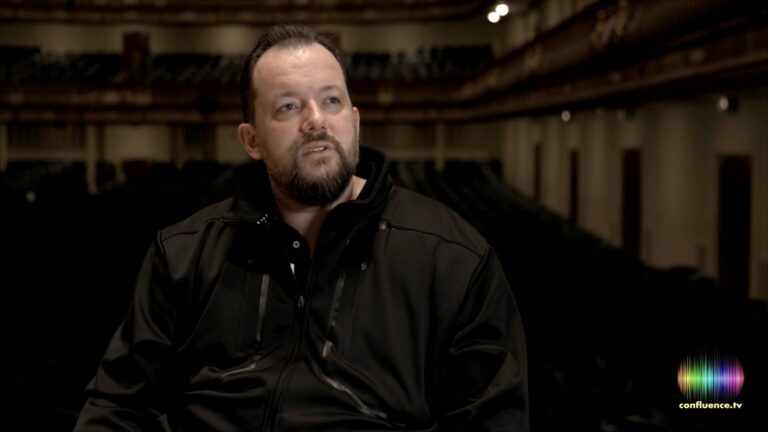
full interview_andris nelsons_7.mp4

Andris Nelsons [00:00:00] My name is Andris Nelsons and I'm a music director of the Boston Symphony Orchestra. I'm also a Kapelmeister Gewandhaus Orchestra in Leipzig in Germany.

Speaker 2 [00:00:13] When you come on the stage here, what happens, what do you feel when you walk onto the stage?

Andris Nelsons [00:00:20] Yeah, I mean, coming and entering this stage, either it's empty, like now it's practically empty, or, of course, coming in the rehearsal or coming to the concert, you enter the hall and you immediately feel the energy or any aura, any kind of, of a... Greatness and of, because what the composers have been here, how many pieces have been premiered, how many musicians have played and all that history, kind of you're aware of that. And you know, and it's so beautiful as well. So, you know and entering this hall is, I think every musician who has been in the Boston Symphony Hall. After they say that this is absolutely one of the best halls, if not the best hall in the world. I'm in love with this hall, of course, I am in love with my orchestra and they know how to play here as well. And, but also this, what is a great thing that, also about this hall that there are some good halls where it works for certain type of music making, let's say, of certain level orchestras. And then, and some holes are. How to say, it exposes so many of what you do, what you play, and they are not too much forgiving if something goes a little bit wrong, you immediately hear. But this is very interesting, the Boston Zimani Hall, this is also the hall who is, if I may say, forgiving, it's It's helping, it's... It blends so well that you hear everything, but you fear it in such a blend that it makes you so pleasant for the ear. And that's, it is a very special, you know.

Speaker 2 [00:02:45] Is the shoebox configuration part of that equation?

Andris Nelsons [00:02:50] I think, you know, we have these, I would say, these shoebox examples, like, well the second Gewandhaus was in Germany, Leipzig, was almost like this hall. And then Boston took it from that example. And of course now Boston Symphony Hall. Konzertgebouw, also also the Schubertz and the Musikverein in Vienna, they all are Schu-Boxers and I think... There is some, some kind of, uh, blend an extreme quality of sound. Coming from these shoebox constructions, because it is something of the blend of the sound, which makes it particularly amazing. And also, you sit, you go sit any place, but if you go up in the second balcony and listen there, it's... It's like a stereo, you know, you have the sound, probably the best sound you can hear is there. And it's blended so well together. And I think it is somehow, I think, it is to do, I'm not an acoustician, but I think it is something to do with the shoebox, let's say, the structure, and then. I mean, there are good modern holes as well and made in a different way and so, but still I think it remains, what is interesting and also that it remains like a secret and like a question mark. What exactly is what what makes this Boston Zimbali Hall being so great? We know it's okay, it's a shoebox, there is the material, it's wood there, but there have been holes like that and there is no magic. But here, hee hee, you talk, you can talk without microphone, sorry, sometimes talk to the audience. And it takes, you know? And of course, the sound, for musicians, it's amazing. And also, this is a very wonderful hall for singing because not all the halls are, how to say, friendly to the singers. But singers, when we do the opera, congetante version, the singers come in front, and they are very, they always say, Oh yes, it's so pleasant to sing. It's, you don't need to force it. You sing and it comes through and, you know, it's difficult to say. It's still, I think there is a secret, the secret, like Musique Ferreira as well. Of course it's smaller and they say that they have a, how you say, there's nothing but like a vacuum, empty under the stage. So that might give, then there is the sand or. But is that the reason or I think that... Knowledge of what great masters have been walking here and working and it also gives something to the whole. I don't want to say that there are ghosts of Beethoven here, but I think there is something, there is some mystical thing that certainly is part of that, because I... For me, as a religious person, I believe in certain things. Which can be actually also part of success of the whole.

Speaker 2 [00:07:30] So Joshua Bell told us that he feels like Symphony Hall, it's like a living thing, that there's something organic.

Andris Nelsons [00:07:42] Yes, I mean, you can say that. I mean when you come in and start rehearsing, it's practically almost, I would say every repertoire you start, organically you start to play, you don't have feeling before the rehearsal, oh, today we're playing that music or that music, it's going to be, again, a lot to do with balancing or. Blending and so of course the musicians are excellent musicians and of course you need to be you know they're wonderful musicians also to make to make wonderful music too you need to have a wonderful musician this is true also only without with those musicians The hole is... But there is something very natural when you come in, which is almost like hugging you. You come in the hall and you, in the rehearsal or in the concert, it feels that you feel very good. You feel also interesting in some halls, or most, very many, many halls, but you make you feel nervous, you know? You know, some hall, I don't know. For me, for example, Carnegie Hall. It's a wonderful hall, but I somehow feel, not nervous, nervous absolutely, of course I can, but it somehow feels different. I don't know why, but it's, but here you come and see, and you feel like at home.

Speaker 2 [00:09:25] So what happens when you're headed to a concert and you know the acoustics in the hall are certainly not as great as this? How do you adjust?

Andris Nelsons [00:09:36] Yeah, well, of course, one part of the orchestra's... Is of course we are going on tours, which is wonderful. I love touring, when we go to Europe, to Japan, to Carnegie Hall, and we see every year as well. And of course, we are touring in different cities, and then there are different halls. And although we've been quite, I think, blessed that there are venues we go there. Mainly of good halls. Not, of course, Boston's even is a special. But I think orchestra musicians, they, what is also interesting is that when they play in the other hall, let's say in Paris or the new hall, or in Hamburg, you know, we played in Elbphilharmonie, that still. Even though it's a different acoustic, it's good acoustic and it's nice holes, you still hear the Boston Symphony with its sound, which reminds you of the hole here. And I think it is great. It means, of course, we have a great hall and we have great orchestra because If Boston Symphony in Hamburg, for example, or which is wonderful hall, would sound absolutely different, you can't tell what good, but absolutely different. That would mean. That the hall itself is giving certain sound to the orchestra. But I think as you can feel the DNA of Boston Symphony in other halls as well, the musicians know how to adapt to create the sound world. What is the DNA in Boston Symphony? Of course, each hole... Which is also to add something and it's some holes are more transparent. Some holes are, you know, more reverberation. And I think, but that's one part of the job as well. You are used to get acquainted and to get quickly adapted to the different holes. For example, we on a tour, first tour, concert in August, end of August, we'll be proms and of course Hewage in London. It's not the greatest acoustic at all, but it's for the event, it's nice to have. And somehow, it works because the audience are giving the energy and of cause each orchestra has their own DNA so you can still play. But of course we are lucky. Lucky in Boston having this amazing concert hall and amazing orchestra. That's, you know, and it's so great to see audience and more and more, more and of them because thanks God, you now, the corona is, you know at least reduced. And you can see again people coming and. And you can, again, experience the sold out concerts and people applauding and it's wonderful. And I think it's also friendly to the audience. I have a feeling because whenever the seats are comfortable, well, at least that I've experienced. And yeah, it's... Wonderful.

Speaker 2 [00:13:52] So I saw an interview with you that I found on YouTube where you talked about conducting as being almost mystical. It's a very special kind of communication without words. Yeah. Would you talk about that, please?

Andris Nelsons [00:14:09] Yes. Again, conducting. What is conducting? You know, when you look to the conductors, they have a different, they're different conductors. One is tall, one is short, one has arms longer, shorter. So, but it is, in more or less, it is a beating time. Showing the character or articulation or that would be trying to describe what it is. But we realize and we know that that's not what music is about. And that's why conducting as a profession is quite mystic. Because. For example, you have two conductors who conduct the same piece with the same orchestra. And you see that orchestra plays differently for one ocarina than the other. And it is not just because one is showing faster, not only about the tempo, there is some kind of feeling of essence, of soul of the piece. I think this is, the magic comes and the mystic system comes from, I think the music is much more just as a sound world and music is like a... It has a soul, you feel when you conduct. What is between the notes. You try to learn and to find out and to analyze what is the essence of that. And of course, we do professionally, we need to conduct or everyone plays its instrument and there is a, certainly it's one, two, three, four, one, two, one two, that's it. So few beats you need to learn. But then you need some help with your hands, with your energy. To transform what do you think the composer wants to express through the piece. And then, and that's, I think the task of the conductor to encourage musicians to. You know, to encourage to... Inspire. Sometimes you inspire from, you get inspired from the musicians very often. They play, they have some ideas. Yes, it's very nice. So you support the idea of some soloist plays solo clarinet or boy or... Oh, yes, I will go with him because he's very... And sometimes you take a lead and you go... So basically, it's what's between the notes, and that's, I think, where it is mystic, because if you perform notes in the right time... In a right dynamic how it's written, it will be just the piece, how it is written, but without soul. You need to, as a conductor and as a musician, we need to get to the soul of the music and of the piece. And how to get that, that's a mystery and it's video. Charismatic and very... Uh, more dictator wise, probably older generation and, you know, previous generations where, you know, the Toscanini who was really good shouting to me, but of course there is excellent results. And then, so it was a different time. And of course you, you can't really shout to the people. That's not right. And, and it, but, but again, it shows that not that the shouting was helping with anything, but just his personality and Because at the same time Bruno Walter who was a very polite man and he was and he got wonderful results without shouting So that's I I think that's just a personality each What is I think clear if you are a conductor? I think all of them certainly have a personality. Some might say, some might seem shy, some might see. Demanding, some might be very diplomatic and very intellectual or very emotional, but... Somehow each of them have to be personality, you know. Because you're coming in front of 100 people and more and... You can't get, you know, you need to have some ability of communication, of course. But that part, communication with the orchestra, communication with the audience, that is already, I would say, not difficult, but that's very important. But then, and then comes this communication, but you communicate. And you talk about the soul of the piece, and that's a communication in a very intimate, intimate, how to say. We are touching the intimate strings of the composer and trying to find out what he or she wanted to express. And still it is subjective because the composer, I think the composers, of course, they wrote on the paper the notes and... Some of them, like Gustav Mahler, for example, he was also a great conductor. He was very, he writes very, how to say, very clear for conductor what to do, you know, dynamics and musical comments. But some composers write very little, but it doesn't mean that they don't feel that the music should. So, what I also wanted to say is that... That I think the composers, when they compose a piece, they kind of also assume. The artists who perform it would feel where, would feel and would find the soul of the piece and would be able to bring it to the audience. And they believe that if it's a good orchestra and a good conductor and a good day, that would happen. You don't need always to write, oh, one second, because that's not in... In mathematical, how do you say, you can't find the soul, I think, in that way. I think it's emotions. And there is this mystic, yeah, and that's...

Speaker 2 [00:22:42] What is it about sound itself, these waves that travel through the air and can make us

Andris Nelsons [00:22:51] Yeah, I mean... Also, of course, the... Boston Symphony, you know, of course having this amazing hall, it also has this, you know, very, you already know worldwide, always been known about a very special sound, you I think it's a combination, of course, of the hall, but also the tradition of playing in this hall since it's very soon to be 150 years, and, well, soon, for eight years, seven years. And the tradition also of the repertoire. Of course, Wettweepertwaar is always wide, but let's say it's, of course it's an American orchestra, but there's also strong influence of French tradition because of the conductors who have been, and of course that gives it a more transparent, but there is also Germanic tradition. Leinsdorf, for example, was here, and Nickish, and that gave maybe more of the richness kind of of of the but there is always next to this richness there is transparency which is very not it's not every orchestra who who can be so how to say uh so diverse because when you when you have this this transparent beautiful beautiful string playing but very Transparent than you You just hear it and... You know, the way of vibrating and not pressing the bow, which makes it feel very, very weightless, but very, beautiful because they know how to make the sound beautiful and they use, of course, the hole and you use the hole and you hear, I think very much is, of cause. Sound and hear, of course sound, immediately of course it's a hearing, so it's important what do you want to hear, because, and then you hear your sound before playing, so you, I think that's kind of a feeling I have, so, it's not like we start and then better, better, better, but you have the... You have the ideal of what you want to hear and and then you are playing that sound and then it becomes this very special sound and it's of course string instruments very much but also woodwind instruments and brass instruments, there was different tasks of percussion instruments but in general I think this is a great, great hall for all instruments and it is really and for singers so we can really do the variety of things, you know.

Speaker 2 [00:26:22] Alita, Kang, and Nick were standing on the stage and they were talking about something I didn't understand which is a 40 millisecond delay from what Alita plays to what can be heard in the back.

Andris Nelsons [00:26:43] Yes.

Speaker 2 [00:26:44] What is that for you?

Andris Nelsons [00:26:45] Well, that's the same, you know, how to say. Like the car, hee hee ooo ooo further, further it sounds different so it is actually about the ensemble playing and because orchestra is organism of of hundred people or more depending on repertoire and of course when you sit as a concertmaster a little for example, sitting there. And then the woodwinds are sitting maybe five meters away, and then the brass, 10 meters, and double bass is there, and they need to play together. Of course, the conductor can help, I mean, I can do the beat, but it's also the feeling of ensemble playing, so understanding also sometimes that... If somebody is playing here and they hear that the wind or brass instruments are a little bit behind, it sounds a little bit behind because they are further away. They can adapt and a little bit micro-adapt because, and then to make it work. Because it's, if you would say, oh, I'm here, I'm playing, this is my position, I'm what conductor shows, I am right. That's another mystical, not as mystical, it's quite from the physics and you know. It's already natural that the instruments who sit further are coming to the place where the conductor is a little bit too late, but they also, those instruments who are further, they know that they should be a little anticipating. So it means very often the percussion or brass instruments play a little, almost before the conducting beat. And it's very interesting. But such adjustments people make and depending of course on the hall as well. This is somehow again, one of the greatest halls which is really helping a lot. It's not so typically, let's say, There's a distance, but it's not as, I don't know how many seconds, how many, but it is not as different. I find it very difficult, a wonderful hall, concert hall, but to play, you know, the double basses, saying things there, and it was somewhat like a violin, you know. I remember as a guest conductor I had to conduct very, you know, it's not together and they don't hear each other and this is not the case here. The great thing is that here you basically can hear or if you don't here that means somebody is playing too loud and then we find, okay, who has a melody or who, what do we want to hear? We want to here the first of all, then maybe we, everyone else in that moment is listening to that and then suddenly the theme goes to somebody else and so it's very interesting. It's almost like it's like I don't know it's I can't say it's like making a movie but it's something very creative and beautiful in the process of rehearsal because that normally happens in the rehearsal where you know when we adapt and make a balance and, you know... The ensemble playing, but it's very much comes, playing in big orchestra, it's important that the thinking is like in the chamber music. So, because in chamber music, you hear a voice and you adapt to each other. And the same is in the orchestra. If you close eyes, it doesn't work. You have to listen. And the the same for conductor, you have to where you have to listen and you have to know where orchestra need your help, or where orchestra needs your encouragement and where you should not disturb them as well because that's very interesting, very interesting subject and I think. I would be very, very curious to talk to Mahler because he was a great, great, good conductor. I mean, maybe genius, genius composer, but also, so, you know, because...

Speaker 2 [00:32:19] Do you remember when you first fell in love with music?

Andris Nelsons [00:32:23] I think I fell in love with music very early, like, I mean, my parents were musicians, but very, very concretely, I was five years old, and my parents took me to the opera house that was in Riga in Latvia, still Soviet times, and they took me the opera Tannhäuser Wagner. So, that was my biggest... Experience, big experience with a three hour long opera and I was crying and I loved that music so much and so that was the biggest exposure early. What I think about technology, personally, is that It really practically helps to, how you say, to transfer or to... Music be heard, you know, in different continents at the same time, and where the people who have no chance to get to certain places, they have a chance to hear or to see and to listen to the concerts or anything, and I think that's a very positive thing of course. But by saying that, I still think that there is nothing really... What can substitute exactly experience in a concert because that's where, you know, you sit next to each other and then this adrenaline feeling and expectation in the orchestra comes on and then, so that's something you can't substitute that with the technology, but technology now, I mean, I've heard such an amazing sound you can make and the feeling that, you know. You know, continents and, I mean, that's a great thing. And I think that it should be, also the recordings, I think it's very, very positive and now it's so advanced. I mean smaller cameras, smaller, and also what it was very good, also Boston Symphony invested in in putting the cameras, small cameras, which can be used and are used for streaming some concerts or... Again, interesting to see for people who can't come. What is interesting is I think we need to think about the people who we still hope that in this world after after 100, 200, maybe 1000 years, people will still, they would have an opportunity to see how what happened, I mean, what did we do, you know, because we are so happy to see, you Koussevitzky or some recordings, or of course, Osage, or Zaovo, or... Of great times of Munich. So I think that's very important to have a legacy for the future and also for the generations to come.

Speaker 2 [00:36:08] I have two other quick questions. Where does the human voice fit in the great scope of musical instruments?

Andris Nelsons [00:36:16] I would say the human voice as an instrument is the most sensitive instrument because it is your vocal cords which is medically very fragile. I think maybe the vocal thinking is the closest to the soul of the piece, because anything you can, you can sing. I always, when I conduct, I... I sing in myself the things we are playing. And I think I was when I was studying trumpet or I was starting singing or when we asked for string instruments or some beautiful place, and we all like to say, you know, we should sing, sing vocally. And then the sound is absolutely different, you know, so it's singing as a basic for everything. Some people say rhythm is a basic. First came rhythm and then, which might be interesting to discuss, but I think the first is you hear somebody singing and that gives you... And therefore, it's a very, very sensitive instrument.

Speaker 2 [00:37:58] Would you just say again, make the point again about what happens between the notes, what's not written down?

Andris Nelsons [00:38:07] Yeah, I think, as so many musicians and conductors, and I think you usually say, and it's very much true that... The most important is, of course, we have the notes, we have written notes from the composer, some directions and so, but that is only the piece of paper, and of course we can play the notes and so. I think the most important is to find what is between the notes. I mean, saying that... Character, what metaphor, what... What is the soul of the piece, what the composer wanted to tell with these notes, using, of course, using this vocabulary, which is the notes in this case, to find what is, how to get to the soul of the peace, and then, and that's a mystical. Magical and that's that's what makes music so always unique experience, you know. Even if you have had a good concert, you constantly start each concert again from the scratch to create the atmosphere again. And that's amazing.