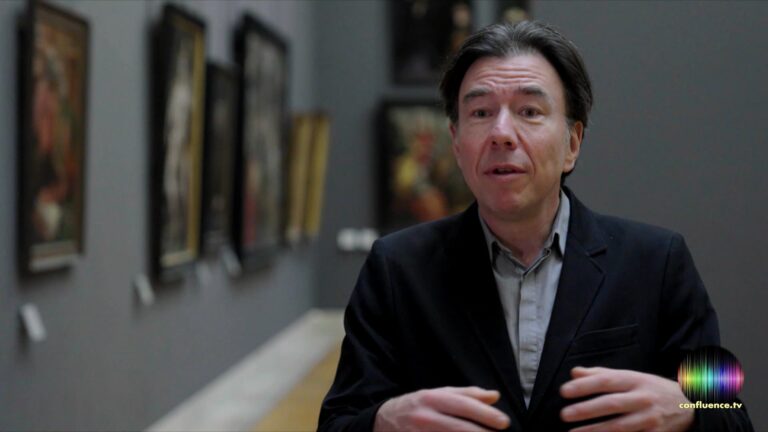
full interview_jerome neutres_3.mp4

Speaker 1 [00:00:00] So yesterday we talked to the gesture to the robots performing the background work and you said these are the artist's pencils.

Jérôme Neutres[00:00:14] In the Louver, which is a universal museum, the largest in the world, you can see from ancient Egypt until the computing art, the mobile by Elias Crespin, for example, that all the history of art is a sort of odyssey of invention by the artist taking every tool new pencils. Since the prehistoric caves, the main issue for the artist has been to find out new tools, new techniques, in order to create, to invent new shapes, new forms, new images. In the Louver You can see through the centuries this amazing odyssey of artists inventing new images through new techniques. Today we have artificial intelligence and the robotics and we can see here in the Louver the masterpiece by Elias Crespin which testifies that the latest technology is also recognized by the Louver. The latest technique for the artist to express their vision of the world and what is the best to express today digital era vision of world than this computing art. But in the Louver you can see that there is a permanent search, a permanent quest for new technique to achieve. The expression of the world each artist tried to express. Today, artificial intelligence, software, and robotics are the latest techniques for the artist to express their vision of the world, of today's world. We live in a digital era, and so there are no better techniques than AI and robotics to express. Our world. The Louver as a universal museum can show to the visitors all along the centuries this permanent and amazing series of inventions by the artist to find out the right technique for the right expression of a time.

Speaker 1 [00:03:09] One of the things that interests us is that often the technical invention comes first. It's invented from robots were invented to build a car. So the artist says, I can do this with my heart. This is an example of probably. Okay.

Jérôme Neutres[00:03:31] The artists are pioneers. A great artist, for me, is the one who invents or reinvents his art. And, of course, the artists are like sponges, you know? They observe the world, they observe the history of the techniques, and they will take everything they need to try and find out and experiment new forms, new imaginaries. And you see in the Louver, how stones, marble... Would print artificial colors, natural colors before. Until the digital world, every single object, technique, technology has been at some point used by the artist to create the new form, the new shapes, the new colors, new perspectives, which... Can open new ways for the art and the expression of the singular walls the artists create for us.

Speaker 1 [00:04:45] To form from what a regular person, an imaginary regular person to sometimes perceive this digital art, this computer-generated art as art. It seems to be.

Jérôme Neutres[00:05:01] In every period of the history, and the Louver is the best place to testify of that. Invention, every new technology used by the artist, is seen at first as very suspicious. Take photography and the Louver as an amazing collection of vintage and ancient photographies, which are definitely amazing works of art. But in 1862, the academic painters and the Nazi. French academy and museum will say, no, no way. Photography is a engineering, industrial technique. It has nothing to see with art. Like at some point, they used to say for the print, printing, when the industrial print was invented. Nothing to see with art, because it doesn't come from the hand of the artist. So it is logical that the AI and robotics techniques... It is logical, therefore, that the robotics and AI techniques are seen also as suspicious today. But it is interesting to see that the curators of the Louver, for example, welcomed some works made by digital computing art, because it is definitely today recognized as the main field of today's creation.

Speaker 1 [00:07:01] I'd like to get that.

Jérôme Neutres[00:07:03] Yeah.

Speaker 1 [00:07:03] Which is, I like that you're trying to start and see what's in every area in the room. There's a pushback. You don't need to mention the link if you can say the photography. Okay, okay, yeah. Photography came out. All the classes came through, so this is not hard, so you can see it. Yeah, yeah, yeah I like they didn't come from the table.

Jérôme Neutres[00:07:27] Shorter, okay, in English, okay.

Speaker 1 [00:07:37] Because we are talking about the acceptance of new technologies.

Jérôme Neutres[00:07:43] Today, people seem a little bit suspicious when you talk about robotics and AI as the new tools of art. But look at every period of the history of art, every single new technology raised some questions, debates, photography in 1862, the French National Academy, all the curators. No way, photography has nothing to do with art. It doesn't come from the end of the artist. It was before the same thing with prints. It was the same before the thing when after the natural color the painters will create for their painting, you had artificial ready-made tube of colors for the impressionist. Then people will say, no, that is not art. This is ready-make colors to make paintings. It is. Garbage, you know? So it is normal that time needs to come and to prove, of course, the legitimacy and the relevance of every single technology. Today, even in the Louver, you have in the permanent collections some computing art masterpieces, like you have Pompidou Center, like you are in MoMA in New York, et cetera. Personally, I don't like the term digital art, because in today's world, where everything is digital, this is not, I think, the right expression to define a specific kind of art using AI techniques and robotics to create new form of art. Everything is digital in todays world. Our communication is digital, all the cinema is digital. All the photography is digital." So I prefer the term of computing art. I tried to convince people through articles and essays that computing art is a much more relevant expression to define specifically all the art computer made. All the art, computer based. In fact, for many artists, using algorithms, using self-generative programs, using code, the main base and the common point is the computer. For me, the computer is the new palette of the artists of the 21st century, and it is not a school of art. It is not movement. It's not like a new cubism or a new surrealism school. It is a revolution in the technology of art, which can open highways for the artist and generate many various kind of arts. You see that sculpture, installation, paintings, videos, you see many kind of work, both immaterial and material. Immaterial versus material is another dead-end debate. Because in fact, as we know, and the philosophers have said that for a long time, immaterial is another form of material, is another materiality. And it is interesting to see that the computing artist are all materializing at some point the result of their research by a visual form. Yeah, yeah, yeah. Okay.

Speaker 1 [00:11:54] So the question arises, when you say that name or anyone, I don't need to name them, just the type. Who is the real creator? Is it the artist, is it the computers, is the robots?

Jérôme Neutres[00:12:11] Like in photography. I will take an example. I own personally the same camera as Irvin Penn used to shoot his photographs. Sadly, my photographs have not the same success as Irving Penn's photographs. The pencil doesn't make the painter. We know that since the beginning of the story of art. It is not the tool which will make the genius. It is the vision, the eye, the innovation, how brave an artist is to impose a new world, a new expression of art and of the world. The computing art, it is the same thing. You can have the best computer, you can have most amazing software, you can all the latest robots most sophisticated. That doesn't mean you will create a masterpiece. What is important to know is that today you have hundreds of thousand artists using AI and robotics to create new forms. I see in the school of arts, I see in the studios. Computers everywhere. But of course, and that is the logic of art, you have to search a lot to find out the masterpieces. And this is the role of the museums, of the curators, and of the collectors.

Speaker 1 [00:13:49] So when you look, when you're looking for your own taste as well as advised guidance, how can you tell a masterpiece from, you know, to something that's kind of clever?

Jérôme Neutres[00:14:04] There is a huge responsibility for a curator to select what could be one day recognized as a masterpiece in art. This is really the big question mark. I have some parameters to analyze the pieces I see. For example, I think that innovation is a key word to select. For example, for instance, I consider innovation and creativity as two main parameters to select artworks. For me, a true great artist is the one reinventing his art. After all, there is also a question of subjectivity and taste can change. And sometimes you make some mistakes maybe, but after time will make its work and you have to continue to search on your way. And when I visit museums such as the Louver, I see that history of art is permanent quest of creativity and what remain at the end of the day are the artist. Created their own signature, their own style. You arrive, you see a Raphael, and you know that it is a Raphaal. You see a Leonardo, you say it is Leonardo. You see Monet, it could be only Monet. You see Rodin, it would be only Rodin. You see Crespain, it can be only a Crespin.

Speaker 3 [00:15:58] Specifically about this, because we have a general question. When we was young, we didn't have the authority to have this kind of approach. Yeah. One of the things we were talking about, and I think that's something that we forgot. You talked about generations. And he said, oh, we have to go. What is this important? And he says, oh well, kids love it. And my grandma loved it. You know, and I think you went on about how important that was for molding generally.

Jérôme Neutres[00:16:40] Another parameter to select artworks for me is the universal dimension an artwork can get. You need to be a French man of a certain generation in a certain social context to understand an artwork. This is not a masterpiece. What I like in some works we have seen with Gaulens in computing art, for example, is that those works can speak to someone born in Venezuela or born in Paris, to a kid of five years old. And to a grandmother of 90 years old. This is called universality. And at the end of the day, when you think of the masterpieces of the history of art, they have also, they're not consensual, but they're this universal dimension, which is, in fact, maybe the biggest challenge for an artist. How to speak beyond this time? How to to speak beyond. His background, how to speak beyond the period, how to speak through the times, you know, how to be more relevant tomorrow than today. Again, it is not, digital art is not more prepared for that than photography or painting. After there is a big mystery of the creative genius and who are the artists who can reach this universality and this creativity. What I know is that today, Most advanced artists, the most talented artists today are using AI and robotics because they are pushing the borders of art history through these mediums. Frankly speaking, I don't see. Major artists using very old fashion techniques in art.

Speaker 4 [00:19:09] So related to that, technology is always considered destructive. Is the computer a more destructive tool in other ways?

Jérôme Neutres[00:19:29] Every technology is considered as, okay, every technology per definition is considered as disruptive. Has to be disruptive. This is a great parameter to find out a masterpiece is how much this artwork was at this time disruptive and is still maybe disruptive. Digital art, what we call digital art, meaning the computing art, the computer-based art is today, undoubtedly, most disruptive technique of art. It questions also our own use of the computer in our daily life. Computer has become the best friend of mankind. We talk through a computer, we manage companies through computers, we create aircraft and all industrial goods through computers. And art, of course, is following the same path, and artists have a great challenge to transform those techniques into a new palette of art.

Speaker 1 [00:20:58] So I'm going to ask you about some of the other issues in that, and the other questions as well. Just give us a little bit of what you see. Why don't we start with the two people that you brought you in to think. So tell us about Elias.

Jérôme Neutres[00:21:22] For me... For me, Elias Crespin is a little bit... Okay, okay. For me, Elias Crespin is the calder of the 21st century. He proves that still today you can invent a new form of suspension, a never seen sculpture. And it is also a great thing for France that this Venezuelan artist has chose Paris as his new base to diffuse his art. Has been showing, no, I showed Crespin the first time in the national, I show Crespain the first time in the National Galleries of the Grand Palais in Paris. It was like a revolution. It took me seven years to impose this artist in the programs. Everybody will say, what are you saying? Everybody would say, he's not an artist. Everybody would say, he's not an artist, he is an engineer. I say, no, look first at the works and let me a window of programs to show it to the art critics, to the audience. We showed a piece in 2018, a tailor-made piece from large stairs of the Grand Palais. The director of the Louver at that time, came to see the show, and he fell in love with that, like 400,000 visitors. We had so much praise that after everybody will consider Crespin. Artist and no one will tell more about the problem of because there is a computer it is not the artist behind that. It is obvious when you see a Crespin work that there is tailor-made. It is obviously when you a Crespin work like the one in the Louver, for example, that you are facing a never-seen sculpture, which is a masterpiece. Talking to many generations and to people from all over the world. Today, you can see at the Houston Museum of Fine Arts, a new Crespin, incredible as part of the permanent collection. You can see Crespins in various museums. I exhibited Crespon in 2020 in China, in Beijing, after the retrospective Picasso in the major contemporary art museum, and people were amazed. Of the creativity of this genius. I don't mind a little... Okay, okay. I can explain the visit of yesterday, very shortly. Okay, I will speak about guidance and why he is very good.

Speaker 1 [00:25:18] Yeah, we'll get to see.

Jérôme Neutres[00:25:19] OK, OK, so. Okay, okay, if you want it in French, tell me. Okay, I have the sentences. I will make it all shorter, okay. Guy Ullens is today the eldest collector in the world. He has been collecting art since he was 25, 62 years ago. So, Guy Uellens' collection is in fact a series of collection from antiquities until digital art. My role has been when Guy Uollens started to collect digital art, he asked me to put together the best artists from all over the world. We have today, like some 30 citizenships of artists. And for example, we went in the studios of Miguel Chevalier, Franco-Mexican, and Elias Crespin, Venezuelan born, in the framework of his Gaulens Paris trip, to see new pieces. That could join the collection. What Guy Huland loves is to find out new forms and new artists. For the last 60 years, he has been collecting always the pioneer artists. In the 1960s, he was collecting Vasarely, Fontana, Paul Burie. Now... Obsessed by digital art because he's convinced that it is in this field of the computing art that he will find the masterpieces of tomorrow.

Speaker 1 [00:27:22] But tell us about the details of it. You've already got it.

Jérôme Neutres[00:27:30] Miguel Chevalier is one of the leading pioneers of computing art. He's 65 years old. He started very early when he was at the school of fine arts of France saying, I want to make painting with computer. People thought this guy is. He had to go to some scientific industrial groups to borrow some computers because at that time in the early 80s, at that time, in the 1980s, for Miguel Chevalier, it was impossible to own a computer. A computer will occupy all the room of this museum. So, he had to make partnerships with some industries and with... Some scientific research groups in order to be able to experiment this visionary feeling he had that the computer could be a new palette to open new ways and new borders for the painters.

Speaker 1 [00:28:45] Tell us about his heart.

Jérôme Neutres[00:28:47] Yeah, yeah, yeah. The colors and the material, the colors and the canvas of Miguel Chevalier is the code, the computer code. He's working with the computer code as a painter will create colors. Today, he develops some original softwares and those programs are the works by Miguel Che valier. Whatever you screen it on a digital screen, on a large projection, the works is this coding program that this artist has created, tailor-made to express his vision of the world. Soulages, who is one of the most classic and important artists of the 20th century in France, turned 100 years old a couple of years ago. And it shows... One senior artist of France, Pierre Soulages, also very well known in the USA, turned 100 years old a couple of years ago. For his great anniversary, he invited Miguel Chevalier to show in his museum in Rhodes, whose digital work. Why? Because Pierre Soulage, 80 years ago, was a pioneer artist also. And he considers that today, his successor is the one inventing again a new form of painting.

Speaker 1 [00:30:51] In the scenario you're feeling about the end of the work is that it's interactive.

Jérôme Neutres[00:31:03] Miguel Chevalier is adding to the self-generativity in his work, the interactivity with the audience. But in fact, if you think... But in fact, if you think of it, the great masterpieces of painting are always interactive works. Art is a question of dialog with a masterpiece. It's always a question interactivity. And this is a great issue for Miguel Chevalier's work to remind us. An interactive discipline, an interactive exercise, that the viewer is making the painting, as Marcel Duchamp was saying. And I can say about generativity also. Generativity and the use of algorithms in Miguel Chevalier's works allowed him to show the time passing. When you think of Monet painting 38 times the same cathedral of Rouen in the same frame at a different hour. Oh.

Speaker 4 [00:32:45] For situational reasons, please keep your bags and joshua and montanis with you at all time. All passengers left, anytime left, must be immediately notified to use their staff member. Thank you for your patience. For safety reasons, we need your help and many of your personal belongings. Point to the museum's restaurant any object that seems abandoned. Thank you for staying with us.

Speaker 5 [00:33:44] Okay.

Jérôme Neutres[00:34:10] Yeah, okay. Generative programs and the use of algorithms is a unique opportunity. Generative software and the use of algorithm are a unique opportunity for Miguel Chevalier to show us the time passing. When you think of Monet, painting 30 times at the cathedral of Rouen in the same frame at different time of the day. To show the time passing. Self-generative programs allow the painter as Miguel Chevalier to show us the time passing in one work. You are facing the unlimited artwork perpetually regenerated by itself.

Speaker 1 [00:35:05] So one more question. So we have these paintings here 600 years old. You can go and see and look at them. They're probably very much like the day they were painted. What about all this stuff that requires technology, computers, and systems that may or may not survive?

Jérôme Neutres[00:35:27] An issue for the museums. Conservation of the works and the restoration of the work. You see in the Louver fantastic paintings, sometimes 600 years old. But behind this show, you have a whole laboratory in the louver, conserving, preserving, maintaining the works. There is something called time. Which is of course affecting every single object and every single human being. Photography has to be preserved very carefully. Paper is becoming yellow, sometimes disappearing. You have also this issue for digital art and computing works. We will have in the near future to preserve those works, to make copy. Of it to make sure that the systems are kept well in order to maintain this work. But this is something that we have seen every time with every single technique.