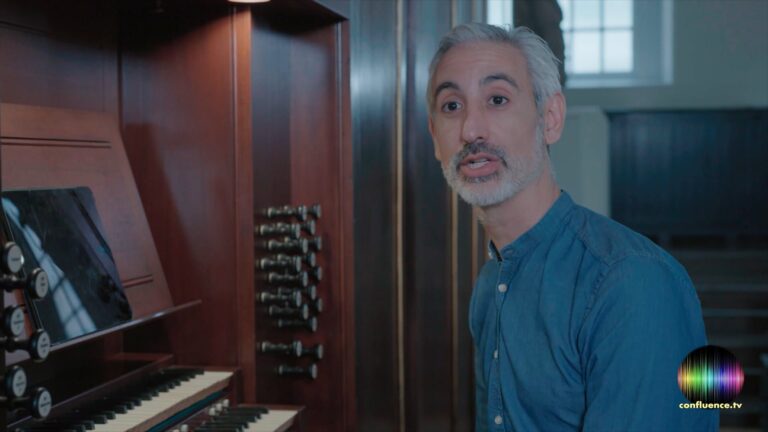
full interview_avi stein_4.mp3

Speaker 1 [00:00:00] So you know the series is about art and technology. And I think you can figure out why you were interested in the pipe organ. What is it about the pipe organs that brings all this stuff together?

Avi Stein [00:00:17] For For many centuries, the pipe organ was really the most complicated piece of technology, certainly in the Western world. When I was a student in France, in graduate school, I lived in Toulouse in southern France, which is the European airspace capital. It's where Airbus and where they make rockets for the European Space Consortium. And we used to have these engineers, these aerospace engineers come down and look at the big 19th century instruments. And there was a joke at one point, one of them said, 747 has nothing on one of these. Now obviously that's an exaggeration but I think it it brings to light the idea that again these were until electronics or until big industrial machinery these were the most complicated pieces of machinery certainly in Europe.

Speaker 1 [00:01:05] And it's complicated machinery to do what.

Avi Stein [00:01:09] It's a complicated piece of machine. So the pipe organ is a complicated piece of machinery because it allows one person to create a wealth of sounds, many different colors, but also to fill up large spaces that they were originally designed to do. We know going back about a thousand years that they filled up the big cathedrals in Europe with transcendental sounds, with divine sounds.

Speaker 1 [00:01:37] Yeah, let's just talk a little bit about technology in the service part. And feel free to, you can give longer... Got it.

Speaker 3 [00:01:51] No, no, that's all right, I can, I just think how I want to...

Avi Stein [00:01:58] For the longest time, organs have been, obviously, associated with churches and these massive cathedrals in Europe, which were, obviously again, another service of technology for creating art, for creating the unimaginable, for bringing the divine down to earth and letting the earth reach up to heaven. The organs were the musical embodiment of that. So in all these European cathedra going back into. The 11th century or so that organs filled up the sound of that so they were the auditory equivalent of these soaring magnificent spaces and they allowed single people to, on their own, to create in music what the people were seeing with their eyes.

Speaker 1 [00:02:45] I'll be a little bit out of the way about this idea of a single person. Yeah. Yeah, I like the idea that you're talking about a single person being able to fill a

Avi Stein [00:03:18] So on its own, an organ is essentially an orchestra of one that you have at your disposal as many different sounds and colors as a hundred person orchestra has at their disposal. And by pulling all these different stops and playing on different keyboards, one person can create effects from the smallest hushed intimate moments to the big massive sounds that people associate with the organ.

Speaker 1 [00:03:44] Now, this must have been pretty amazing, 300 years ago.

Avi Stein [00:03:47] I think it was amazing 300 years ago, it must have been incredible a thousand years ago to most people. And many of the organs at the time were of course the pride not only of the churches but of the cities. For a lot of European capitals these were the great civic examples of what made these cities so great and of course it was a great point of pride for them.

Speaker 1 [00:04:15] So why are they still around? Why are they so extinct? Why are we working?

Avi Stein [00:04:24] I think organs always tried to capture the unquantifiable, the idea of something beyond the human ability in music. If we have the intimate connection between a person and a violin or a singer and their voice, the organ, I think, always attempted to go beyond what either a single person or the collective of humanity could do to create something that was the divine, which why they were often associated with churches. And so I think that still stands today, even though with technological advancements and certainly electronic sounds, we can get more possibilities, but something about the combination of the analog technology, the acoustic technology of this, which is human in many ways, and the massiveness of it and the complexity of it, I think, bridges for us. The human and the transcendental.

Speaker 1 [00:05:28] Can you say that again? That was good. Let's get another one. Okay. It's like, why, why are pipe workers, you know, something an old machine buys itself in our lives?

Avi Stein [00:05:41] Pipe organs have stayed around for this long. I think even despite all the advancements that we have in technology, we can create more sounds. We can create louder sounds today with electronics. But somehow I think the connection between handmade instruments and the acoustic properties of this bridges the human with the complexity and the massiveness of this sound to the divine, to the otherworldly.

Speaker 1 [00:06:09] And what is the, are we now living out the life of one year ago?

Avi Stein [00:06:16] Organs today incorporate a lot of technological changes that have come about in the last 50 years or a hundred years or several hundred years, but essentially we're still using kind of medieval technology. Basically, it's the same instrument that it was many, many centuries ago. You still have. Tin whistles or wood whistles that make sound. You blow air through them, you hit a key, and it allows the air to rush in. We no longer have people pumping the bellows by themselves. We now have machines to do that. And sometimes the connections between the keys and the pipes can be electric wires rather than physical pieces of wood. But essentially the basic idea of how the music is made, how the sound is made has not changed very much in many, many centuries.

Speaker 1 [00:07:07] So does this mean that you can't really make it in the factory per se, it can't be a family line, it's a family-made artisan?

Avi Stein [00:07:18] Most shops today that make organs are rather small. About 100 years ago, there could have been, about 100 years there were factories for this when it was the heyday of the organ and they were building many, many more of these. And just like big piano companies, Steinway, for example, you could essentially call what they do a factory, but everything is done by very skilled artisans. And so you could make. You could make these things in factories, but I think you lose some of the qualities. I'm not sure that's the most interesting version of it. Let me start up again.

Speaker 1 [00:07:55] We have the footage of you, we didn't go there, but there's a gym shot in Chattanooga, and I think what we're looking for is the continuity of manufacturing work, the technology, they're still doing it the old way.

Avi Stein [00:08:15] Let me put it this way. To create very beautiful sounds and to create a connection, a physical connection between the player and the instrument requires, of course, great skill by the builders, and these being musical instruments, to make something that's not merely just sounding but to make something that is really beautiful and something that doesn't sound like a machine, rather sounds like an actual living organism requires the same skills. And the same artistic quality today that it did many centuries ago.

Speaker 1 [00:08:47] I was in the... We were waiting on Sunday for you to come and do the voicing. I went into the main church and you were playing and the choir was singing. I was raised atheist, okay? Why did I get that thrill? What is it? What's going on?

Avi Stein [00:09:06] Um. I think certainly today we all live in a very multicultural society, certainly much more than it would have been at the heyday of these instruments many years ago. But I think as we encounter things that we didn't grow up with, whether we were raised secular or religious or depending on which religion, we can certainly appreciate things from other cultures and. And going in and seeing something done particularly beautifully within its own context, even if you weren't raised that way, you certainly understand the power of it.

Speaker 1 [00:09:40] There's just something in it that's thrilling about it, even if I wasn't interested in this. Right. There's something really thrilling about the sound of the organ in the big space. Right. They just sit talking.

Avi Stein [00:09:50] I think in the same way that you go into a big beautiful building, whether that's Trinity Church here or whether that is Grand Central Station and you look up at these soaring vaults and it's not quantifiable but it certainly is undeniable the effect that the space has on you. I think organs, organs again are the musical embodiment of that space and they fill the rafters of these big beautiful buildings with a variety of sounds, again either from the intimates to the majestic. And I think that has always had an effect on people. In the same way that we look up at the ceilings 60, 70, 80 feet above us and just the space between us and them is something that is undeniably impressive. But you can also look at little details, perhaps a little arch or a little window off in the corner and be impressed by that. In the same with the organ, you can be impressed with the massive totality of it or just something very beautiful and small on a very close scale.

Speaker 1 [00:10:58] Can an organ be...

Avi Stein [00:11:01] An organ can certainly be intimate. Let me play some musical examples. I'll start off with a big sound, perhaps something that is the stereotype of what an organ sounds like. It'll always take me a second to do this. If I were to say this is what people usually associate with sounds of the organ, I think it's the total sum, the big majestic sound of an organ. But, depending on which sounds I choose, I could go much more quiet than that. I could have something rather impressionistic, a little bit like the wind. Let me try that one more time. I'll wait for all this stuff. Welcome to New York.

Speaker 1 [00:12:17] In New York.

Avi Stein [00:12:35] Those are older than the organ. Those are $17.99. Seniority counts. Okay, in contrast to the big sounds, of course, I could pull out only a couple of stops and I could do something very wispy, very quiet, a little bit like wind. Or I could do something very sweet, a little transparent perhaps. As I mentioned, the organ is... Okay. Right, we have no idea. Right. Let me just find something.

Speaker 1 [00:13:47] You can repeat yourself. It's fine.

Speaker 3 [00:13:50] Um.

Avi Stein [00:14:01] The organ can be very playful as well. I could also decide that I want to do something joyful. Um, then. Like an orchestra, you could decide that you have one instrument taking a solo and the rest of them accompanying it.

Speaker 3 [00:15:10] Uh... Let's try another one.

Avi Stein [00:16:22] I could play a very sweet melody, a bit like an oboe being accompanied by strings of the orchestra.

Speaker 3 [00:16:53] Um.

Avi Stein [00:17:12] If I want to, I could decide on a lush texture, again, like the full string section of an orchestra. Should I do that again with the paper or did it matter? Okay, great.

Speaker 1 [00:17:51] So, are there certain composers that really seem to understand the argument when it can be?

Avi Stein [00:18:03] Sorry, let me back up. Let me just think how I want to say this. Of course, writing for any instrument requires a certain amount of knowledge of that instrument and certain composers, if they played that instrument, have certain basic tricks that they understand of how it's supposed to work. So the organ is inextricably connected with composers like Bach, of course, who wasn't himself an organist. And because there are idiosyncrasies to this instrument, very particular ones, you have to know how it works to make the instrument work. So, often times... The composers that we play who became part of the basic repertoire of the instrument, they were themselves organists and they understood it, but that's not always the case. And in fact, it was very common, especially 100 years ago, but even today, to take orchestral pieces and to arrange them for the organ and do it that way so you can get the repertoire of orchestral music. That was not written for the organ, but as I say, the organ has a certain analogy to the wealth of sounds in an orchestra, and so it's been very common to take orchestral pieces and play them on the organ.

Speaker 1 [00:19:12] But I assume the people who made the arrangements were working on it. Yes, yes. So probably some of them didn't work out. But I guess the question for us, since we're talking about technology, is the artist needs to be aware of what the technology can do, or even, I don't know if it's true, they push the technology in a certain direction by what they demand of them. Right.

Speaker 4 [00:19:37] Right. Yeah, yeah.

Avi Stein [00:19:44] Organs, in many ways, haven't changed in a thousand years, certainly the basic technology of it, but of course they have changed quite a bit as well, depending partially on technological advancements, being able to harness wind for pneumatic assists or having the organ being pumped by a machine rather than people physically operating the bellows. But esthetics have changed as well in the same way that in painting, you know, people painted in a romantic style and then expressionistic style, modern style, anything that you want to have, the basic sound of the instruments have changed as well. So an organ built in the 17th century would not sound exactly the same as an organ in the 19th century or in the 20th century. And these reflect the basic differences between the music that was composed at the time. And as you look back at the repertoire, there's often a question of which came first. Did. The instruments inspire the composers or did the changing taste in composition inspire the builders to create instruments that played those better?

Speaker 1 [00:20:54] There seems to be certain... I'm asking you actually, do you think certain cords on the organ seem to provoke a particular emotional response? Is that something you're aware of?

Avi Stein [00:21:11] I think there's always a visceral response to the depth of the sound, certainly the organ with its large pipes going up from, let me just start again.

Speaker 1 [00:21:29] I'm going to tell you, the reason, the question, I didn't open up our list because it depends on this article about death and fidelity and the voice of God. Oh, and the cord. It doesn't have to be about that, but there are things, it intends to try to comfort the God, or it's supposed to blow the roof off the place, and I don't know if that's just that.

Avi Stein [00:21:48] My assistant had the best quote, please don't put this on paper, my assistant had that best quote about that, that particular chord in Adeste Fidelis is, a white man writes a 2-5-1 chord progression and everybody goes nuts, because that's the basic progression in jazz, but we'll leave it alone at that. And it's a great chord, it really is a great cord. It's also, it is also without totally going nuts, it's the Wagner-Tristand chord, it's same sound. Um, uh, it's... Is that chord, but the Wagner's... So it's that particular one. So you could go really, really geeky about it. It's a really great arrangement. I don't know. I'm not sure I can really get metaphysical about those particular things. I think those are just sort of cultural markers. It's great moment in music. I'm I'm sure I'm gonna say that there was something biologically inherent about it The organ can create a wide variety of sounds. As I said, not just in colors, but in terms of pitches as well. So you can get very, very high sounds. Where the pipes are about that big, or you could get very, very low, rumbly sound. And the little ones, as I said, are about this big. And the big ones on this organ are 16 feet long. That's basically three people standing one on top of the other. In larger instruments, they can get up to 32 feet long, so that's six people standing on top the other, and again, these are sounds that are inhuman. Who's going to play a musical instrument that takes six people to stand one top of other? And I think oftentimes for organs, what gives people a visceral reaction that depth of sound in a way like a subwoofer that people love so much in their living rooms or in the back of their cars, having that richness and depth of sounds creates an emotional reaction that is undeniable.

Speaker 1 [00:23:50] If we said, what would be, what could you play that there's an audience here, whether they're here for religious purposes or sexual purposes, what would basically, let me show you what I can do to your emotions. What would that be?

Avi Stein [00:24:05] Um Let me think about what would be... I think certainly the most impressive part is just the basic volume of the instrument. And so we get used to the big stuff. And in the 19th century, organs were used not just for church, but they were big concert instruments and it was very common, especially in France, to use them to improvise storm scenes, big nature scenes. And in fact, a trick was built into a lot of organs at the time that you could with one push of a button. You could just make a big cacophony down low, something like this, for thunder and lightning. So at the time that would have been the IMAX film, the 3D movie of its time. And you could easily see how making something very dramatic on the organ for a storm scene. Something like that would be very impressive.

Speaker 1 [00:25:16] What about some religious music? Is there something that you occasionally have to play that really talks about the divine that you have to close them off? Maybe not. I'd have to even play family.

Speaker 3 [00:25:30] Yeah, um...

Speaker 1 [00:25:35] Like, for me, when I have a little mute, you know, that's like, just, you know, like, okay. Right.

Speaker 5 [00:25:43] Um.

Speaker 1 [00:25:46] Just try to, just try to get a sense of what our audience would kind of understand. And if not, we can come back to that.

Avi Stein [00:25:55] Yeah, let's come back to it. Let me see if I can think of something.

Speaker 5 [00:25:59] Yeah, and you got a question? Yeah, just talking about the organ that we are following, the one at the end of the chapel. So obviously they're different organs for different spaces.

Speaker 1 [00:26:09] They're different sorts because they play different kinds of music, they're suited for certain kinds of music, right? Can you talk a little bit about that?

Avi Stein [00:26:17] Sure. So if a violin has a soundboard that amplifies it, same thing with a piano, for the organ, the soundboard is the building. And so when you build an organ, you build it for that particular building. If the building is large and magnificent with soaring vaults, then the organ needs to match that. If a building is intimate and personal, like the little chapel that this organ is built for, then the organ needs to do that as well. I don't know.

Speaker 1 [00:26:53] There's some kind of music that is certainly better.

Avi Stein [00:26:57] Uh, certainly. Sorry, sorry, I have to think about what I have to say. One of the reasons that I asked Ralph and Bruce to build this particular instrument in this beautiful little space is the gem quality, the jewelry box quality of this space and their magnificent artistry and ability to create an instrument that with very simple and small sounds can still evoke something transcendental. This particular instrument is specific to a 17th century style, where small scale music works really well. For certainly for 20th century or big 19th century romantic music, we like the small stuff, but we really love the big stuff. And so having something that plays these miniatures so beautifully and that the miniatures are the high art of the time that fits the space.

Speaker 1 [00:28:00] When you were listening to the voices, how do you know when it's right? I mean, is it something that can be measured, or is it kind of a feeling?

Avi Stein [00:28:12] Um. Whenever you talk about art, it's very hard to quantify things. When you listen to whether something is voiced perfectly, I think it's when it gives you that feeling that it fits, that this is what it should be. You can certainly, you try your best to find the words to say, I want it to be brighter or darker or louder or softer, more percussive or smoother, but in the end... These are not things that can be digitized or quantified in the same way. I remember a particular moment I was going through the National Gallery and seeing a bunch of fantastic 17th century paintings and at some point you've seen enough and it's lovely, but then at one point I just, I made it up to one and it was a Velasquez and it just punched you in the face with its power. And it's that kind of a thing that makes you know that it's right. Where you look at it and it goes from being something that's merely beautiful to being something, that that really affects you in the moment.

Speaker 1 [00:29:24] I mean, you have seen music is your life, but do you ever think about how strange it is that sound waves traveling through space hits someone's ear and can make them cry?

Avi Stein [00:29:39] Yes. Certainly the power of music is something that's very abstract, and the organ is probably one of the more abstract musical instruments out there. There's a certain distance, both from the audience to the instrument, inherently, because organs are in galleries, often very far away, but also there's a distance between the player. It's not like a singer where the instrument is within them, or a violinist where you physically see them creating the sound. So there's something inherently abstract to it. And I think many people over the centuries have tried to explain why the movement of air at particular frequencies affects us emotionally so much. And people have done it in metaphorical ways and poetic ways and people have tried explain it in scientific ways. I think the truth lies in the totality of it all.

Speaker 1 [00:30:34] Um, you talked about, uh, Yep.

Avi Stein [00:30:39] Okay. Do you want me to say that again?

Speaker 6 [00:30:45] Got it

Speaker 1 [00:31:11] I just want to go back because we're going to spend a little bit of time on the making of the application. You said something funny back there. If it wasn't in context of going bankrupt, the idea that you can make a violin, it could be kind of done on a small scale. Right. Or it could still work like that. Right. Thank you.

Avi Stein [00:31:36] One unusual aspect of making a violin is the teamwork that's required to do this. Pianos require teams as well, but organs are even on a much bigger scale. If you have a violin maker, they often work alone or in very small teams, and it requires a single person with great skill to make a beautiful instrument. But a single-person can rarely, if ever, make something this big. You have people who are metal experts. To deal with that part of it or you have wood carvers or you have people with mechanical inclinations and then people with the ears to do the final touches and put in a sense the fairy dust on this thing that again turns it from something merely beautiful to something extraordinary. And so the teamwork that's required to do this I think is also part of the the transcendental quality of this in the same way that big gothic cathedrals in Europe more than a single person and often more than a single lifetime to create these edifices that attempted to bridge earth and heaven. The organ, I think, is again the musical equivalent of that not only because of the sounds that it makes, but because of because of the effort that it takes to build one of these.

Speaker 1 [00:32:47] So then we aren't going to have it so personality.

Avi Stein [00:32:51] Certainly, every organ has its own personality. There are things in common, but I think at its root, every organ is more different from each other than most instruments, most other instruments would be. For example, this organ has three keyboards. Good. They can go anywhere from one up to four, five, and sometimes even bigger for the really extravagant ones. They can also have different ranges depending on the time period. The farther back you go, the more restrictive the range, the closer you are to now, the more they expanded. So compared to an instrument, a standard instrument built in the 20th century, I'm the last few notes of it on this particular instrument. And again, whether you have a direct mechanical connection between the keys and the pipes or whether it's an electronic connection Depending on the basic style that the person has tried to attempt to do either some sort of historical or geographical Style or something eclectic on their own You can have a very different quality to each instrument. And of course each maker or each team of makers Has their own personality to it and you often can tell oh this instrument was built by this crew and this instrument was built, by that crew and you hire the person based on if you ever have the luck to to build one of these things you hire the person, based on their own artistry.

Speaker 1 [00:34:16] When people think of Oregon, like Oregon's like this, there's also Oregon and Yankee stadiums. There's Oregon, there's water makers in Philadelphia, there's a million kinds of Oregon's. Oregon's a small church in the south. Talk about the differences. Do you see them as distinct, really distinctive differences?

Avi Stein [00:34:35] Um. Every organ fits its context and so whether they are large or small depends on the building, depends on use. Huge instruments for big churches or giant concert halls of course are supposed to fill that room and entertain a thousand or two thousand people at a time. Small instruments for little churches that have 50 people on a Sunday morning are supposed give that experience its own quality and its own significance.

Speaker 1 [00:35:14] We're at stadiums, probably a public public...

Avi Stein [00:35:16] Sure. An organ at a baseball stadium is of course an electronic instrument. It's not an acoustic instrument and certainly if you're going to fill an outdoor space that has 60,000 people in it, you need to amplify it. So that's its own thing, but it certainly comes out of the same tradition as these, where you've got one instrument and one player who's somehow trying to communicate with and encompass the total feelings of a large group of people.

Speaker 6 [00:35:50] So, I mean, how can you get through it by yourself? OK. When do we end? Yeah. It's another way of being thought of, being shared with others on that. Is that something you can just take us through on the board?

Avi Stein [00:36:16] Oh, I don't really believe the music is a universal language, so I'm not sure I'm the right guy to do this. I mean, I think in a sense everything is culturally inherent. I think seeing things across cultures, we understand a certain humanity to things, but there's a specificity that I think gets lost in translation as well, and that's not a value judgment. I remember playing, when I was in undergrad I played in a Balinese gamelan group, and there was one piece that was supposed to represent the ferociousness of a pouncing tiger, but because the basic scale of it is something that in Western music we feel is rather sweet. I think most Western audiences, if they heard a piece like that, regardless of how ferociously we may have played it, that particular specificity to it doesn't come across. I think music is certainly a universal language in some ways in that we all feel something out of it, but I don't think we all have the same vocabulary to it.

Speaker 1 [00:37:21] Have you been, have you heard music either in travels or in concerts that has, from another culture, another tradition, that has the same kind of transcendent effect that organ music does?

Avi Stein [00:37:38] I think when you're talking about music from other cultures, I think in some ways the large scale compositions of Indian classical music that go on for a very long time and involve musical structures that are beyond what we tend to understand, I thinks those come close in many ways to the organ. Again, it's the connection between the individual and something larger than themselves.

Speaker 1 [00:38:07] Just like you were saying, you know, it's interesting if we were to have someone who is from the Indonesian tradition, let's say, and you put them in the church, where the organ was played, do you think that they would have a similar reaction, or would it, that a Western person would have, or is it culturally based?

Avi Stein [00:38:26] Any person's reaction is very personal, and we could say that some of it is culturally based, but even within the same culture, we all have very different reactions to things based upon our associations with them. If you've heard organ music in a particular movie, then you tend to have an association with that. If you grew up in the church, you have certain associations as well. So, to take somebody from another culture... And guess what they might think of the organ, I think they would probably be impressed by it in the way that anybody from any culture tends to be. But again, the specificity of how they would react to any particular piece of music being played on it is hard to measure and probably would be as diverse as it would be with people who have a cultural association with the organ in first place.

Speaker 1 [00:39:16] How did you get it?

Avi Stein [00:39:23] My star with the organ is a bit funny. When I was a kid, I grew up in Israel and there was a French TV show. It was a cartoon about the history of the world, strangely enough, and the opening credits, the opening scene would have the famous Bach, Dekat and Fugue in D minor. That was the theme music for it and anybody who grew up in Israel in the 1980s knows that as a major part of their childhood. So when I was five years old I started the piano and after a year I said I want to learn how to be able to play that piece of music and so my parents found one of the few people to teach organ in Israel the mid-80s, and that's how I started.

Speaker 1 [00:40:12] And you never decided to, it wasn't a childhood thing, just because you really fell in love with it.

Avi Stein [00:40:18] I really fell in love with it and it was only later that I decided to be a professional. I learned a musical instrument like many kids do. You do it as a duty that your parents make you do and then eventually in high school it was something that I thought I might want to do professionally.

Speaker 1 [00:40:40] How are they, how is it, how are the, you know, technically, how is that different in terms of how the machine's working?

Speaker 3 [00:40:51] Okay, let's see.

Avi Stein [00:40:54] So I also play the harpsichord and the harpichord for several centuries was the home equivalent of the organ in many ways. It was another machine by which you could control large amounts of sound, but instead of being a wind instrument, it was a string instrument. So it was essentially a harp laid down on its side and rather than plucking the strings with your fingers, the instrument does it for you. And so for a few centuries, they were the... The opposite end of it for most keyboard players. So Bach played, of course, both the organ and the harpsichord, and then eventually when the harpsi-chord was supplanted by the piano in the mid-18th century, there was some connection. People who played the organ could have also played the piano. These days there's probably a little bit more specialization in these things, but I still play the harpichord. It allows me to play with other groups within orchestras doing eighteenth-century music and uh... The organ can be a bit of a solitary instrument, you do it on your own. And so when I was in college, at the end of the hallway where all the practice rooms were was a classroom where they had the early music ensemble and people would play a small organ and a harpsichord to accompany strings and singers and various other instruments. And so since I was in the practice room by myself all day. I said, you know, this this looks like fun, I want to do it. So I learned the way of accompanying in Baroque times, the way the improvising accompaniments. And that's my other life as well.

Speaker 1 [00:42:24] There are instruments that have sort of fallen by the way of western music, but the organ is still jumping along.

Avi Stein [00:42:36] As styles change, as esthetics change, some things come into vogue and other things go out of fashion. So the harpsichord or the viola de gamba or the recorder as concert instruments went out of a fashion a bit in the 18th century, but then made a resurgence kind of with the counterculture of the 1960s and 70s. And... And we see these days that electronic instruments are as popular. And you see, you know, guitars versus pianos versus what is it that people want to teach their kids these days. Everything comes and goes. The organ is, of course, interesting because many of the instruments that are still played today are in fact that old, or at least parts of them are that old. The wooden case around me for this instrument is from 1802 which makes it the oldest organ case in New York City, but many additions were made over the centuries in 1870, 1920, 1950, 1960, and then most recently five years ago when we built this last instrument. So a lot of the great instruments, especially in Europe, a lot, of the great organs are combinations of built over the years, in the same way that many of the great buildings. Were built over consecutive efforts, certainly the big beautiful cathedrals in Europe, you see parts that were built in the 10th century and then in the Gothic age they added to them and then they might have a Baroque facade to them in various paintings from the 19th century. So they're a combination of many, many efforts over time to create something new.

Speaker 1 [00:44:18] In a lot of environments, the organ shares the phase when the human body acquires what it's supposed to be.

Avi Stein [00:44:34] The organ's tradition in religious music and Christian religious music is of course centuries old and so has the human voice, the participation of singers and choirs with that as well. So the organ has for many many years been the primary accompanimental instrument for these. It allows us to support and envelop the sound of singers, and perhaps because it's a wind instrument that it creates sound in. In a similar way that it is the instrumental equivalent of singers.

Speaker 1 [00:45:10] Is that a computer organ with a human voice?

Avi Stein [00:45:14] Um, let's see.

Speaker 1 [00:45:16] Yeah, yeah, yeah. Let me, let me just...

Avi Stein [00:45:19] Yeah, that's fine, let me just think of the best way to do this. I think most musicians, most instrumentalists in many ways, would attempt to emulate certain aspects of singing. Of course, creating... Creating sound with your own body is the most basic way of making music and so on some level any instrumentalist thinks of themselves as a singer and the organ again with its ability to create a variety of sounds can be a single singer, can be large group of singers and with the choral tradition in religious music the organ is the natural accompanist for The The analogy to the human voice goes back many centuries. There were certain organ stops, even 500 years ago, that were called human voice in various languages. Although, if you were to hear it, it might take you by surprise what they thought sounded like the human voices 500 years. Go.

Speaker 1 [00:46:24] Welcome back, everyone.

Avi Stein [00:46:28] Pulling out all the stops is a bit of a funny term because the way that organs were originally built, again this was maybe eight, nine hundred years ago, that the basic sound was the full organ sound. So a basic sound And the idea of changing sounds would not be additive. You wouldn't add more stops. You would stop the sound of certain sets of pipes. And so if my basic sound. And I wanted to modify it. I would silence certain pipes, stop the sound. So they were called stops because they stop the sound of certain things. So it was a subtractive quality rather than the additive quality that we assume for now. So pulling out all the stops means that you take all the sounds on the organ and you engage them all and play full blast.

Speaker 1 [00:47:41] It's funny, it's one of those things that I'm sure most people said, what does that mean?

Avi Stein [00:47:47] So, yeah, absolutely, even though it's the backwards idea of what we think it is.

Speaker 5 [00:48:08] Itself is, of course, something beautiful and appreciated. But is it, talk about the difference between listening to that on your earbuds and an airplane compared to just being in the space with the volume like that.

Avi Stein [00:48:21] Right. I think anybody who goes to a concert hall or hears any live performance knows that there is something undeniably different between a recording and a live performance. And since the building is the resonance box, it is the sound box of the organ, listening to a recording can give you a good approximation of it, but you will never understand the 3D effect of the sound without having the space to be filled. So listening on your headphones is lovely, and you can certainly hear instruments that you would have to pay many thousands of dollars to travel and hear in person. But there's something loft when you have the recording, even if it's a video where you see the visual aspect of it.

Speaker 1 [00:49:13] Have you ever, just look at me, have you ever talked to a neuroscientist about organ music?

Avi Stein [00:49:21] No, I haven't. We may do that. I mean, look, as I say, I think people have explained the power of music in many ways, some of which are poetic, metaphorical, and other ways are very, very scientific and very quantifiable. And I think in the same way that we talk about human emotions No one particular way really captures the full totality of it, in the same way that any artistic genres or any philosophy or any religious tradition is only one window of the human or the beyond-human experience of the world. Each one of those gives us a wonderful window into understanding our world. But very few of them, if any, actually capture the full experience of it, which is why we have so many esthetics, so many philosophies, and so many religious traditions.

Speaker 1 [00:50:24] Um, can we talk again about, can you rate the headlabs, sort of another version of the idea that this is a target put together, all these things, engineering, physics, math, engineering and all that, just into art.

Speaker 3 [00:50:43] Um

Speaker 1 [00:50:46] I mean, there really isn't any other instrument that's quite like it, you know? Right. I mean... I mean that's about just how far you think it is. Right, right. No, no, it's... It's really... It's really something, you now? And, you, know, the age of it is especially fascinating, in fact. It's going off.

Avi Stein [00:51:06] Right. Looking back over the centuries, there was always a connection between the artistic and the scientific with the organ. The artistic quality is of course its music and its ability to create beautiful sound. But we know, going back many, many centuries, that they talked about and quantified... How you make these instruments, how big the pipes need to be, how the ratio between the height and the width to create certain sounds, the relationship between the pipes and the vibrations per second. So there was always a kind of scientific quality to it because you have to quantify this thing in order to build it correctly. So... Even going back into the time of pre-science, pre-modern times that they talk about these things in quantifiable equations and mathematics in a way that is essentially scientific.

Speaker 3 [00:52:06] So does the organ bring together all of those things?

Avi Stein [00:52:11] Certainly to build a machine as complicated as this, you have to have a certain amount of engineering background in order to make it stand, in order to make all these pieces, and we're talking about tens if not hundreds of thousands of pieces put together, make them work together like a, quote, well-oiled machine. And so there is that particular mechanical scientific aspect to it. And then being able to make something that is musically, structurally sound, follows certain principles that make it work correctly. And then on top of all of that, there is the. The artistic and the emotional aspect of it that turns it from a mere machine into a work of art.

Speaker 1 [00:52:58] Can you just, can I just ask you a question? Yeah, no, please. Just tick off, okay, just the headline. Tick off the business, yeah. You know, just tick off the things that have to come together. Got it. That are represented by this.

Avi Stein [00:53:20] Basic considerations of the physics of it have to do with how long pipes need to be, how long they need to in order to create certain tones, the ratio between the width and the height in order create certain sound qualities, whether again it's darker, brighter, the kinds of overtones that are being accentuated by any pipe. And then the engineering aspect is being able to make something that, first of all... Stands and doesn't fall apart, but then second of all something that allows the player to have a very tactile connection and very reliable connection between the keys and the pipes so that when I play this thing I know it's going to do what I think it's supposed to do and I'm able to create music. That's an engineering feat, because again, we've got many, many moving parts that all have to work very, very well together and very smoothly together so that the player has real control over what's going on at a great distance. Then finally, the builder needs to have a great ear in order to be able to say in order to be able to manipulate... On a very fine level each pipe so that it makes just the right kind of sound for something that is transcendental.

Speaker 1 [00:54:41] So now I'm going to ask you just to step aside. Yeah, no, it's fine. You're moving great. You're going to give us so much time. But I just need the very basic. The pipe organ represents this fusion of music and technology, physics, mathematics, engineering. Got it. Okay. Not doing anything type. Got it Just like the first sentence of a moniker.

Avi Stein [00:55:06] So the physics of the organ are basic properties of acoustics.

Speaker 1 [00:55:11] I just need what I just said to you so that way you can feedback.

Speaker 4 [00:55:15] Got it.

Speaker 1 [00:55:16] It's just that I know what you need. Got it. A pipe organ represents perfect coming together of art and technology. You say that and then just pick one. Got it Literally one, two, three, four, five, six. If you feel comfortable.

Avi Stein [00:55:32] Sure, sure. The pipe organ represents a great marriage of technology and art. With physics, we have the controlling of overtones and the mathematics of acoustics. You have the engineering of creating a machine that can control all these different pipes and all these moving parts. And finally, you have the musical aspect, which is creating sounds that emotionally remove the listener.

Speaker 3 [00:56:08] I was curious, when you're not listening to organ music, what do you listen to?

Speaker 1 [00:56:19] It's your left field that's driving. Oh, you're driving, you are driving.

Avi Stein [00:56:23] Oh, I mean, anything. I don't know. I have a four-year-old. I listen to whatever he wants to listen to these days. I try not to. Beetles are good for a four year old, so that's good right now.

Speaker 1 [00:56:34] Thank you for driving along in the car.

Avi Stein [00:56:37] Um i would hope i have eclectic taste various uh i don't know i'm not sure this is uh sometimes

Speaker 7 [00:56:47] Okay, perfect.

Avi Stein [00:56:51] I'm not sure it's anything that's illuminating to it.

Speaker 1 [00:56:55] It's the best test metal.

Avi Stein [00:56:58] Yeah. I usually find when people give those answers, they're trying to show off how cool they are.

Speaker 1 [00:57:05] It's doing it easy.

Speaker 6 [00:57:10] What's the greatest working that was made on for a person fired from the prison?

Speaker 4 [00:57:18] Oh. That's it.

Speaker 1 [00:57:23] Wait, what are you doing here? I'm trying to cover your nose a little bit. A little shiny.

Avi Stein [00:57:38] Great instrument. It's hard to narrow down one particular instrument that is the total highlight, but certainly here in New York, an instrument at St. John the Divine, the cathedral which has this massive space and when you play the sounds and they resonate for 10 seconds throughout the room, that's an experience that you have nowhere else. But playing old European organs, I've played instruments, 16th century instruments, and the idea of playing something that in 1585 somebody worked on and somebody played is certainly something that is incomparable.

Speaker 1 [00:58:18] When you play something that old, do you think, wow, there's some guides, some guides to figure out how to make all this work?

Avi Stein [00:58:26] Absolutely, I think you can't help but imagine another person sitting there four or five hundred years ago and doing essentially what you're doing right now.
full interview_avi stein_6.mp4

Avi Stein [00:00:08] It's such a beautiful instrument. I think beauty is the one word that comes to mind. It's a tricky place to make an organ. It's small space and usually we rely on large buildings to amplify it, to add warmth to it. And this is a building where this particular room is somewhere where the organ needs to do all of that. And Ralph and Bruce worked very hard to make it a lyrical instrument and a gentle instrument and an instrument that envelops the player in the audience. And I think they really created what people for the last half millennium building these instruments really hoped it would be, which is it's a machine that turns into its own organism. It breathes and it sings, and it creates something more than the sum of its parts. This is an instrument that was the most complicated machine of its day. It was the more complicated machine in the world until the height of the Industrial Revolution. And to turn it into something that is in essence alive and expressive is I think it's a bit reflective of the alchemy that they thought of at the time, that back in the day they thought that you could turn lead into gold, and in a way you turn inanimate objects, lead being the main metal that was used to make these pipes, that turns into the gold of sound.

Speaker 2 [00:01:38] What does it feel like, you know, if you go to a place, a lot of places where organs have been in that space for a long time, you have birthed this organ, you've been on the trip, what does it feel like to play an organ if you have held it?

Avi Stein [00:01:56] There's a real pride to it. This is a space that hasn't had organ music for a couple of decades. And to make this intimate and contemplative space alive with appropriate sound, with the kind of sound that helps lift people's spirits, helps them ponder their own troubles, their own joys is really gratifying.

Speaker 2 [00:02:26] To kind of walk me through a little bit.

Avi Stein [00:02:31] This particular instrument, partially because of its size and partially because of the mechanical connection between the keys and the pipes, has a real intimate feeling and I can, with the tips of my fingers, I can really sense what is happening throughout the instrument. And so at any given point I am trying to gage how much more pressure or when to let go. Exactly, the instrument is very responsive. And it tells you what you should be doing. It tells you when you're pushing too hard or when there's more to give.

Speaker 2 [00:03:20] Morning's hard to be late.

Avi Stein [00:03:24] I think like the aim of any religion or philosophy or art is to explore things that are unquantifiable that are larger than us and I think that's what the organ has always tried to express and I this particular instrument being as well made and as beautiful as it is I hope helps create a bridge between the individuals. Seated here, the community around them, and hopefully larger feelings about the world around them.

Speaker 2 [00:03:59] How does it make you feel being such an integral part of its space?

Avi Stein [00:04:06] My experience so far with this instrument is that anyone who has heard it for the first time is so surprised. They're just taken, they're completely swept off their feet by it in ways that they never expected. It's not just hearing sound of an organ in this particular building for the first time, but it's just new and unusual sounds to them and I find it eye-opening and heart-opener when they tell me, wow, I've never heard anything quite like this before. Yeah, please.

Speaker 2 [00:04:47] So, you know, being that you were along on this journey of making Sorghum, when you play it, you mentioned it sort of being greater than the sum of its parts. Are you hearing the wood choices, are you hearing that the gilding choices and all the pieces that made it, or does that kind of fade away to some unified set?

Avi Stein [00:05:06] It depends on the moment. At certain moments, I concentrate on the details and I might ponder the specific choices of any particular stop. At other points, it's more about the totality of it. One thing I have to be honest about is that as an organist, we generally have the worst seat in the house. The organ is right over our head. I have a little roof here. And so what I hear is only a fraction of what the audience hears. So as organists, we play by faith so much of the time. We take what we do and we make the sound come out but we have to assume that what it does is what we hope it does because we don't hear it exactly in the same way that everyone else does.

Speaker 2 [00:05:59] My other thought is this is built, this is now here. I don't want to put words in your mouth, but is there now, is the challenge now looking ahead to the future? Learning how it exists, learning how to play, how to get better with this.

Avi Stein [00:06:18] Absolutely. It's a brand new instrument, and I am still learning what it wants to do, what combinations of stops sound like, which ones create particular colors, and which ones work really well with other musicians, which one's function on their own. And it's going to be a long time, and my colleagues and I are going to play for each other, go stand out in the room while the other person is playing, and say, Oh, that's what it sounds like out here. I didn't expect it to be exactly like that.

Speaker 3 [00:06:54] So I was sitting out here. Feeling this sword, this tremendous emotion with this music and this instrument, and I was looking around at the people who were having this experience as well, and the roof over your head notwithstanding, you know, the lack of completeness, what's going on in here when you're playing these grand sounds for the first time?

Speaker 4 [00:07:31] Got it, got it, yeah, yeah. Got it, got it.

Avi Stein [00:07:32] Yeah, yeah, all right. Sorry, Marin, can you repeat the end?

Speaker 3 [00:07:42] When there has to be a sense of completion in some way. This has been a five-year journey. This is fish, and it makes the most of it.

Avi Stein [00:08:00] I certainly feel a sense of satisfaction over having this completed, but it feels more like it's the start of the next chapter rather than the finality of it. I think perhaps for the builders there's a certain sense of finality, but for me it's really when I start engaging with the instrument. My role up to now has been in a sense theoretical. I talked with Ralph and Bruce for a long time about what I thought this instrument might need to be, but essentially it was their creation. They were the ones who gave birth to it. They were the ones that fabricated it. They were craftsmen for it. And so now this is the start of my journey towards understanding how this instrument works, what its possibilities are, what it likes to do, and how to make people come in and enjoy it and really feel something as a result.

Speaker 5 [00:09:01] So we saw you playing solo, and we saw you playing with head voice, okay? Tell us, especially with the voice, what are the challenges in terms of being the organist with all this other sound happening? Can you go back and look at this?

Avi Stein [00:09:22] Because, oftentimes when I accompany singers on this kind of music, we use very small instruments that are portable and we can be among them. Those instruments are built for logistics and for ease. It means that I can have a lot of physical contact with the singers, I can look at them, I might even be able to conduct them. From this particular vantage point, it's a lot harder. But the result is the fact that the instrument itself is that much more beautiful and has that many more possibilities of sound. So again, there's a kind of faith that where you just have to play the instrument and rely and trust on the singers to listen to it and to go along. It's a little bit more chamber music in that way than it would be with other instruments.

Speaker 2 [00:10:21] Well, I was just thinking, this could be in multiple ways for us. So, I'm just thinking if you have a thought about what you play, purely as a musician, inspiring others to go make an instrument of their own, or go learn how to play the organ, or go paint a painting, or go create a new vaccine, whatever it may be, Something that happens in here that's spiritual and inspiring. Can you speak to your partner in that process?

Avi Stein [00:10:54] Let me think about it. I think all of us are striving to find something outside of ourselves, whether that's a connection with other people, or whether that is an understanding of abstract concepts of this world that are beyond us. And certainly I think the organ as a communal music making instrument, it's an instrument that is built to accompany large groups of people singing, it is an instrument that's built to fill the sound of congregational rooms, rooms where large groups of people meet together. I think there's a community aspect to this instrument by design. And I think also the fact that it is an instrument that amplifies a single person. It's an instrument allows one person to do many, many different things, create many colors, play very softly, play loudly, but essentially turn a single player into an orchestra. Allows us as players and as spectators to connect with something that's larger than ourselves, whether that's other human beings or whether that is the abstract ethos of the world around us. And so I would hope that people would find that inspiring to do so in their own way.

Speaker 5 [00:12:24] Yeah, well said.

Speaker 3 [00:12:26] So, we have talked from the beginning about the pipe organ being, representing the perfect confluence between art, science, and technology. When you hear this beautiful instrument, can you hear the art simply from the technology that we did, or is it?

Avi Stein [00:12:50] I think all those things work in synergy. I think the whole point of this is that this is essentially a machine that becomes something more than a machine. And so I think you can't separate the craft from the art, from the science. I think they all work together in a kind of alchemy to create something. Again, it's something larger than the sum of its parts.

Speaker 2 [00:13:22] We don't, not every story has taken this much time. Do you have any hard parting words? Any mic drop things?

Avi Stein [00:13:30] Oh my goodness. I should have thought of a vibe. You always have to have your going up.

Speaker 4 [00:13:55] Yeah. So, at the end of the process, do you find yourself kind of being...

Speaker 6 [00:14:05] Elated or is it kind of disappointed? You don't mean is there a something in there?

Avi Stein [00:14:11] I think, again, for me, it's not the end of the process. For me, It's the beginning. I wasn't the one carving the wood. I wasn't the one pounding the metal. I'm the one who now has the joy and the challenge of making this thing work and bringing out the best in this instrument. So for me my hope is that people will come and discover what this instrument has to offer. And I'm looking forward to programming. Many concerts and playing services here and having more of the experience that I've only glimpsed so far where people, their eyes open up and their jaw drops and they come up to me afterwards and they are just so amazed and surprised in ways that they never expected to be.