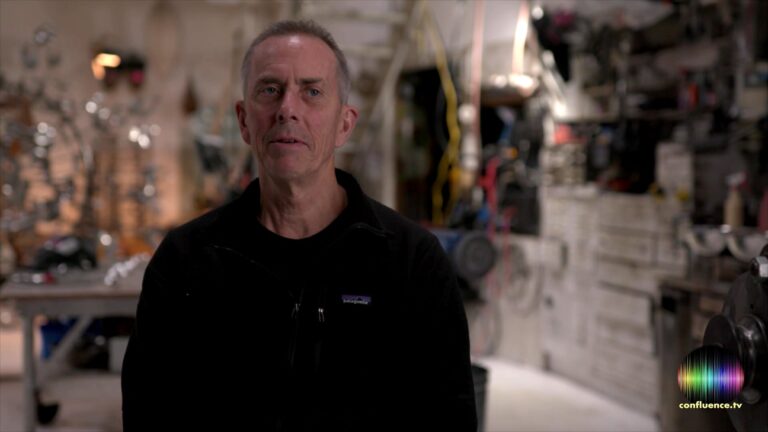
full interview_anthony howe_2.mp4

Anthony Howe [00:00:00] My name is Anthony Howe. I am a sculptor, mostly stainless steel kinetic sculpture. I reside on Orcas Island, Washington.

Speaker 2 [00:00:10] Would you be able to say my name as to how I'm a kinetic sculptor? Or is that too narrow in the script?

Anthony Howe [00:00:18] No, that's fine. My name is Anthony Howe. I'm a kinetic sculptor.

Speaker 2 [00:00:25] And do you remember when you started, when you thought of yourself, or did you always think of yourself as somebody who was creative?

Anthony Howe [00:00:33] I never thought of myself as being creative and really ever in my life. To this day, I just sort of do it and I have always done things, built things with my hands. It just is what I've always enjoyed doing ever since I can remember. And it's conveniently called art now, and they conveniently give you money for it. Sometimes.

Speaker 2 [00:01:06] So when you were little, you were always tinkering and doing every toss about in youth.

Anthony Howe [00:01:12] When I was young, that's all I did with all of my free time when I wasn't in school. I was doing something with my hands, be it playing with electric motors or rector sets or working in a sandbox, making rafts when we lived near water, always something with my hands.

Speaker 2 [00:01:42] So, did you ever realize that actually you could you could make a living with the people who would pay you to do this stuff that you love to do?

Anthony Howe [00:01:49] When I was in high school, and I began to paint because I had a very excellent painting teacher, but soon after I made a few paintings, people wanted to give me money for them. And I thought, well, if I can make a living doing this, this is for me. But during that time that I was, thought of myself as a painter, I met some sculptors and I had a certain irreverent respect for that avocation, an exaggerated respect, and kind of surprised me. I thought, these people are unbelievable. So in other words, I never thought I could be a sculptor at that time. I think I was a little afraid of being a sculpter. I think it's something deep inside me that I was afraid of. In a similar way, I was afraid to move to New York City, where the center of the arts. It's a fear of confronting who you really are. Maybe that's what it is.

Speaker 2 [00:02:55] Tell us how that played out.

Anthony Howe [00:02:58] Through circumstances, I, well, I was painting in the woods of New Hampshire in a house I'd built on the top of a mountain, and things weren't going well. I was very lonely in the wintertime. My paintings began to get more and more oblique or weird. My gallery wasn't really enjoying the direction I was going in. A lot of things kind of indicated that it was time for a move. I moved short term to Boston and then three months later moved to New York.

Speaker 2 [00:03:33] So tell us about you, you have a story about maybe wrong or maybe conflating things about when you kind of realized that the wind and the metal and all that was going to be what you wanted to do.

Anthony Howe [00:03:56] Yeah, I was living in New York as a superintendent for a building on West 25th Street. I lived on the top of the fifth floor in a very projected apartment with a huge roof extending out from it. And trying to paint, once I realized I wanted to make sculpture, there was a lot of wind on that roof and a lot space. Making things move was always something I'd done as a child, so this combination of sculpture and moving sculpture was just kind of a natural occurrence.

Speaker 2 [00:04:39] So what is it about the wind?

Anthony Howe [00:04:43] You know, I don't think it's any it's really specific to the wind. It just happens to be a free source of energy and It's Everyone has it. There's there's some negatives to using the wind and one of them is showing the work It's not that easy for a gallery to show a kinetic wind sculpture and as They have to invariably become motorized if you show them indoors So they're not the easiest thing to show

Speaker 2 [00:05:13] What do you think about the motor?

Anthony Howe [00:05:15] I have no problem with motors. I do have a problem. They make noise. I don't like the sculptures to make any noise. In indoors, you're just limited to how big you can build a sculpture.

Speaker 2 [00:05:34] What do you expect a viewer to get when they look at one of your works? I realize all your works are different.

Anthony Howe [00:05:45] Yeah, I think what most artists expect to get, and that's to take over the person's brain for a few seconds to occupy their minds with some kind of dialog. My case, I kind of hope people would become a little bit more meditative, to relax them. I'm not trying to shake them up. Or make them uncomfortable. It's kind of opposite to what some people regard as real art, if you will. I want people to have a pleasant reaction to my stuff.

Speaker 2 [00:06:29] You talk about that, what's going on with the, because obviously some art is supposed to be disturbing.

Anthony Howe [00:06:35] Yeah, that's what, yeah.

Speaker 2 [00:06:36] So just talk about that because I think you sort of have to be in one camp or another, I guess, right?

Anthony Howe [00:06:42] I suppose you do. Early on in art school when we were visited by many artists, the high caliber artists at Skowhegan, I began to see that these guys' personalities were really just an exact reflection, mirror of who they were as artists and the kind of art they created. There was really, you'd meet one guy and say your work doesn't line up with personality. I had, at that time, I was trying a lot of different things and styles and was enamored with a lot different artists. That doesn't help you yourself really to figure out what kind of work you're going to do. At that point, I kind of realized that you just have to do it and not think so much about who you're doing it after. You just kind of got to get to work and it will happen.

Speaker 2 [00:07:41] Are you frustrated a lot?

Anthony Howe [00:07:44] I am not that frustrated these days. I'm frustrated for reasons that don't have anything to do with my art and my work. In the old days, I was frustrated about 100% of the time.

Speaker 2 [00:07:59] Is that part of being a creative person, that you're frustrated and you're failing and you

Anthony Howe [00:08:06] If an artist is frustrated or not, that's a good question. I have some friends who love everything they do. They think that everything they is somehow good and that they've done is good. I'm not sure that's healthy attitude. I don't know if that person, some of these people don't evolve over time. They don't change the kinds of things they're making. And I think it's important to... Be very self-critical and to try to be as honest with yourself as you can.

Speaker 2 [00:08:40] What about, you talked about this yesterday a little bit, but I think this is part of, we've discovered from talking to people that just failing is just an incredibly important part of what goes on in a relationship.

Anthony Howe [00:08:53] I think failing is hugely important. After we'd lived here for five or eight years, I had a lot of discarded pieces that I had built. And I put them in the back of my property in a huge pile spread all over the woods. And decided that, at that point, that I was never going to make another piece of trash again. I rented an excavator, got a container. And fill the whole thing to the top with bad, bad discarded failures. So yes, I think it's very important to fail again. Absolutely.

Speaker 2 [00:09:39] What about getting complacent? I mean, you obviously, one of the things that struck us yesterday is you had, you seem to, and I want to talk to you about Martin Luther Smith, you have this sort of innate relationship now with the metal and the torque and the, you know, all that kind of stuff. You just, there's all this stuff that you just know. I'll just talk about.

Anthony Howe [00:09:58] Well, people wonder how long does it take to become a kinetic sculptor? And I think Ricky might've said something along these lines. I think it takes 20 years. Many little keys, little parts to the whole process, the whole puzzle of being able to make one of these, I sometimes don't realize how many there are until someone comes into my studio and says, how did you make that and how would I make that? You don't really realize. And I'm saying, anything you've spent a lifetime doing, those things become instinctual after a while.

Speaker 2 [00:10:43] One of the things about this kind of work is it does seem to involve a lot of technical knowledge.

Anthony Howe [00:10:52] It does. Kinetic sculpture definitely is very technical. It's important to know how to make it last a long time, how to survive extreme wind forces, forces of heat and cold. On top of that, you're trying to make something that does something visual.

Speaker 2 [00:11:18] So what about your, do you have training in that, or are you just picking up for them?

Anthony Howe [00:11:22] I do not have any training in any of the disciplines, really, that I practice. I did take a class at Cornell on home building, and when it got into plumbing design, I started to fail badly. That was the last time I took... I'm self-taught in welding and all the other things, but I think they're in my nature. That's the thing. As a kid, I was working with electric motors and gears and pulleys, and I think it just kind of is a gene DNA-related progression.

Speaker 2 [00:12:04] Or if we talk to you, you could tell us, like, when the wind's 20 miles an hour, it behaves like this. And this is the effect it has on something that's 20 feet tall, versus, right? I mean, all that, there's all sorts of, you know, I don't know what you call it, fluid dynamics? I don't know what the...

Anthony Howe [00:12:18] It is fluid dynamics, exactly what it is. And there are even programs that are, but after trying a couple of them, my pieces have way too many weird surfaces for those programs to work. Yes, it is important. And people that make wind generators, electrical wind generators have terrible problems with high winds. Most people that buy a small generator will tell you after five or 10 years they don't work anymore or they self-destructed. And the nature of the climate right now, changing so dramatically, is a huge issue.

Speaker 2 [00:12:59] Is there something that you haven't built yet that you want to?

Anthony Howe [00:13:04] Is there something that I haven't made yet? I hope there isn't. I've made a lot of things. There's always something you haven't make. If you're not busy, you get very uncomfortable after a little while. Who's the great music producer from Hollywood? Who just said, what's your definition of unhappiness? And he just said it's being uninspired. What's his name? Joel.

Speaker 2 [00:13:42] Doesn't matter, that's a good quote. Yeah, but what's that like? Do you have days where you just can't try to get creatively?

Anthony Howe [00:13:53] Oh, I have terrible days and periods. Have days when I walk into my shop and look at something I made and I have no idea how I made that, you can feel absolutely inept to a degree that's frightening at times, yes. But I have come to see sometimes that it's the whole cycle that you go through and sometimes at the end of those, you make your best. And it seems to be part of it.

Speaker 2 [00:14:30] So you're saying when you really feel least creative, somehow that the next step is... Just tell me that, yeah.

Anthony Howe [00:14:38] It's when you feel like totally worthless, it could be a part of something's going on in the background that is part of the process or the cycle that leads to something great later on. And you just have to go through it.

Speaker 3 [00:15:00] How do you account for that? Do you have any idea?

Anthony Howe [00:15:02] How do you what?

Speaker 3 [00:15:03] And you account for all that, is there any idea?

Anthony Howe [00:15:05] No, I don't pretend to understand the human psyche and why people are stupid and do silly things like not getting vaccinated.

Speaker 2 [00:15:24] I just there's something about the You can't, I find, I finally, you can't will creativity. You can will an idea.

Anthony Howe [00:15:36] No, you can't will creativity, but you can go to work every day. I think it was Bach that said, well, how did you make so much great music? He just said, I went to work everyday. I woke up and went to worked. And he also claimed that it was from a higher power, but whatever it is, getting to work each day is a big.

Speaker 2 [00:16:01] We wanted to ask you about some of your collaboratives, because you're essentially a solitary worker. But you have collaborated.

Anthony Howe [00:16:09] I have, yeah.

Speaker 2 [00:16:10] You collaborated with this designer, this Dutch designer, Iris.

Anthony Howe [00:16:15] I did, yep.

Speaker 2 [00:16:17] We may end up talking to her just coincidentally. I wouldn't do that. Why is that?

Anthony Howe [00:16:23] We had a major fallout. We did. What are you doing?

Speaker 2 [00:16:25] Okay.

Anthony Howe [00:16:26] Yeah, major attribution issue.

Speaker 2 [00:16:29] Oh, I'm sorry to hear that.

Anthony Howe [00:16:30] Yeah, she claimed that our work together was based on CERN. Her trip to CERН, I never heard about CERHN. It just really went south. It got unfortunate, it really was heart breaking kind of in a way. She was a really dear friend.

Speaker 2 [00:16:48] I'm sorry, really sorry to hear that, okay. No, because we saw some cool footage of you. Yeah. You were in a suit.

Anthony Howe [00:16:56] Yeah, well... I'm so used to runway shows, let me tell you. Right, right in my blood.

Speaker 2 [00:17:08] But okay, generally though, do you find yourself, you prefer to work alone? Can you collaborate? Let's take her off the table. Ha ha ha ha

Anthony Howe [00:17:23] I definitely prefer to work alone. I like help when I have to do something that's very repetitive and physically difficult for me to do. But in terms of enjoying my thinking process and being able to concentrate, when I another person in the room, I get distracted by what's going on in their minds. Especially if they're that kind of person that... Wants to be noticed. When you can find someone who doesn't want to be noticed and can just isolate themselves with their project, that's the ideal person. I fortunately have a neighbor who is like that and can come over and helps me out sometime on the really difficult, repetitive stuff.

Speaker 2 [00:18:17] Your sculptures, I think you alluded to this before, they're friendly. They're like friendly beasts.

Anthony Howe [00:18:22] Uh-huh. Haha.

Speaker 2 [00:18:23] Do you feel that way when you go out and look at them?

Anthony Howe [00:18:29] Occasionally, it's up and down at this point whether I get excited to see my own stuff. I think if I didn't see it out there, I would have a problem. I would be upset. I wouldn't be comfortable. I think it's just like this looking at yourself, basically, and who likes to see themselves, who's enamored with themselves, and that's kind of the issue.

Speaker 2 [00:18:55] I mean it's funny because sometimes I like to think about my work, and other times it's like yeah, I did it already, I don't want to remind me. People say, oh I saw this film you made eight years ago. I go yeah, glad you liked it. But I've moved on to something else, psychology.

Anthony Howe [00:19:09] I think that it's healthy to be excited about what you're doing and making, but when it's done, my usual reaction is to be exciting about the next thing and not the thing that I've made.

Speaker 2 [00:19:26] Anybody want to, this is great, anybody want to jump in with anything?

Speaker 3 [00:19:32] Well, thank you.

Speaker 4 [00:19:35] Not on any particular thread you're going back. When you have to solve these tech science problems of finding the right mixture for nitrogen or perfecting your welding technique, can you kind of compare that feeling to achieving the artistic intent, if that makes sense?

Anthony Howe [00:19:56] Yeah. A lot of what I do requires a lot of technical expertise. I find that when I have a project or reach a place where I need to know something, my ability to digest the technical information to make that happen is very good. My brain seems to swallow it and get it going. Now if I'm... Doing something else different and someone goes, how did you make that? And what's the, how did the technical side of that happen? And I have no idea because it's out of my head. It's gone. But yeah, the combination of esthetic and the science of the technical aspects is important in the making of these things.

Speaker 2 [00:20:52] Do you ever find yourself talking to somebody who's like an engineer or something and they want to talk about the tech of what you do?

Anthony Howe [00:21:02] Yeah, there are some engineers. I do come across engineers that want to talk about the technical nature of them. I was invited to teach an online class at MIT on these things at one point and declined. But by and large, I avoid engineers. Engineers are really, really like boxes and generally speaking, I get in trouble here. But they're difficult to work with when it comes to kinetic sculpture.

Speaker 5 [00:21:37] One of the things that you just said, which was interesting to me, was like, okay, so you learn the engineering and you learn to technical stuff, but then it's a part of you, right? And it's sort of like, you can't separate it anymore. Oh, yeah. You know what I mean? Because that happens with me too, honestly. I mean, when I have to do a lot of technical stuff and I shove it into my head, and they don't have to think about it anymore, right, it sort of comes out, it just works it out.

Anthony Howe [00:22:02] Do you remember it though?

Speaker 5 [00:22:05] If somebody asks me, I can kind of regurgitate it, okay? But I think about it. You know what I mean?

Anthony Howe [00:22:13] The important thing is maybe it's not understanding all the technical aspects, but understanding someone else does know it, and that you can find that if you're diligent, you can get access to that information. That's when it gets really over my head. Like with nitrogen generation, I relied on other people's knowledge of that.

Speaker 2 [00:22:39] Do you, you know, part of our idea behind the series is that science and art are often treated separately. You know, we say science like the STEM subjects, all that kind of, are sort of treated separately from the arts in this country, in this culture. Do you have an opinion about that idea, whether it's right or wrong?

Anthony Howe [00:23:01] Science in the arts is science how You think that we don't like to combine the two as a rule

Speaker 2 [00:23:11] Well, I think it's sort of like you go and you can either be an artist, in which case you don't learn about science or you're a scientist and you don t particularly learn about art unless you choose to like play the piano or something as a, you know.

Anthony Howe [00:23:22] Right, how do art and science, can they exist together in the same individual? Can you put those two together to make relevant art? I really did not do well in extreme science, but I was fascinated by it. Fascinated by physics, but not quantum physics. What I wanted to know growing up, it seems like it was all pointing towards what I now. Not in extreme sense. I'm not a terribly good mathematician. I was a lot better at it when I was 17 than I am now. But yeah, they all kind of go together. Plus, my childhood, I spent a lot of time in the outdoors, a lot a time on the ocean and on lakes, catching fish and snorkeling and doing those sorts of things. My parents were very insistent on being in the out doors. I think that that experience has a lot to do with how I see things and what I want to see in my work. The things that are important to me.

Speaker 2 [00:24:58] You talked about yesterday about the importance of sort of holding on to sort of a child-like openness to the world.

Anthony Howe [00:25:09] When people go to make art, sometimes they have an idea that it has to look a certain way. Maybe not the way that they are as people. One of the times in your life when you do the most pure art is when you're least aware of what you're doing when you were a kid, when you are a child. A lot of artists find themselves to be making better work when they think of it in terms of what they liked when they were very young.

Speaker 2 [00:25:43] Are you like?

Anthony Howe [00:25:46] I definitely think that I'm getting closer to, or hope that I am getting closer to something that I liked when I was very young. There are certain shapes that I have never forgotten. The shape of a snowplow to me has always the big, the curved shape, concave, convex shapes, and the high swoop of the. It's always been one of my favorite shapes.

Speaker 2 [00:26:18] As soon as you said that, I was like, absolutely. I haven't thought of the shape of a snowplow for decades. But yeah, I can see it right now in what you were doing yesterday with the metal. Yeah, that's great. But you don't think about that. That's just something that comes out of you. It's not like, oh, I remember the childhood thing. In.

Anthony Howe [00:26:36] When I was painting, I would be sitting in the middle of a stream. This happened to me. Very relaxed in the New Hampshire summertime, painting a picture of the water, and I started to paint a sculpture into the patterns of the water. It was almost like something was saying, you know, saying, You need to be doing this, not this. It was weird.

Speaker 2 [00:27:03] Was that emotionally difficult to be sort of to cast off what you thought you wanted to be doing as a painter and to choose a different profession?

Anthony Howe [00:27:15] I think to switch from painting to sculpture was a devastating process. I think it was like, if you're going to be good at anything, you really integrate that into your character and who you think you are and how you present yourself. So I had to be pretty much torn to pieces to change my discipline. And that's what happened. It was a very emotionally upsetting time. Fortunately, I was mostly alone. I didn't have to put it on anyone.

Speaker 4 [00:27:54] What kept you going?

Anthony Howe [00:27:58] Well, that's a good question. I really was kind of at the end of my rope at one time in New York City when I still was trying to paint. And what happened was I made something for a friend. And I knew. My brain, all of a sudden, it was like coming out of the gloom, out of the darkness and into the light. And it was the engines whirring and the imagination growing with new ideas. It's kind of like you know it when it happens. You want it, and it doesn't happen just because you wish it to. It just happens if you're lucky. Or if you pray for it. Whatever you do, you run 20 miles to get it to happen. And that doesn't work.

Speaker 2 [00:28:50] Just to clarify, so you made a sculpture for him.

Anthony Howe [00:28:54] I made a sort of a sculpture, yeah. I made heart for somebody, a girl. Out of, I carved it, you know. And it was like. It wasn't, you know, it's gone now and she's gone but it was the process that woke me up. That developed, that worked its way into metal. I sold my motorcycle and bought a welder and got to work.

Speaker 2 [00:29:24] That's a really great story. I gotta tell you. Sorry for your pain, man. That was really good. It's a happy ending. To discover this thing that was inside you all the time.

Anthony Howe [00:29:36] And there was a period when I started welding things, welding these things, and I would hang them out on the rooftop from outside of the apartment where I lived. And what happened internally was it was like a dam breaking in terms of my imagination. I was just bombarded. Ideas and colors and things moving. It was so intense and entertaining in a way that I could not go to the movies. I could watch. I couldn't see other people's work either. It was like, had to get out. It was overwhelming in a ways. And it's not like that anymore. I won't show me any movies, you know, watch anything. But it was something at one time.

Speaker 2 [00:30:32] I'm not sure we got the basic piece of information about but maybe you guys can remember about being a painter first Do we need to get that restated?

Speaker 5 [00:30:42] You can always do it again if you want. Yes, do you remember? Well, we have it.

Speaker 2 [00:30:46] We have the second part, and I know we have some stuff yesterday. You talked about it, but I see no harm in that. Okay, yeah, it's just for our editing purposes, just saying. You know, the really basic, the very basic story, but I've tried to be a painter for extroverted years.

Anthony Howe [00:31:03] I had to it. I had an excellent painting teacher in my high school, and he encouraged me to, I wanted to be a painter. I thought that's what I wanted to do. I was fairly good at it. I could paint realistically, but I came to a point where it wasn't working, and my paintings weren't any good. They were getting very strange. They didn't... They didn't gel, and that was when I went through a period of great discomfort until I found sculpture.

Speaker 2 [00:31:45] Okay, that's good.

Speaker 5 [00:31:46] I'd love to just ask real quick. Yeah, sure. Well, this is sort of like a segue to something else, because we're going to talk to Lynn, too. So I was just curious now about, OK, what's your relationship with Lynn in terms of what you do? She kind of runs. What does she run? What do you do, what's the interplay, blah, blah.

Anthony Howe [00:32:09] Yeah, the relationship part of doing this kind of thing is always, it's kind of key to have someone who is willing to let you kind of go and do what you do. I think one of the problems some artists run into is when they pick a partner who also kind of does the same thing and whether or not it's good or bad, they need that attention on themselves to spark their creativity. If two people living together are needing this kind of, these energies, it can be difficult. You can find yourself in competition with the other person. All kinds of weird interactions documented by people over the years of two creatives trying to live together. My wife is incredibly supportive. Of what I do, I think that has been an absolutely important, very important part of my success.

Speaker 2 [00:33:17] Yeah, there always seems to be, oops, sorry. Yeah, the idea of, I guess it goes back to the collaboration question also, but two creative souls in a single space.

Anthony Howe [00:33:29] Yeah.

Speaker 2 [00:33:30] Well, it must work sometimes. Yeah, it does, yeah.

Anthony Howe [00:33:35] But I know, I know what you mean. How does it work?

Speaker 2 [00:33:38] Well, I'll tell you, the couples were like what, you know, the careers are not always in tandem, unless they are a couple, like Jean-Claude and Christo, you

Anthony Howe [00:33:46] Yeah, yeah, exactly. Yeah, right.

Speaker 2 [00:33:47] And usually it's like, he's up, no, no he's down. I think poor Diego Rivera and Frida Kahlo, were like, his stock was super high, now where's the difference? It's

Anthony Howe [00:33:55] Yeah.

Speaker 2 [00:33:56] I just did a re-trigger over here. Yeah, yeah, yeah. Chris, did you want to ask him? Yeah, just one more thought. And just look at me when you.

Speaker 4 [00:34:09] I'm just curious at what point you feel something becomes...

Anthony Howe [00:34:19] What point do I feel like something becomes art? That's a good question. I think the way I can tell is when I come upon a piece of work. I don't know if I want, I don't really like the word art per se, I kind of feel like it really kind of blows, explodes your brain for a second, there's some kind of pop that goes off in your head, sometimes you'll get chills up your back when those magical things happen. I see it when I see a sculpture. Or a painting or hear a piece of music that it's just like your brain just kind of gets this very pleasant thing. Sometimes you can quantify it, sometimes you can't quantify it. But you know it when you see it.

Speaker 4 [00:35:14] Well, in the instance of the piece behind you that we were watching you make yesterday, you said to us, well, this needs 100% more pieces to it, it's not full, it is not dense enough.

Anthony Howe [00:35:26] Right.

Speaker 4 [00:35:27] And that feeling, when it's dense enough, is it then art, or is it somewhere in between right now, or do you just don't ever make that distinction?

Anthony Howe [00:35:36] When I'm making something, you have to be able to say when it's done or when it is not done or it needs something else to be done. That now is a very distinct, instinctual decision for me at this point. And that's a difficult thing to know when you're starting out, especially a lot of painters will paint a picture and they're painting five different paintings. And you just take your hands and go, this is the poetry. This is the magic right here. That's a very common mistake early in a lot people's careers. You overdo it, thinking you're not. It's fear-based kind of just things you make, mistakes you make.

Speaker 5 [00:36:27] That plane is a lot more present than the other ones have been.

Speaker 2 [00:36:33] We talked about this yesterday, but I'd like to talk again. One of the things about being an artist, I guess, could be, I guess, a lot of things, but after you're gone. Your art's still there, right?

Anthony Howe [00:36:47] Yeah. As I've gotten older, and in recent years, as your body starts to fall apart, you begin to think about what's going to be around, what are you leaving? What have you done in your life? One of the things that I started to think about was, is there anything that I haven't done that's important to get out? You know, that's kind of how I operate day-to-day now and what I decide to do is based on it's not a bucket list per se but it is this design needs to get made because it's a good one and sometimes it's not something I'm going to enjoy doing making but it's important so I am I suppose in that way thinking about Posterity.

Speaker 2 [00:37:41] But you're also building them to endure.

Anthony Howe [00:37:44] Yeah, no, I'm trying to make them stay the last 200 years, at least, in all wind conditions.

Speaker 2 [00:37:57] So I'm standing at, you know, under your tree there, looking out at your field. What, what am I seeing?

Anthony Howe [00:38:06] You're seeing 13, so mostly kinetic sculptures when you stand in a corner of my field, you'll see 13 kinetic sculptures, mostly kinetic sculpture. All different kinds of basic design structures. There's a kind of a popsicle style with a base and a circular axle on top of it. You will see more figurative kind of shapes, forms with an asymmetrical axle and fan blades rotating around that axle. Well, you'll see. A couple of stationary works. You will see a large aluminum sculpture that I actually made for the Mars conference. Before COVID, I was invited to Mars. Jeff Bezos' people reached out to me and invited me to that. That didn't happen because. And that's what you'll see out there.

Speaker 2 [00:39:17] If I look at any one of them... There's a simplicity about just about the design, but they're not simple at all.

Anthony Howe [00:39:29] When you look at one of my things, they might appear complicated, but the actual mechanism itself is quite simple. It's as simple as two fingers interlocking in a Y and an I kind of configuration. That's how you link the ball bearings together.

Speaker 2 [00:39:51] But the product is just this, it's, I don't know, there's kind of an elegance about it. Like I was thinking about the thing with mirrors, all right, which is very different than anything else that's out there. But just, it was kind of like, okay, that looks really nice just standing there. And then every once in a while I look at this flock of birds and it was like, wow, this is great.

Anthony Howe [00:40:10] Yeah.

Speaker 2 [00:40:12] There's a kind of elegance that, but yet it seems, it's hard to describe it, it seems both simple and complicated at the same time. And that's where the sense of wonder comes, because you're more like, how did he do that? That's what I feel as a viewer. I don't know if that's, people say that.

Anthony Howe [00:40:29] Right, I guess these notions of things being complicated and simple at the same time are not really something I think about. But I do think of, when I do design things, sometimes I'll say to myself, I wanna make something that's more pure and that's simple and just elegant and fewer pieces than there's other times when I say, this has got to go overboard. This has to be, have hundreds and hundreds of pieces because it needs it. I think as I get older the challenge is not to wow people with more parts and more complexity but to make them more and more simple and refined and poetic.